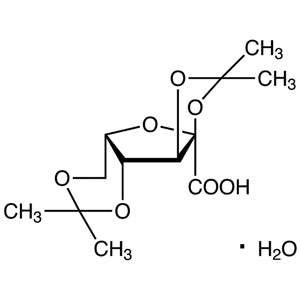
(-)-2,3:4,6-Di-O-isopropylidene-2-keto-L-gulonic Acid Monohydrate is a protected form of 2-keto-L-gulonic acid, a very well known intermediate in the manufacturing route to vitamin C. Two pairs of hydroxyl groups on the parent molecule are tied up as isopropylidene acetals, leaving only the carboxylic acid group free to react. In the laboratory the compound plays a dual role: as a synthetic intermediate toward ascorbic acid and its derivatives, and as an enantiomerically pure chiral compound that can be exploited in carbohydrate chemistry and asymmetric synthesis. Its classification as a glycoscience material reflects how closely it sits to sugar chemistry.
The main properties that lead researchers to select this compound are the combination of chiral purity and a selective protection pattern. The isopropylidene groups shield the diols from side reactions while simultaneously locking the ring conformation, so that reactions at the carboxylic acid group proceed with controlled stereochemistry and repeatable yields. This protection can also be removed under mildly acidic conditions, giving the researcher full control over the sequence of synthetic steps. Being a carboxylic acid, the compound is able to form diastereomeric salts with racemic amines, which is the basis of its use as a resolving agent.
In Indonesian laboratories this material is typically handled in academic and industrial research settings that work on vitamin C chemistry, carbohydrate derivatives, and stereoselective synthesis. It is used at bench scale for multi-step preparations, for method development where a defined chiral building block is required, and in teaching or research groups that need a reliable protected sugar acid. As a TCI catalogue item it is ordered as a research chemical rather than a production raw material.
- Ascorbic acid derivative synthesis — the compound is the protected precursor on the established vitamin C route, so only the free carboxylic acid needs to be functionalised before deprotection delivers the target skeleton.
- Chiral resolution of racemic amines — as a single-enantiomer carboxylic acid it forms diastereomeric salts with racemic bases, allowing separation of the two enantiomers by differential crystallisation.
- Asymmetric synthesis building block — the fixed stereocentres and conformationally locked acetal rings transfer defined stereochemistry into new bonds formed at the carboxylate position.
- Carbohydrate chemistry research — because it derives from a sugar acid with selectively masked diols, it serves as a convenient starting point for preparing modified glycoscience targets.
- Protection and deprotection method development — the isopropylidene acetals are stable during carboxyl-group manipulation yet cleavable under mild acid, making the molecule a useful model substrate for studying protecting-group strategies.
| Brand | TCI |
|---|---|
| CAS number | 68539-16-2 |
| Molecular formula | — |
| Purity | — |
| Category | Chemistry > Chemical Biology > Glycoscience |
| Pack sizes | available in standard TCI research-scale packaging; please confirm the size required when ordering |
| Physical form | — |
| Storage | store as indicated on the manufacturer's label and accompanying documentation |
- Catalogue number: D2191
- Chemical name: (-)-2,3:4,6-Di-O-isopropylidene-2-keto-L-gulonic Acid Monohydrate
Keep the container tightly closed in a cool, dry, well ventilated area, away from moisture, heat, and direct sunlight, since the acetal protecting groups are sensitive to acidic and humid conditions. Store in the original manufacturer's container or in a clean, chemically compatible glass vessel with a secure closure, clearly labelled and separated from strong acids and oxidising agents. Handle in a fume hood using safety glasses, gloves, and a laboratory coat, weighing the solid carefully to avoid dust formation. Allow refrigerated material to reach room temperature before opening to prevent condensation. Always consult the manufacturer's Safety Data Sheet before use and follow institutional waste disposal procedures.
—
Produk Terkait
-
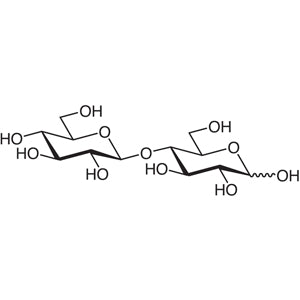
D-(+)-Cellobiose TCI C0056
Regular price From Rp 875.700,00Regular price -
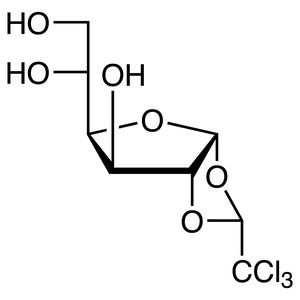
alpha-Chloralose(containsbeta-isomer) TCI C0074
Regular price Rp 848.400,00Regular price -
ChondroitinSulfateSodiumSalt TCI C0335
Regular price From Rp 2.068.500,00Regular price -
alpha-Cyclodextrin TCI C0776
Regular price From Rp 689.850,00Regular price -
beta-Cyclodextrin TCI C0777
Regular price From Rp 2.094.750,00Regular price -
alpha-D-CellobioseOctaacetate TCI C0861
Regular price Rp 2.518.950,00Regular price -
gamma-Cyclodextrin TCI C0869
Regular price From Rp 1.087.800,00Regular price -
beta-Cyclodextrin TCI C0900
Regular price From Rp 505.050,00Regular price