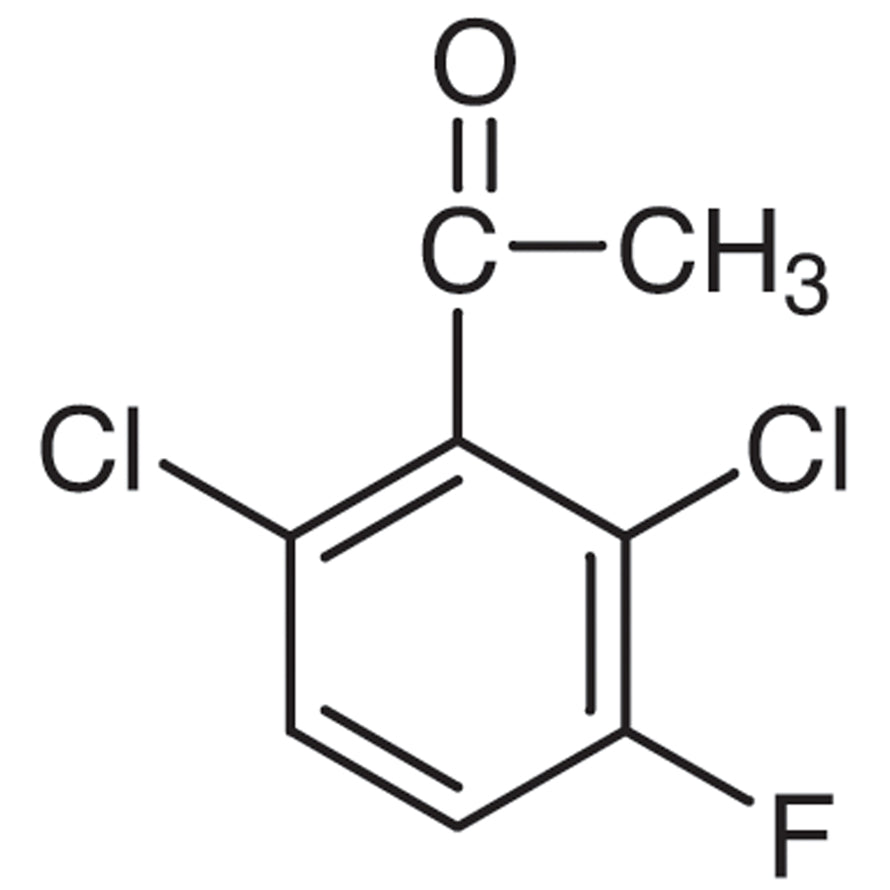
TCI D2750 2',6'-Dichloro-3'-fluoroacetophenone is a fluorinated building block from TCI designed for advanced organic synthesis work. The compound is an acetophenone derivative whose aromatic ring carries two chlorine atoms and one fluorine atom at defined positions, presenting a substitution pattern that is difficult to construct from scratch in the laboratory. The methyl ketone group serves as an entry point for classical transformations such as condensation, enolate alkylation, reduction, and heterocyclic ring formation, while the halogenated aromatic framework is carried directly into the target molecule.
The main reason this material is selected is the combination of a reactive functional group with a specific halogenation pattern. The fluorine atom on the aromatic ring exerts a strong electronic influence and is frequently used to tune the properties of the target molecule, while the chlorine atoms can act both as reactivity directors and as handles for further transformation. The ketone group provides broad synthetic flexibility, since it can be converted into alcohols, amines, oximes, hydrazones, or a wide range of heterocyclic cores. A tri-substitution pattern of this kind saves a considerable number of synthetic steps compared with attempting to install the substituents individually.
In Indonesian laboratories, a building block of this type is typically used in university research groups, medicinal and agrochemical discovery programmes, and contract synthesis work where a defined halogenated aromatic scaffold is needed as a starting point. Purchasing the intermediate ready-made lets researchers direct their effort towards the key bond-forming steps of a route rather than towards preparing the substituted aromatic core, which shortens project timelines and improves reproducibility between batches of work.
TCI brochures (PDF)
- Fluorination Reagents, Fluorinated Building Blocks 2026-03-18 · p. 27
Related TCI products
- Medicinal chemistry intermediate synthesis: the fluorinated aromatic core is carried directly into candidate molecules, and the ketone allows rapid diversification into amines, alcohols, and related pharmacophores.
- Heterocycle construction: the methyl ketone readily condenses with nitrogen- and sulfur-containing reagents, giving access to pyrazoles, isoxazoles, pyrimidines, and other ring systems bearing the halogenated aryl group.
- Agrochemical research and development: halogenated acetophenone scaffolds are common in active ingredient design, and this substitution pattern provides the electronic profile such programmes typically target.
- Carbonyl transformation studies: the ketone supports reduction, reductive amination, oxime and hydrazone formation, making the compound a convenient substrate for methodology development and for teaching advanced synthetic techniques.
- Structure-activity relationship work: the fixed positions of the two chlorine atoms and one fluorine atom allow researchers to probe how specific halogen placement affects the properties and activity of an analogue series.
| Brand | TCI (Tokyo Chemical Industry) |
|---|---|
| CAS number | 290835-85-7 |
| Molecular formula | — |
| Purity | — |
| Category | Chemistry > Building Blocks > Fluorinated Building Blocks |
| Pack sizes | available in standard TCI research-scale packaging; please confirm the current pack options when ordering |
| Physical form | — |
| Storage | keep in the original tightly closed container as indicated on the manufacturer's label |
- Chemical name: 2',6'-Dichloro-3'-fluoroacetophenone
- Catalogue code: D2750
Store the material in its original tightly closed container, kept in a cool, dry, and well-ventilated area away from direct sunlight, heat sources, and incompatible chemicals such as strong oxidising agents and strong bases. Amber glass or the supplied manufacturer packaging is suitable for storage, and containers should be resealed promptly after each use to limit moisture uptake and vapour release. Handle the compound inside a fume hood using standard personal protective equipment, including safety goggles, chemically resistant gloves, and a laboratory coat. Avoid inhalation of vapours and any contact with skin or eyes. Always consult the manufacturer's Safety Data Sheet before use, and dispose of residues and contaminated materials as chemical waste in accordance with applicable local regulations and institutional procedures.
—
Produk Terkait
-
2',4'-Dichloro-5'-fluoroacetophenone TCI D2385
Regular price Rp 1.167.600,00Regular price -
5'-Bromo-2'-fluoroacetophenone TCI B5237
Regular price From Rp 980.700,00Regular price -
4'-Bromo-2'-fluoroacetophenone TCI B5236
Regular price From Rp 1.140.300,00Regular price -
2-Bromo-4'-fluoroacetophenone TCI B2382
Regular price From Rp 1.378.650,00Regular price -
3'-Bromo-4'-fluoroacetophenone TCI B2014
Regular price Rp 1.670.550,00Regular price -
2'-Fluoroacetophenone TCI F0364
Regular price From Rp 875.700,00Regular price -
3'-Fluoroacetophenone TCI F0262
Regular price From Rp 823.200,00Regular price -
4'-Fluoroacetophenone TCI F0261
Regular price From Rp 1.115.100,00Regular price