

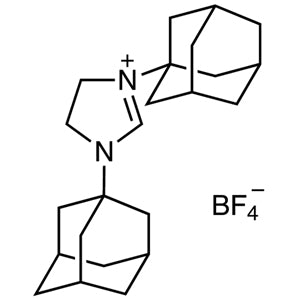
TCI D3620 1,3-Di(1-adamantyl)imidazolinium Tetrafluoroborate is an imidazolinium salt that serves as a precursor to a saturated N-heterocyclic carbene ligand bearing two adamantyl substituents, commonly abbreviated as an SIAd precursor. The saturated imidazolinium framework distinguishes it from its unsaturated imidazolium relatives, while the two cage-shaped adamantyl groups impart exceptionally large steric bulk. In the laboratory, the compound is used to generate the free carbene, which is subsequently bound to transition metals in order to produce catalysts with a strongly shielded coordination environment.
The property that makes this salt valuable is the combination of two factors. First, the saturated imidazolinium backbone gives rise to a carbene whose sigma-donor ability is generally stronger than that of carbenes derived from unsaturated rings, so the metal centre becomes more electron rich and more readily undergoes oxidative addition. Second, the adamantyl groups are rigid and very large, yet rounded in shape, so they cover the metal centre from certain directions without completely blocking substrate approach. The weakly coordinating tetrafluoroborate anion also makes the salt readily soluble in organic solvents.
In Indonesian laboratories, this reagent is typically encountered in university and institutional research groups working on homogeneous catalysis, organometallic synthesis, and methodology development for carbon–carbon and carbon–heteroatom bond formation. It is normally handled on a small synthetic scale inside a fume hood, using standard Schlenk or glovebox technique when the free carbene is liberated in situ, and it is usually purchased as part of a ligand-screening set alongside other carbon-donor ligand precursors.
- Preparation of saturated NHC metal complexes: the imidazolinium salt is deprotonated to release the free carbene, which is then coordinated to transition metals to build well-defined organometallic catalysts.
- Cross-coupling catalyst development: the strong sigma-donor character of the resulting saturated carbene enriches the metal centre electronically and facilitates oxidative addition, a key step in carbon–carbon bond forming cycles.
- Sterically controlled catalysis studies: the two bulky, cage-shaped adamantyl substituents shield the metal from selected directions, allowing researchers to study how steric protection influences selectivity and turnover.
- Comparative ligand screening: because it pairs a saturated backbone with adamantyl bulk, it serves as a useful reference point against unsaturated imidazolium-derived carbenes in structure–activity investigations.
- Homogeneous solution chemistry and in situ catalyst generation: the weakly coordinating tetrafluoroborate anion gives good solubility in organic solvents, so catalysts can be assembled directly in the reaction medium.
| Brand | TCI (Tokyo Chemical Industry) |
|---|---|
| CAS number | 1176202-63-3 |
| Molecular formula | — |
| Purity | — |
| Category | Chemistry > Catalysis and Inorganic Chemistry > Carbon-Donor Ligands [Catalysis] |
| Pack sizes | supplied in TCI research-scale catalogue pack sizes; please confirm the available size when ordering |
| Physical form | — |
| Storage | store in a tightly closed container in a cool, dry place away from moisture |
- Chemical class: imidazolinium salt; saturated N-heterocyclic carbene (SIAd) ligand precursor with tetrafluoroborate counter-anion
Store the salt in its original tightly closed container in a cool, dry, well-ventilated place, protected from moisture and kept away from strong bases and incompatible chemicals. Glass containers with well-sealed caps, or the supplier's original packaging kept inside a desiccator, are suitable; transfer under an inert atmosphere is advisable when the material will be used to generate the free carbene. Handle the solid in a fume hood while wearing safety glasses, chemically resistant gloves, and a laboratory coat, avoid raising dust or inhaling it, and wash hands after handling. Always consult the manufacturer's safety data sheet before use, and dispose of residues and contaminated materials through the laboratory's chemical waste route.
—
Produk Terkait
-
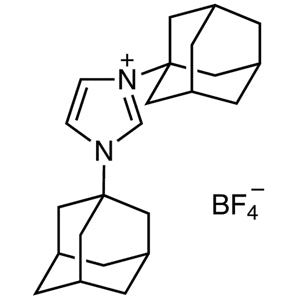
1,3-Di(1-adamantyl)imidazoliumTetrafluoroborate TCI D3621
Regular price Rp 3.683.400,00Regular price -
1,3-Bis(2,4,6-trimethylphenyl)imidazoliniumChloride TCI B3158
Regular price From Rp 2.094.750,00Regular price -
1,3-Bis(2,6-diisopropylphenyl)imidazoliniumChloride TCI B3157
Regular price From Rp 1.193.850,00Regular price -
1,3-DiisopropylimidazoliniumTetrafluoroborate TCI D3622
Regular price Rp 3.312.750,00Regular price -
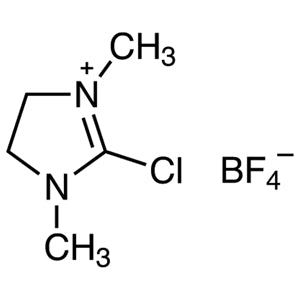
2-Chloro-1,3-dimethylimidazoliniumTetrafluoroborate TCI C3444
Regular price From Rp 769.650,00Regular price -
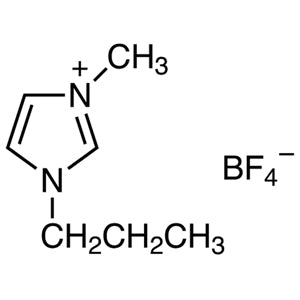
1-Methyl-3-propylimidazoliumTetrafluoroborate TCI M3036
Regular price From Rp 1.115.100,00Regular price -
1-(2,6-Diethylphenyl)-2,2,4-trimethyl-4-phenyl-3,4-dihydro-2H-pyrrol-1-iumTetrafluoroborate TCI D5655
Regular price From Rp 5.565.000,00Regular price -
6,7-Dihydro-2-pentafluorophenyl-5H-pyrrolo[2,1-c][1,2,4]triazoliumTetrafluoroborate TCI D4624
Regular price Rp 7.209.300,00Regular price



![6,7-Dihydro-2-pentafluorophenyl-5H-pyrrolo[2,1-c][1,2,4]triazolium Tetrafluoroborate (CAS 862095-91-8) - TCI D4624 - AMI Scientific](http://amiscientific.com/cdn/shop/files/TCI2510D4624.jpg?v=1767107769&width=533)