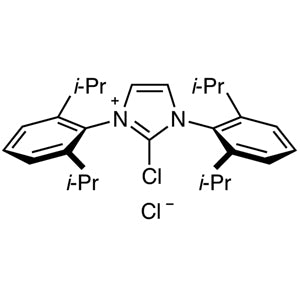
1,3-Bis(2,6-diisopropylphenyl)imidazolinium Chloride is a chemical compound widely used in catalytic and organic reactions within laboratory settings. It belongs to the category of carbon-donor ligands, playing a crucial role as a catalyst or co-catalyst in various chemical reactions. This compound is particularly valuable for its ability to facilitate reactions without altering the fundamental structure of the reactant molecules. Its application spans across multiple areas of chemical research, including the synthesis of heterocyclic compounds and nucleophilic substitution reactions.
The compound is known for its chemical stability and efficiency in catalytic processes under various reaction conditions. Its complex molecular structure allows it to interact specifically with a wide range of substrates, enhancing reaction specificity and yield. The presence of chloride at the end of the molecular chain contributes to its solubility in organic solvents such as ethyl acetate and dimethyl sulfoxide, making it highly versatile for different synthetic applications. This solubility characteristic simplifies its use in a variety of chemical synthesis processes.
In Indonesian laboratories, 1,3-Bis(2,6-diisopropylphenyl)imidazolinium Chloride is commonly used in organic chemistry research, heterogeneous catalysis, and the synthesis of complex compounds. It is a key component in experiments requiring efficient and selective catalysts. Many research institutions and universities rely on this compound for advanced chemical experiments and process development. Its reliability and performance make it a preferred choice for both academic and industrial research in Indonesia.
TCI brochures (PDF)
- ParaffinNi(cod)2 Capsules for Use in Ni-catalyzed Cross-Couplings on the Benchtop 2025-09-08 · p. 1
- Air-Stable and Easy-to-Handle Nickel(0) Catalyst Ni(COD)(DQ)(RR182E)202608 2026-08-20 · p. 1
- N-Heterocyclic Carbene (NHC) Ligands and Metal Complexes 2026-02-10 · p. 1
- Ligands 2025-12-01 · p. 8
- Suzuki-Miyaura Cross Coupling Reaction 2025-12-01 · p. 26
Related TCI products
- TCI B3158 173035-10-4 1,3-Bis(2,4,6-trimethylphenyl)imidazolinium Chloride
- TCI D3611 250285-32-6 1,3-Bis(2,6-diisopropylphenyl)imidazolium Chloride
- TCI C3429 1228185-09-8 2-Chloro-1,3-bis(2,6-diisopropylphenyl)-1H-imidazolium Chloride
- TCI D3620 1176202-63-3 1,3-Di(1-adamantyl)imidazolinium Tetrafluoroborate
- TCI M2791 889617-36-1 3,3'-Methylenebis[1-(2,6-diisopropylphenyl)-3-imidazolium Bromide]
- TCI D5596 1141464-90-5 2-(2,6-Diisopropylphenyl)-3,3-dimethyl-2-azaspiro[4.5]dec-1-en-2-ium Hydrogen Dichloride
- Organic synthesis applications benefit from this compound's ability to enhance reaction efficiency and specificity in complex molecule formation.
- Heterogeneous catalysis research utilizes its stability and reactivity to improve reaction rates without requiring extensive purification steps.
- Nucleophilic substitution reactions are effectively supported by its solubility in organic solvents, ensuring uniform reaction conditions.
- Heterocyclic compound synthesis relies on its catalytic properties to facilitate the formation of ring structures with high selectivity.
- Industrial chemical processes incorporate this material for its consistent performance in large-scale catalytic systems.
From the TCI brochure
- Used as cat. with N1198 in the Buchwald-Hartwig coupling scheme (NaOtBu, CPME, 100°C)
| Brand | TCI |
|---|---|
| CAS number | 258278-25-0 |
| Molecular formula | — |
| Purity | — |
| Category | Chemistry > Catalysis and Inorganic Chemistry > Carbon-Donor Ligands [Catalysis] |
| Pack sizes | Available in various quantities as per supplier specifications |
| Physical form | Solid powder |
| Storage | Store in a cool, dry place away from direct sunlight |
This compound should be stored in a cool, dry environment, away from direct sunlight and sources of heat. It is recommended to use airtight containers to prevent moisture absorption and contamination. Due to its chemical stability, it does not require refrigeration but should be protected from humidity. Laboratory personnel should handle it with appropriate personal protective equipment, including gloves and safety goggles, to ensure safe handling. It is important to maintain proper ventilation in the workspace to minimize exposure to vapors. Regular inspection of storage conditions is advised to ensure the compound remains in optimal condition for use.
References cited in the TCI brochure
- Jacob E. Dander. Benchtop Delivery of Ni(cod) 2 using Paraffin Capsules Organic Letters, 2016. doi:10.1021/acs.orglett.6b01758
- Van T. Tran. Ni(COD)(DQ): An Air‐Stable 18‐Electron Nickel(0)–Olefin Precatalyst Angewandte Chemie International Edition, 2020. doi:10.1002/anie.202000124
Product Categories
- Catalysis and Inorganic ChemistryCarbon-Donor Ligands [Catalysis]Imidazolinium Salts, Cyclic Alkyl Amino Carbene (CAAC) Pecursors [Carbon-Donor Ligands]
- Catalysis and Inorganic ChemistryCross-coupling Reaction using Transition Metal Catalysts [C-C Bond Formation]N-Heterocyclic Carbene (NHC) Ligands [Cross-coupling Reaction using Transition Metal Catalysts]
- Synthetic ReagentsC-C Bond Formation [Synthetic Reagents]Cross-coupling Reaction using Transition Metal Catalysts [C-C Bond Formation]
Produk Terkait
-
1,3-Bis(2,4,6-trimethylphenyl)imidazoliniumChloride TCI B3158
Regular price From Rp 2.147.250,00Regular priceRp 1.517.250,00Sale price From Rp 2.147.250,00 -
1,3-Bis(2,6-diisopropylphenyl)imidazoliumChloride TCI D3611
Regular price From Rp 1.060.500,00Regular priceRp 757.050,00Sale price From Rp 1.060.500,00 -
2-Chloro-1,3-bis(2,6-diisopropylphenyl)-1H-imidazoliumChloride TCI C3429
Regular price Rp 5.141.850,00Regular priceRp 3.610.950,00Sale price Rp 5.141.850,00 -
1,3-Di(1-adamantyl)imidazoliniumTetrafluoroborate TCI D3620
Regular price Rp 3.207.750,00Regular priceRp 2.258.550,00Sale price Rp 3.207.750,00 -
3,3'-Methylenebis[1-(2,6-diisopropylphenyl)-3-imidazoliumBromide] TCI M2791
Regular price From Rp 4.584.300,00Regular priceRp 3.221.400,00Sale price From Rp 4.584.300,00 -
2-(2,6-Diisopropylphenyl)-3,3-dimethyl-2-azaspiro[4.5]dec-1-en-2-iumHydrogenDichloride TCI D5596
Regular price From Rp 3.472.350,00Regular priceRp 2.443.350,00Sale price From Rp 3.472.350,00 -
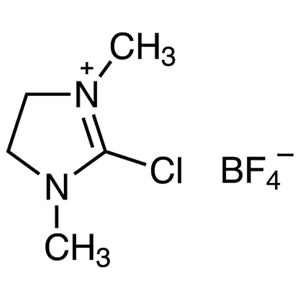
2-Chloro-1,3-dimethylimidazoliniumTetrafluoroborate TCI C3444
Regular price From Rp 822.150,00Regular priceRp 590.100,00Sale price From Rp 822.150,00 -
1,3-Bis(2,6-diisopropylphenyl)imidazol-2-ylidene TCI B3465
Regular price From Rp 3.630.900,00Regular priceRp 2.554.650,00Sale price From Rp 3.630.900,00