TCI D3611 1,3-Bis(2,6-diisopropylphenyl)imidazolium Chloride is an imidazolium salt widely recognised among catalysis chemists as the precursor to the IPr-type N-heterocyclic carbene (NHC) ligand. The compound is not a ready-to-use catalyst but a parent material: once deprotonated by a strong base, it releases a stable carbene that is ready to coordinate to transition metals such as palladium, nickel, gold, copper, or ruthenium. Its role in the laboratory is to supply a strongly electron-donating centre that fundamentally alters the reactivity of a metal complex, allowing transformations that were previously difficult to proceed.
The main characteristic that leads chemists to select this compound is the combination of high sigma-donor strength with the substantial steric bulk contributed by the two 2,6-diisopropylphenyl groups flanking the imidazolium ring. This steric umbrella shields the metal centre, suppresses catalyst deactivation pathways, and favours the formation of reactive low-coordinate active species during both oxidative addition and reductive elimination steps. Because the material is supplied as a solid chloride salt, it is stable enough to be weighed in open air, far easier to handle than the free carbene itself, and straightforward to store.
In Indonesian laboratories, this material is typically used in university research groups, graduate-level synthetic chemistry projects, and industrial or institutional R&D units working on transition-metal catalysis. It is generally handled on a small scale at the bench, weighed out as a solid and then deprotonated in situ or used to prepare a defined metal–NHC complex before a catalytic run. Its air-stable solid form suits laboratories where inert-atmosphere capacity is limited to a glovebox or a Schlenk line rather than being available at every workstation.
- Palladium-catalysed cross-coupling research — the bulky, strongly donating IPr ligand generated from this salt stabilises low-coordinate palladium species and accelerates both oxidative addition and reductive elimination.
- Preparation of defined metal–NHC complexes — the compound serves as the starting point for isolating well-characterised palladium, nickel, gold, copper, or ruthenium NHC complexes used in further study.
- Nickel catalysis studies — the strong sigma-donor character of the derived carbene modifies the electronic environment of nickel, opening reactivity that simpler phosphine ligands do not readily support.
- Gold and copper catalysis investigations — the steric umbrella from the two 2,6-diisopropylphenyl groups protects the metal centre and suppresses deactivation during catalytic turnover.
- Ruthenium catalyst development — the material provides a convenient, air-weighable route to an NHC donor for building ruthenium complexes without handling a free carbene directly.
| Brand | TCI |
|---|---|
| CAS number | 250285-32-6 |
| Molecular formula | — |
| Purity | — |
| Category | Chemistry > Catalysis and Inorganic Chemistry > Carbon-Donor Ligands [Catalysis] |
| Pack sizes | available in standard TCI research-scale packaging; please confirm the pack size required when ordering |
| Physical form | solid imidazolium chloride salt |
| Storage | keep the container tightly closed in a cool, dry place away from moisture |
Store the container tightly closed in a cool, dry place, protected from moisture and kept away from strong bases and incompatible reagents. Original manufacturer bottles are suitable; if the material is transferred, use clean, dry, well-sealed glass or plastic containers with clear labelling of the compound name and CAS number. Although the solid chloride salt is stable enough to weigh in open air, good practice is to handle it in a fume hood using gloves, safety glasses, and a laboratory coat, and to use dry glassware and dry solvents when the compound is deprotonated, since the resulting free carbene is moisture-sensitive. Consult the manufacturer's safety data sheet before use.
—
Produk Terkait
-
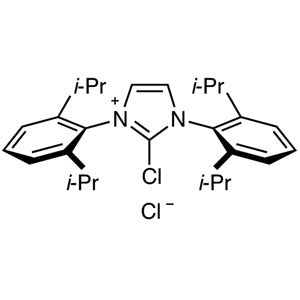
1,3-Bis(2,6-diisopropylphenyl)imidazoliniumChloride TCI B3157
Regular price From Rp 1.193.850,00Regular price -
3,3'-Methylenebis[1-(2,6-diisopropylphenyl)-3-imidazoliumBromide] TCI M2791
Regular price From Rp 4.531.800,00Regular price -
2-Chloro-1,3-bis(2,6-diisopropylphenyl)-1H-imidazoliumChloride TCI C3429
Regular price Rp 5.089.350,00Regular price -
2-(2,6-Diisopropylphenyl)-3,3-dimethyl-2-azaspiro[4.5]dec-1-en-2-iumHydrogenDichloride TCI D5596
Regular price From Rp 3.419.850,00Regular price -
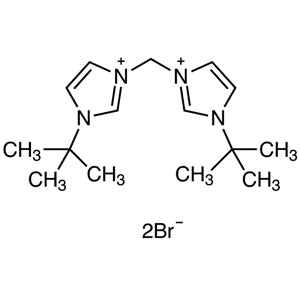
3,3'-Methylenebis(1-tert-butyl-3-imidazoliumBromide) TCI M2790
Regular price From Rp 2.041.200,00Regular price -
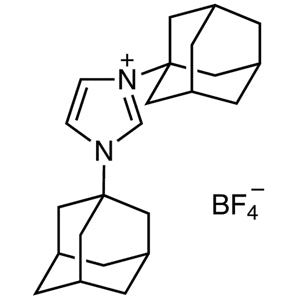
1,3-Di(1-adamantyl)imidazoliumTetrafluoroborate TCI D3621
Regular price Rp 3.683.400,00Regular price -
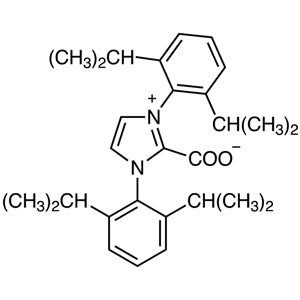
1,3-Bis(2,6-diisopropylphenyl)imidazolium-2-carboxylate TCI B5603
Regular price Rp 2.625.000,00Regular price -
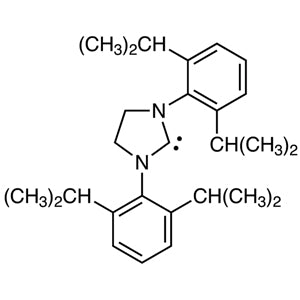
1,3-Bis(2,6-diisopropylphenyl)imidazolidin-2-ylidene TCI B3506
Regular price Rp 7.792.050,00Regular price

![889617-36-1 3,3'-Methylenebis[1-(2,6-diisopropylphenyl)-3-imidazolium Bromide] - AMI Scientific](http://amiscientific.com/cdn/shop/files/TCI2510M2791.jpg?v=1767127228&width=533)
![2-(2,6-Diisopropylphenyl)-3,3-dimethyl-2-azaspiro[4.5]dec-1-en-2-ium Hydrogen Dichloride (CAS 1141464-90-5) - TCI D5596 - AMI Scientific](http://amiscientific.com/cdn/shop/files/TCI2510D5596.jpg?v=1767108948&width=533)