

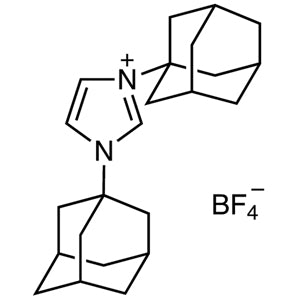
TCI D3621 1,3-Di(1-adamantyl)imidazolium Tetrafluoroborate is an imidazolium salt that serves as a precursor to an unsaturated N-heterocyclic carbene ligand bearing two adamantyl groups, commonly known as the IAd precursor. This compound is one of the classical NHC ligands that played an important role in the historical development of carbene chemistry, and it remains in use today whenever a catalyst with a very large steric umbrella is required. In the laboratory, the material is converted into the free carbene by deprotonation and then coordinated to a transition metal to form the active catalyst.
The most notable characteristic of this compound is the combination of an unsaturated imidazolium ring with rigid adamantyl substituents. The unsaturated ring confers aromatic stabilisation on the carbene once it is generated and produces electronic behaviour that differs slightly from that of its saturated relatives, while the cage-shaped adamantyl groups create a narrow coordination pocket so that only substrates approaching in a particular orientation can reach the metal centre. This pattern is extremely useful for controlling selectivity. The tetrafluoroborate anion is weakly coordinating and does not interfere with complex formation, while at the same time improving the solubility of the salt in common organic solvents.
In Indonesian laboratories, this material is typically found in synthetic and catalysis research groups at universities and in research institutes working on organometallic chemistry and ligand development. It is generally used at small scale for preparing metal–NHC complexes and for screening catalyst systems, where a sterically demanding ligand is needed to steer a reaction. Because it is handled as a defined ligand precursor rather than a bulk reagent, it is usually purchased in small research quantities and stored alongside other air-sensitive reagents.
TCI brochures (PDF)
- N-Heterocyclic Carbene (NHC) Ligands and Metal Complexes 2026-02-10 · p. 1
- Ligands 2025-12-01 · p. 8
- Suzuki-Miyaura Cross Coupling Reaction 2025-12-01 · p. 26
- Boron Compounds 2025-10-07 · p. 24
Related TCI products
- TCI D3620 1176202-63-3 1,3-Di(1-adamantyl)imidazolinium Tetrafluoroborate
- TCI M2791 889617-36-1 3,3'-Methylenebis[1-(2,6-diisopropylphenyl)-3-imidazolium Bromide]
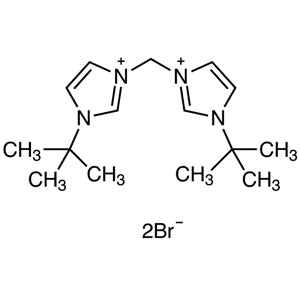
- TCI M2790 247902-48-3 3,3'-Methylenebis(1-tert-butyl-3-imidazolium Bromide)
- TCI D3611 250285-32-6 1,3-Bis(2,6-diisopropylphenyl)imidazolium Chloride
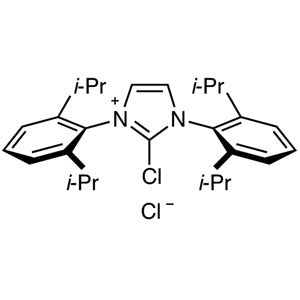
- TCI C3429 1228185-09-8 2-Chloro-1,3-bis(2,6-diisopropylphenyl)-1H-imidazolium Chloride
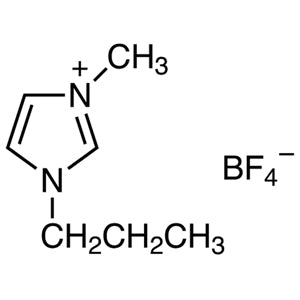
- TCI M3036 244193-48-4 1-Methyl-3-propylimidazolium Tetrafluoroborate
- Preparation of metal–NHC complexes: the imidazolium salt is deprotonated to release the free carbene, which is then coordinated to a transition metal centre to build a well-defined catalyst.
- Sterically controlled catalysis: the bulky adamantyl cages create a narrow coordination pocket, so this precursor suits reactions where selectivity must be enforced by restricting substrate approach.
- Cross-coupling catalyst development: the strongly donating unsaturated NHC ligand supports catalyst systems that require electron-rich metal centres combined with a very large steric umbrella.
- Ligand comparison and screening studies: as a classical IAd precursor, it acts as a reference ligand against which saturated or less hindered NHC analogues can be benchmarked electronically and sterically.
- Organometallic and methodology research: the compound is used in academic studies of carbene chemistry, where free-carbene generation and metal coordination behaviour are investigated systematically.
| Brand | TCI |
|---|---|
| CAS number | 286014-42-4 |
| Molecular formula | — |
| Purity | — |
| Category | Chemistry > Catalysis and Inorganic Chemistry > Carbon-Donor Ligands [Catalysis] |
| Pack sizes | available in standard TCI research-scale packaging; please confirm the size required when ordering |
| Physical form | — |
| Storage | keep in a tightly closed container, protected from moisture |
- Product Code: D3621
Store the container tightly closed in a cool, dry place, away from moisture and direct sunlight, since imidazolium salts and the carbenes derived from them are sensitive to water and air. Keep the material in its original well-sealed container or transfer it to a dry, chemically compatible vessel; a desiccator or glovebox is recommended where free-carbene generation is planned. Handle the solid in a fume hood using gloves, safety glasses, and a laboratory coat, avoid dust formation, and weigh out portions quickly to limit exposure to atmospheric humidity. Keep the material separate from strong bases and strong oxidising agents, label all working containers clearly, and consult the manufacturer's safety data sheet before use and disposal.
—
Product Categories
- Catalysis and Inorganic ChemistryCarbon-Donor Ligands [Catalysis]Imidazolinium Salts, Cyclic Alkyl Amino Carbene (CAAC) Pecursors [Carbon-Donor Ligands]
- Catalysis and Inorganic ChemistryCross-coupling Reaction using Transition Metal Catalysts [C-C Bond Formation]N-Heterocyclic Carbene (NHC) Ligands [Cross-coupling Reaction using Transition Metal Catalysts]
- Synthetic ReagentsC-C Bond Formation [Synthetic Reagents]Cross-coupling Reaction using Transition Metal Catalysts [C-C Bond Formation]
Produk Terkait
-
1,3-Di(1-adamantyl)imidazoliniumTetrafluoroborate TCI D3620
Regular price Rp 3.155.250,00Regular price -
3,3'-Methylenebis[1-(2,6-diisopropylphenyl)-3-imidazoliumBromide] TCI M2791
Regular price From Rp 4.531.800,00Regular price -
3,3'-Methylenebis(1-tert-butyl-3-imidazoliumBromide) TCI M2790
Regular price From Rp 2.041.200,00Regular price -
1,3-Bis(2,6-diisopropylphenyl)imidazoliumChloride TCI D3611
Regular price From Rp 1.008.000,00Regular price -
2-Chloro-1,3-bis(2,6-diisopropylphenyl)-1H-imidazoliumChloride TCI C3429
Regular price Rp 5.089.350,00Regular price -
1-Methyl-3-propylimidazoliumTetrafluoroborate TCI M3036
Regular price From Rp 1.115.100,00Regular price -
1-(2,6-Diethylphenyl)-2,2,4-trimethyl-4-phenyl-3,4-dihydro-2H-pyrrol-1-iumTetrafluoroborate TCI D5655
Regular price From Rp 5.565.000,00Regular price -
6,7-Dihydro-2-pentafluorophenyl-5H-pyrrolo[2,1-c][1,2,4]triazoliumTetrafluoroborate TCI D4624
Regular price Rp 7.209.300,00Regular price

![889617-36-1 3,3'-Methylenebis[1-(2,6-diisopropylphenyl)-3-imidazolium Bromide] - AMI Scientific](http://amiscientific.com/cdn/shop/files/TCI2510M2791.jpg?v=1767127228&width=533)


![6,7-Dihydro-2-pentafluorophenyl-5H-pyrrolo[2,1-c][1,2,4]triazolium Tetrafluoroborate (CAS 862095-91-8) - TCI D4624 - AMI Scientific](http://amiscientific.com/cdn/shop/files/TCI2510D4624.jpg?v=1767107769&width=533)