![TCI M2791 889617-36-1 3,3'-Methylenebis[1-(2,6-diisopropylphenyl)-3-imidazolium Bromide]](http://amiscientific.com/cdn/shop/files/TCI2510M2791_2cbe188a-24b9-4584-afee-4e2701774adf.jpg?v=1792649182&width=1946)
![889617-36-1 3,3'-Methylenebis[1-(2,6-diisopropylphenyl)-3-imidazolium Bromide] - AMI Scientific](http://amiscientific.com/cdn/shop/files/TCI2510M2791.jpg?v=1767127228&width=1946)
![TCI M2791 889617-36-1 3,3'-Methylenebis[1-(2,6-diisopropylphenyl)-3-imidazolium Bromide]](http://amiscientific.com/cdn/shop/files/TCI2510M2791_2cbe188a-24b9-4584-afee-4e2701774adf.jpg?v=1792649182&width=1445)
![889617-36-1 3,3'-Methylenebis[1-(2,6-diisopropylphenyl)-3-imidazolium Bromide] - AMI Scientific](http://amiscientific.com/cdn/shop/files/TCI2510M2791.jpg?v=1767127228&width=1445)
3,3'-Methylenebis[1-(2,6-diisopropylphenyl)-3-imidazolium Bromide] is a chemical compound used in catalytic reactions to accelerate chemical processes without directly participating in the reaction. This compound is widely applied in laboratory settings to enhance reaction efficiency and reduce the time required for chemical transformations. It is particularly valuable in synthetic chemistry due to its ability to facilitate complex reactions with high selectivity. Its role as a carbon-donor ligand makes it an essential component in various catalytic systems, supporting both homogeneous and heterogeneous reaction mechanisms.
The compound's unique properties make it a preferred choice in laboratory applications. It possesses a complex chemical structure that allows for strong interactions with substrates, enhancing its catalytic activity. The imidazolium structure imparts ionic characteristics, enabling high reactivity under specific reaction conditions. Additionally, it exhibits stability under varying temperature and humidity levels, making it suitable for a wide range of experimental environments. These features contribute to its reliability and effectiveness in both research and industrial chemical processes.
In Indonesian laboratories, this compound is extensively used in chemical research, especially in the fields of catalysis and organic synthesis. Its availability and consistent quality make it a top choice for researchers aiming to achieve efficient and reproducible results. Its application in academic and industrial settings underscores its importance in advancing chemical innovation and process optimization.
TCI brochures (PDF)
- N-Heterocyclic Carbene (NHC) Ligands and Metal Complexes 2026-02-10 · p. 1
- Ligands 2025-12-01 · p. 8
- Suzuki-Miyaura Cross Coupling Reaction 2025-12-01 · p. 26
Related TCI products
- TCI M2790 247902-48-3 3,3'-Methylenebis(1-tert-butyl-3-imidazolium Bromide)
- TCI D3611 250285-32-6 1,3-Bis(2,6-diisopropylphenyl)imidazolium Chloride
- TCI C3429 1228185-09-8 2-Chloro-1,3-bis(2,6-diisopropylphenyl)-1H-imidazolium Chloride
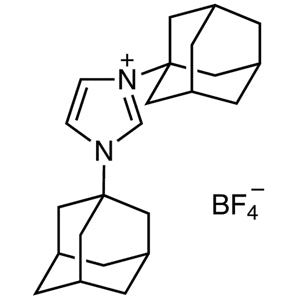
- TCI D3621 286014-42-4 1,3-Di(1-adamantyl)imidazolium Tetrafluoroborate
- TCI B3157 258278-25-0 1,3-Bis(2,6-diisopropylphenyl)imidazolinium Chloride
- TCI D5596 1141464-90-5 2-(2,6-Diisopropylphenyl)-3,3-dimethyl-2-azaspiro[4.5]dec-1-en-2-ium Hydrogen Dichloride
- Catalytic Reactions: This compound is ideal for catalytic reactions due to its ability to enhance reaction rates and improve selectivity, making it a valuable tool in synthetic chemistry.
- Organic Synthesis: It supports a variety of organic synthesis processes, including substitution and polymerization reactions, by acting as a stable and effective ligand.
- Oxidation Reactions: The compound's structural stability and reactivity make it suitable for oxidation reactions, where it facilitates electron transfer and enhances reaction efficiency.
- Industrial Catalysis: Its robust performance under varied conditions makes it a preferred choice for industrial catalytic processes that require high efficiency and reliability.
- Research Development: It is widely used in research laboratories to develop new catalytic systems and improve existing chemical processes through its versatile reactivity and stability.
| Brand | TCI |
|---|---|
| CAS number | 889617-36-1 |
| Molecular formula | — |
| Purity | — |
| Category | Chemistry > Catalysis and Inorganic Chemistry > Carbon-Donor Ligands [Catalysis] |
| Pack sizes | Available in various quantities as per standard laboratory supply |
| Physical form | Solid powder |
| Storage | Store in a cool, dry place away from moisture and direct sunlight |
This compound should be stored in a cool, dry environment to maintain its chemical stability and prevent degradation. It is recommended to use airtight containers to protect it from moisture and humidity, which can affect its performance. Due to its ionic nature, it should be handled with care to avoid exposure to incompatible substances. In laboratory settings, it is important to use appropriate personal protective equipment, such as gloves and safety goggles, to ensure safe handling. Proper labeling of storage containers is essential for identification and safety. Regular monitoring of storage conditions ensures the compound remains effective for its intended applications.
—
Product Categories
- Catalysis and Inorganic ChemistryCarbon-Donor Ligands [Catalysis]Imidazolinium Salts, Cyclic Alkyl Amino Carbene (CAAC) Pecursors [Carbon-Donor Ligands]
- Catalysis and Inorganic ChemistryCross-coupling Reaction using Transition Metal Catalysts [C-C Bond Formation]N-Heterocyclic Carbene (NHC) Ligands [Cross-coupling Reaction using Transition Metal Catalysts]
- Synthetic ReagentsC-C Bond Formation [Synthetic Reagents]Cross-coupling Reaction using Transition Metal Catalysts [C-C Bond Formation]
Produk Terkait
-
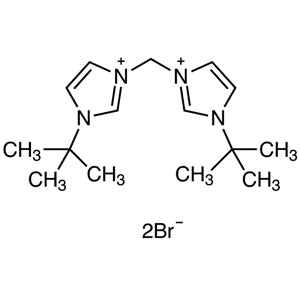
3,3'-Methylenebis(1-tert-butyl-3-imidazoliumBromide) TCI M2790
Regular price From Rp 2.093.700,00Regular priceRp 1.479.450,00Sale price From Rp 2.093.700,00 -
1,3-Bis(2,6-diisopropylphenyl)imidazoliumChloride TCI D3611
Regular price From Rp 1.060.500,00Regular priceRp 757.050,00Sale price From Rp 1.060.500,00 -
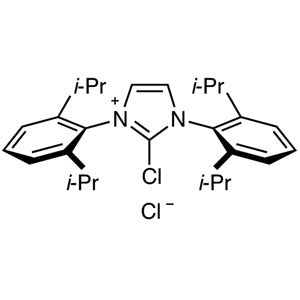
2-Chloro-1,3-bis(2,6-diisopropylphenyl)-1H-imidazoliumChloride TCI C3429
Regular price Rp 5.141.850,00Regular priceRp 3.610.950,00Sale price Rp 5.141.850,00 -
1,3-Di(1-adamantyl)imidazoliumTetrafluoroborate TCI D3621
Regular price Rp 3.735.900,00Regular priceRp 2.628.150,00Sale price Rp 3.735.900,00 -
1,3-Bis(2,6-diisopropylphenyl)imidazoliniumChloride TCI B3157
Regular price From Rp 1.246.350,00Regular priceRp 887.250,00Sale price From Rp 1.246.350,00 -
2-(2,6-Diisopropylphenyl)-3,3-dimethyl-2-azaspiro[4.5]dec-1-en-2-iumHydrogenDichloride TCI D5596
Regular price From Rp 3.472.350,00Regular priceRp 2.443.350,00Sale price From Rp 3.472.350,00 -
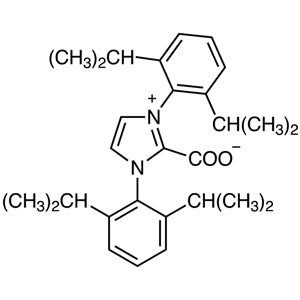
1,3-Bis(2,6-diisopropylphenyl)imidazolium-2-carboxylate TCI B5603
Regular price Rp 2.677.500,00Regular priceRp 1.887.900,00Sale price Rp 2.677.500,00 -
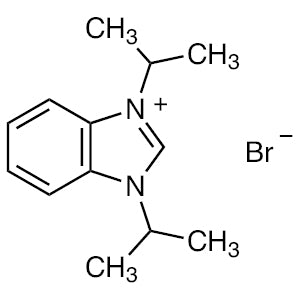
1,3-DiisopropylbenzimidazoliumBromide TCI D5778
Regular price From Rp 4.108.650,00Regular priceRp 2.888.550,00Sale price From Rp 4.108.650,00






![TCI D5596 1141464-90-5 2-(2,6-Diisopropylphenyl)-3,3-dimethyl-2-azaspiro[4.5]dec-1-en-2-ium Hydrogen Dichloride](http://amiscientific.com/cdn/shop/files/TCI2510D5596_5be461f4-1601-451e-ab2e-b40efea1ec15.jpg?v=1792640043&width=533)
![2-(2,6-Diisopropylphenyl)-3,3-dimethyl-2-azaspiro[4.5]dec-1-en-2-ium Hydrogen Dichloride (CAS 1141464-90-5) - TCI D5596 - AMI Scientific](http://amiscientific.com/cdn/shop/files/TCI2510D5596.jpg?v=1767108948&width=533)