1,3-Bis(2,6-diisopropylphenyl)imidazolidin-2-ylidene is a carbon-donor ligand widely used in catalytic reactions within laboratory settings. This compound plays a crucial role in facilitating chemical transformations by acting as a ligand that binds to transition metals, enhancing their catalytic activity. Its unique structure allows it to interact effectively with various metal centers, making it a valuable tool in synthetic chemistry. In the laboratory, it is often employed to accelerate reactions while maintaining the integrity of the original substrate. Its versatility and efficiency make it a preferred choice for researchers working in catalysis and organic synthesis.
The compound’s molecular structure provides excellent electronic properties, enabling strong interactions with transition metals. These interactions are essential for the catalytic process, as they help stabilize reactive intermediates and lower activation energy. Additionally, the compound exhibits good stability under reaction conditions, minimizing degradation during use. These properties contribute to its effectiveness in a wide range of chemical applications, from hydroformylation to isomerization and substitution reactions. Its reliability and performance make it a go-to material for advanced chemical research.
In Indonesian laboratories, this compound is commonly used in organic chemistry and catalysis research. It is a key component in studies aimed at developing new synthetic methods and improving reaction efficiency. Many research institutions and universities in Indonesia rely on this material for its consistent performance and reliability. Its role in advancing chemical processes makes it an essential part of the laboratory toolkit for scientists and researchers.
TCI brochures (PDF)
- Air-Stable and Easy-to-Handle Nickel(0) Catalyst Ni(COD)(DQ)(RR182E)202608 2026-08-20 · p. 1
- N-Heterocyclic Carbene (NHC) Ligands and Metal Complexes 2026-02-10 · p. 1
- Ligands 2025-12-01 · p. 8
- Suzuki-Miyaura Cross Coupling Reaction 2025-12-01 · p. 26
Related TCI products
- TCI B3465 244187-81-3 1,3-Bis(2,6-diisopropylphenyl)imidazol-2-ylidene
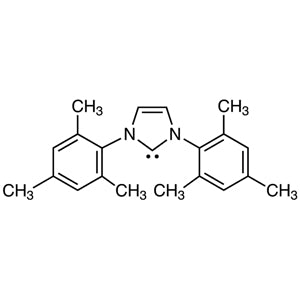
- TCI D3870 141556-42-5 1,3-Dimesitylimidazol-2-ylidene
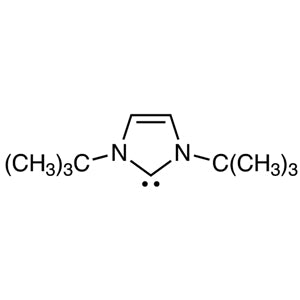
- TCI D3472 157197-53-0 1,3-Di-tert-butylimidazol-2-ylidene
- TCI D3611 250285-32-6 1,3-Bis(2,6-diisopropylphenyl)imidazolium Chloride
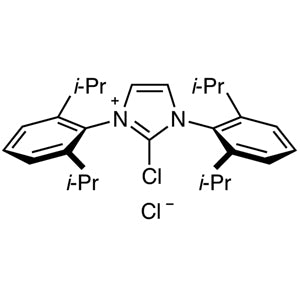
- TCI C3429 1228185-09-8 2-Chloro-1,3-bis(2,6-diisopropylphenyl)-1H-imidazolium Chloride
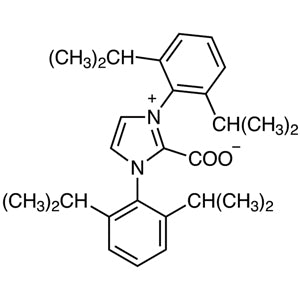
- TCI B5603 917604-39-8 1,3-Bis(2,6-diisopropylphenyl)imidazolium-2-carboxylate
- Organic synthesis reactions benefit from this ligand's ability to enhance metal catalytic activity and improve reaction efficiency.
- Catalytic hydrogenation processes utilize its strong metal-binding properties to facilitate hydrogen transfer effectively.
- Hydroformylation reactions rely on its stability and reactivity to produce aldehydes from olefins under controlled conditions.
- Isomerization reactions benefit from its capacity to stabilize transition states and promote structural rearrangements efficiently.
- Substitution reactions use this ligand to improve selectivity and control reaction pathways in complex synthetic systems.
| Brand | TCI |
|---|---|
| CAS number | 258278-28-3 |
| Molecular formula | — |
| Purity | — |
| Category | Chemistry > Catalysis and Inorganic Chemistry > Carbon-Donor Ligands [Catalysis] |
| Pack sizes | Available in various quantities as per supplier specifications |
| Physical form | Solid (as per standard product description) |
| Storage | Store in a cool, dry place away from moisture and direct sunlight |
This compound should be stored in a cool, dry environment to maintain its stability and effectiveness. It is recommended to keep it in a sealed container to prevent exposure to moisture and air, which could lead to degradation. Suitable storage containers include glass or high-density polyethylene vessels that are resistant to chemical interactions. In laboratory settings, it is important to handle the material with care, using appropriate personal protective equipment such as gloves and safety goggles. Avoid prolonged exposure to heat or light, as these conditions may affect its performance. Proper storage and handling ensure the compound remains effective for its intended applications in catalytic research.
—
Product Categories
- Catalysis and Inorganic ChemistryCarbon-Donor Ligands [Catalysis]Stable Carbenes [Carbon-Donor Ligands]
- Catalysis and Inorganic ChemistryCross-coupling Reaction using Transition Metal Catalysts [C-C Bond Formation]N-Heterocyclic Carbene (NHC) Ligands [Cross-coupling Reaction using Transition Metal Catalysts]
- Synthetic ReagentsC-C Bond Formation [Synthetic Reagents]Cross-coupling Reaction using Transition Metal Catalysts [C-C Bond Formation]
Produk Terkait
-
1,3-Bis(2,6-diisopropylphenyl)imidazol-2-ylidene TCI B3465
Regular price From Rp 3.630.900,00Regular priceRp 2.554.650,00Sale price From Rp 3.630.900,00 -
1,3-Dimesitylimidazol-2-ylidene TCI D3870
Regular price From Rp 4.213.650,00Regular priceRp 2.962.050,00Sale price From Rp 4.213.650,00 -
1,3-Di-tert-butylimidazol-2-ylidene TCI D3472
Regular price From Rp 5.352.900,00Regular priceRp 3.759.000,00Sale price From Rp 5.352.900,00 -
1,3-Bis(2,6-diisopropylphenyl)imidazoliumChloride TCI D3611
Regular price From Rp 1.060.500,00Regular priceRp 757.050,00Sale price From Rp 1.060.500,00 -
2-Chloro-1,3-bis(2,6-diisopropylphenyl)-1H-imidazoliumChloride TCI C3429
Regular price Rp 5.141.850,00Regular priceRp 3.610.950,00Sale price Rp 5.141.850,00 -
1,3-Bis(2,6-diisopropylphenyl)imidazolium-2-carboxylate TCI B5603
Regular price Rp 2.677.500,00Regular priceRp 1.887.900,00Sale price Rp 2.677.500,00 -
1,3-Bis(2,6-diisopropylphenyl)imidazoliniumChloride TCI B3157
Regular price From Rp 1.246.350,00Regular priceRp 887.250,00Sale price From Rp 1.246.350,00 -
3,3'-Methylenebis[1-(2,6-diisopropylphenyl)-3-imidazoliumBromide] TCI M2791
Regular price From Rp 4.584.300,00Regular priceRp 3.221.400,00Sale price From Rp 4.584.300,00