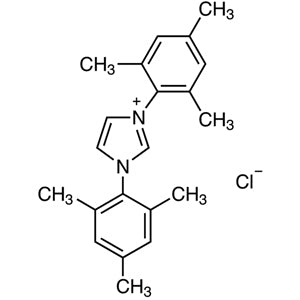
TCI B3158, 1,3-Bis(2,4,6-trimethylphenyl)imidazolinium Chloride, is a chemical compound widely used in catalytic reactions and organic chemistry processes. It functions as a catalyst or ligand, facilitating electron activation or transfer in chemical reactions. This compound is particularly valuable in laboratory settings where precise control over reaction mechanisms is required. Its ability to accelerate chemical reactions without altering the structure of the main molecule makes it a versatile tool for researchers and technicians.
The compound’s chemical stability and controlled reactivity make it a preferred choice for various experimental conditions. Its complex molecular structure enables specific interactions with substrates, enhancing the efficiency of chemical reactions. This characteristic allows it to be used in a wide range of applications, from simple synthesis to more complex organic transformations. Its durability also contributes to its reusability, reducing waste and increasing cost-effectiveness in laboratory operations.
In Indonesian laboratories, this compound is commonly found in organic chemistry research, heterogeneous catalysis, and the synthesis of complex compounds. Its reliability and effectiveness in multiple applications have made it a top choice among researchers and laboratory technicians. The compound’s consistent performance supports high-quality research and development, making it an essential component in many chemical processes.
TCI brochures (PDF)
- N-Heterocyclic Carbene (NHC) Ligands and Metal Complexes 2026-02-10 · p. 1
- Ligands 2025-12-01 · p. 8
- Suzuki-Miyaura Cross Coupling Reaction 2025-12-01 · p. 26
Related TCI products
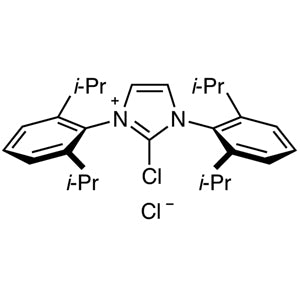
- TCI B3157 258278-25-0 1,3-Bis(2,6-diisopropylphenyl)imidazolinium Chloride
- TCI D3620 1176202-63-3 1,3-Di(1-adamantyl)imidazolinium Tetrafluoroborate
- TCI D3622 137581-18-1 1,3-Diisopropylimidazolinium Tetrafluoroborate
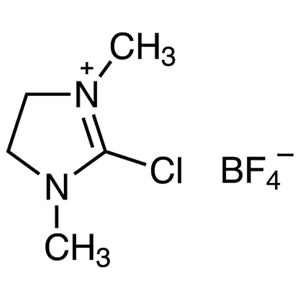
- TCI C3444 153433-26-2 2-Chloro-1,3-dimethylimidazolinium Tetrafluoroborate
- TCI D3882 181422-72-0 1,3-Dicyclohexylimidazolium Chloride
- TCI D3611 250285-32-6 1,3-Bis(2,6-diisopropylphenyl)imidazolium Chloride
- Organic synthesis reactions benefit from its ability to activate electron transfer, enhancing reaction efficiency and yield.
- Heterogeneous catalysis applications utilize its stability and reusability, reducing the need for frequent catalyst replacement.
- Complex compound synthesis relies on its specific molecular interactions, allowing precise control over reaction pathways.
- Electron activation processes take advantage of its catalytic properties, improving reaction rates without altering the target molecule.
- Laboratory-scale chemical transformations benefit from its controlled reactivity and chemical stability, ensuring consistent results.
| Brand | TCI |
|---|---|
| CAS number | 173035-10-4 |
| Molecular formula | — |
| Purity | — |
| Category | Chemistry > Catalysis and Inorganic Chemistry > Carbon-Donor Ligands [Catalysis] |
| Pack sizes | Available in various quantities as per standard laboratory requirements |
| Physical form | Solid powder |
| Storage | Store in a cool, dry place away from moisture and direct sunlight |
This compound should be stored in a cool, dry environment to maintain its chemical stability and prevent degradation. It is recommended to use airtight containers to protect it from moisture and contaminants. Due to its chemical nature, it should be handled with appropriate personal protective equipment, such as gloves and safety goggles. It is important to ensure proper ventilation in the workspace to minimize exposure. Avoid contact with incompatible substances to prevent unwanted reactions. Regular inspection of storage conditions ensures the compound remains effective for laboratory use.
—
Product Categories
- Catalysis and Inorganic ChemistryCarbon-Donor Ligands [Catalysis]Imidazolinium Salts, Cyclic Alkyl Amino Carbene (CAAC) Pecursors [Carbon-Donor Ligands]
- Catalysis and Inorganic ChemistryCross-coupling Reaction using Transition Metal Catalysts [C-C Bond Formation]N-Heterocyclic Carbene (NHC) Ligands [Cross-coupling Reaction using Transition Metal Catalysts]
- Synthetic ReagentsC-C Bond Formation [Synthetic Reagents]Cross-coupling Reaction using Transition Metal Catalysts [C-C Bond Formation]
Produk Terkait
-
1,3-Bis(2,6-diisopropylphenyl)imidazoliniumChloride TCI B3157
Regular price From Rp 1.246.350,00Regular priceRp 887.250,00Sale price From Rp 1.246.350,00 -
1,3-Di(1-adamantyl)imidazoliniumTetrafluoroborate TCI D3620
Regular price Rp 3.207.750,00Regular priceRp 2.258.550,00Sale price Rp 3.207.750,00 -
1,3-DiisopropylimidazoliniumTetrafluoroborate TCI D3622
Regular price Rp 3.365.250,00Regular priceRp 2.368.800,00Sale price Rp 3.365.250,00 -
2-Chloro-1,3-dimethylimidazoliniumTetrafluoroborate TCI C3444
Regular price From Rp 822.150,00Regular priceRp 590.100,00Sale price From Rp 822.150,00 -
1,3-DicyclohexylimidazoliumChloride TCI D3882
Regular price From Rp 1.908.900,00Regular priceRp 1.350.300,00Sale price From Rp 1.908.900,00 -
1,3-Bis(2,6-diisopropylphenyl)imidazoliumChloride TCI D3611
Regular price From Rp 1.060.500,00Regular priceRp 757.050,00Sale price From Rp 1.060.500,00 -
1,3-DimesitylimidazoliumChloride TCI D3446
Regular price From Rp 1.988.700,00Regular priceRp 1.405.950,00Sale price From Rp 1.988.700,00 -
2-Chloro-1,3-bis(2,6-diisopropylphenyl)-1H-imidazoliumChloride TCI C3429
Regular price Rp 5.141.850,00Regular priceRp 3.610.950,00Sale price Rp 5.141.850,00