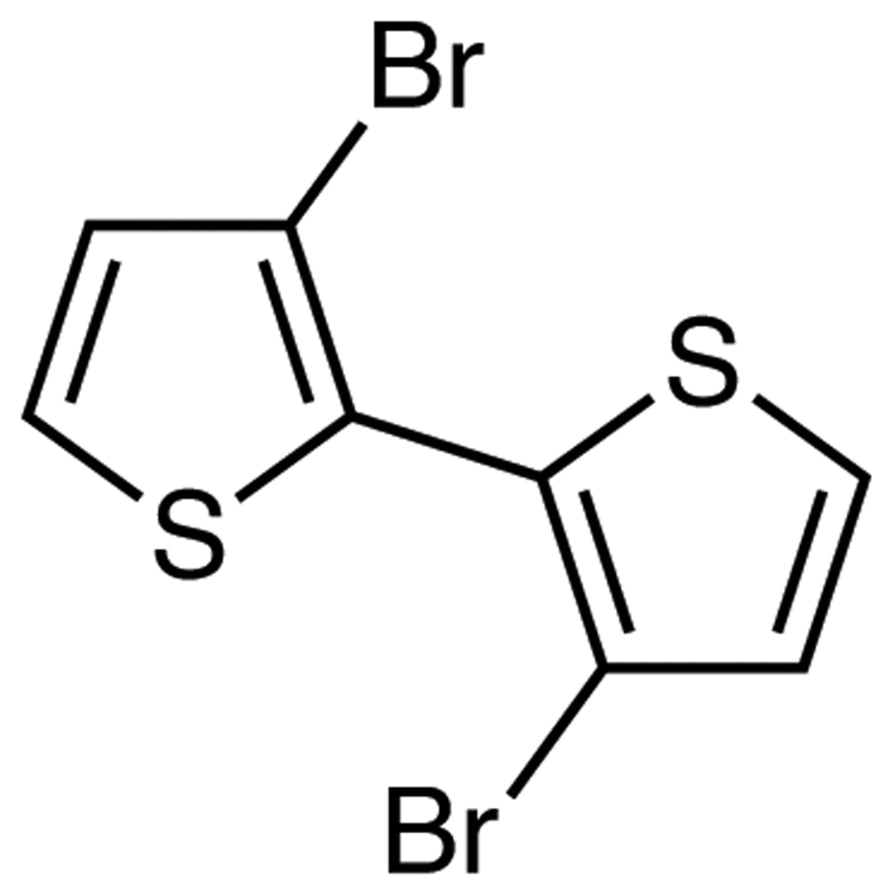
TCI D3798 3,3'-Dibromo-2,2'-bithiophene is a materials science building block composed of two thiophene rings joined at their 2 and 2' positions, each carrying a bromine atom at the 3 and 3' positions. This structure is one of the most important precursors in organic semiconductor chemistry, because the closely adjacent bromine positions allow the formation of a new ring that bridges the two thiophene units. From this compound many fused cores such as dithienothiophenes, cyclopentadithiophenes, and related derivatives are constructed, and these in turn become the backbone of polymers and small molecules used in organic electronic devices.
The property that makes this compound especially valuable is the dual functionality of its bromine atoms, which can be treated in two different ways. Through halogen–metal exchange using organolithium reagents, the bromine atoms are converted into nucleophilic centres that are ready to be closed into a five-membered ring together with a carbon, nitrogen, silicon, or sulfur bridge. Alternatively, the bromine atoms can be used directly in palladium-catalysed cross-coupling reactions to extend the conjugated system. The bithiophene framework itself contributes good electron delocalisation and stability, giving synthetic chemists two complementary routes from a single starting material.
In Indonesian laboratories, this building block is typically used in university and institutional research groups working on organic electronic materials, as well as in polymer and materials chemistry programmes. It is commonly handled in synthesis laboratories equipped for air-sensitive work, where organolithium chemistry and palladium-catalysed coupling are routine, and it supports postgraduate research, publication-oriented studies, and collaborative projects aimed at developing conjugated polymers and small-molecule semiconductors.
- Synthesis of fused thiophene cores — the adjacent 3,3'-bromine positions make ring closure into dithienothiophene and related fused systems straightforward and reliable.
- Cyclopentadithiophene preparation — halogen–metal exchange generates nucleophilic centres that close onto a carbon bridge, giving the widely used cyclopentadithiophene semiconductor core.
- Bridged heterocycle construction — nitrogen, silicon, or sulfur bridging atoms can be introduced between the two thiophene rings to tune the electronic character of the core.
- Palladium-catalysed cross-coupling — the bromine substituents serve directly as coupling handles for extending conjugation and building larger donor–acceptor architectures.
- Conjugated polymer research — the resulting fused units act as monomer backbones for polymers and small molecules developed for organic electronic devices.
| Brand | TCI (Tokyo Chemical Industry) |
|---|---|
| CAS number | 51751-44-1 |
| Molecular formula | — |
| Purity | — |
| Category | Materials Science > Material Building Blocks > Polymer/Macromolecule Semiconductor Building Blocks |
| Pack sizes | available in standard TCI research-scale catalogue pack sizes; please confirm the currently listed options when ordering |
| Physical form | — |
| Storage | store according to the conditions stated on the manufacturer's label and Safety Data Sheet |
- Product Code: D3798
Store the material in its original tightly closed container, in a cool, dry, and well-ventilated area away from direct sunlight and sources of ignition, following the conditions given on the manufacturer's label and Safety Data Sheet. Amber glass or the supplied original packaging is suitable for protecting the contents from light and moisture. Handle the compound in a fume hood using appropriate personal protective equipment, including safety goggles, gloves, and a laboratory coat. Because this building block is frequently used in organolithium and palladium-catalysed reactions, transfers should be carried out under inert atmosphere where the intended procedure requires it. Keep containers clearly labelled, avoid generating dust, and dispose of residues and contaminated materials in accordance with institutional chemical waste procedures.
—
Produk Terkait
-
5,5'-Dibromo-4,4'-dihexyl-2,2'-bithiophene TCI D4184
Regular price From Rp 3.180.450,00Regular price -
5,5'-Dibromo-3,3'-dihexyl-2,2'-bithiophene TCI D4183
Regular price From Rp 8.745.450,00Regular price -
3,3'-Dibromo-5,5'-bis(trimethylsilyl)-2,2'-bithiophene TCI D3941
Regular price From Rp 3.419.850,00Regular price -
5,5'-Dibromo-2,2'-bithiophene TCI D2755
Regular price From Rp 1.353.450,00Regular price -
5,5'-Bis(trimethylstannyl)-2,2'-bithiophene TCI B4854
Regular price From Rp 2.068.500,00Regular price -
5,5'-Bis(4,4,5,5-tetramethyl-1,3,2-dioxaborolan-2-yl)-2,2'-bithiophene TCI B3363
Regular price Rp 11.025.000,00Regular price -
(3,3'-Difluoro-[2,2'-bithiophene]-5,5'-diyl)bis(trimethylstannane) TCI D5436
Regular price Rp 6.916.350,00Regular price -
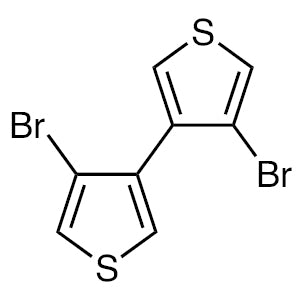
4,4'-Dibromo-3,3'-bithiophene TCI D5374
Regular price Rp 5.830.650,00Regular price


![(3,3'-Difluoro-[2,2'-bithiophene]-5,5'-diyl)bis(trimethylstannane) (CAS 1619967-09-7) - TCI D5436 - AMI Scientific](http://amiscientific.com/cdn/shop/files/TCI2510D5436.jpg?v=1769142108&width=533)