

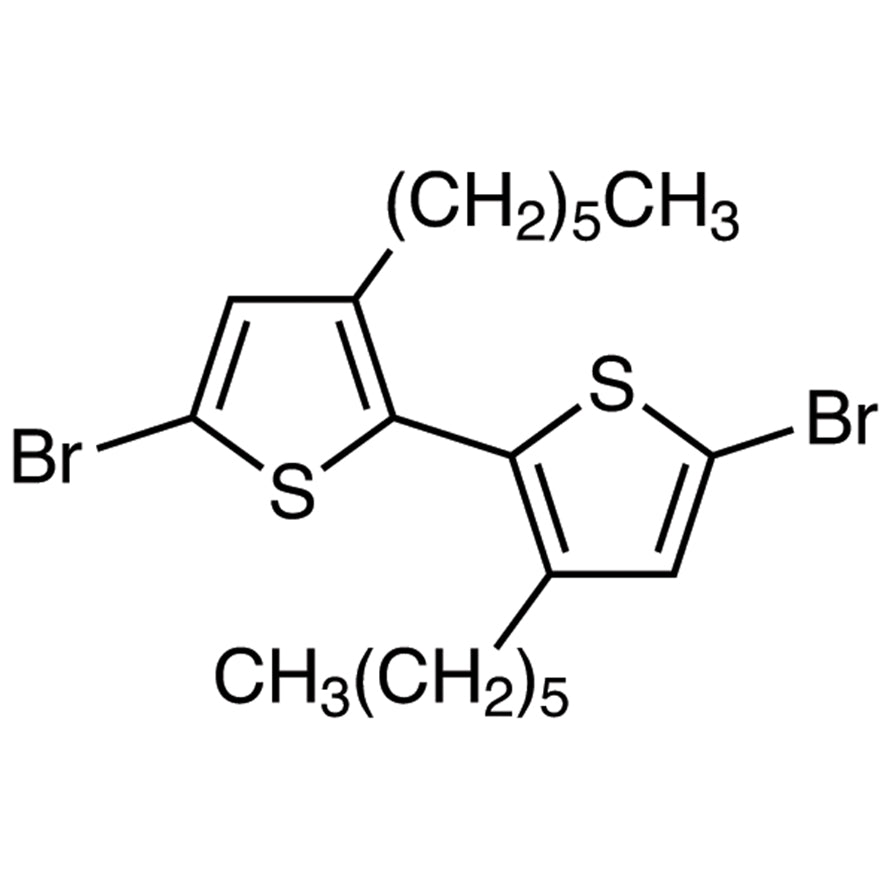
TCI D4183 is 5,5'-Dibromo-3,3'-dihexyl-2,2'-bithiophene, a bithiophene monomer that already carries two hexyl chains at the 3 and 3' positions together with two bromine atoms at the 5 and 5' positions. The compound is classified as a polymer/macromolecule semiconductor building block, and its laboratory role is highly specific: it serves as a ready-to-use monomer for polymerizations that yield alkyl-substituted polythiophenes. Because both sets of functional groups are already installed at the correct positions, researchers can move directly to the polymer-forming step without having to perform their own bromination or alkylation.
The property that gives this compound its value is a molecular design that takes polymer chain regularity into account. The bromine atoms at both alpha positions are the coupling points commonly used in Yamamoto, Stille, Suzuki, and Kumada catalyst-transfer polymerizations, so the chain grows linearly through ring-to-ring connections between thiophene units. The hexyl chains at the 3 and 3' positions ensure that the resulting polymer remains soluble and can be processed into thin films by solution techniques. The symmetric arrangement of the two alkyl chains on a single bithiophene unit also helps produce a more regular polymer backbone.
In Indonesian laboratories, this monomer is typically found in university and institutional research groups working on organic electronics and polymer materials science. It is used by teams preparing conjugated polymers for thin-film studies, where the ability to start from a pre-functionalized building block shortens a multi-step synthetic route considerably. Materials chemistry and polymer synthesis laboratories generally order it in research-scale quantities for specific project work rather than for routine analysis.
- Polythiophene synthesis — the dibrominated bithiophene core acts as a direct monomer for building alkyl-substituted conjugated polymer chains without prior functionalization steps.
- Yamamoto and Kumada catalyst-transfer polymerization — the two alpha-position bromine atoms provide the standard reactive handles these nickel-mediated coupling routes require for linear chain growth.
- Stille and Suzuki cross-coupling polymerization — the compound pairs with stannyl or boronic comonomers to build donor–acceptor copolymers through established palladium-catalyzed chemistry.
- Solution-processable thin-film preparation — the hexyl side chains keep the resulting polymer soluble, allowing films to be deposited by spin coating and other solution techniques.
- Organic semiconductor materials research — the symmetric alkyl substitution supports regular backbone formation, which is important when studying structure–property relationships in conjugated systems.
| Brand | TCI (Tokyo Chemical Industry) |
|---|---|
| CAS number | 170702-05-3 |
| Molecular formula | — |
| Purity | — |
| Category | Materials Science > Material Building Blocks > Polymer/Macromolecule Semiconductor Building Blocks |
| Pack sizes | available in research-scale quantities; please confirm the current pack options when ordering |
| Physical form | — |
| Storage | keep in a cool, dark place in a tightly closed container |
- Product Code: D4183
- Chemical Name: 5,5'-Dibromo-3,3'-dihexyl-2,2'-bithiophene
Store this monomer in a cool, dark place in a tightly closed container, protected from light and moisture. Amber glass bottles or the original manufacturer packaging are suitable, and the container should be resealed promptly after each use to limit exposure to air and humidity. Handle the material inside a fume hood while wearing safety glasses, chemical-resistant gloves, and a laboratory coat, and avoid generating dust or aerosols during weighing. Keep the compound away from strong oxidizing agents and ignition sources. Where the material will be used for moisture-sensitive coupling reactions, transfer and weighing under an inert atmosphere helps preserve its quality. Always consult the manufacturer's Safety Data Sheet before use, and dispose of residues and contaminated consumables through the laboratory's chemical waste procedures rather than through general waste or drains.
—
Produk Terkait
-
5,5'-Dibromo-4,4'-dihexyl-2,2'-bithiophene TCI D4184
Regular price From Rp 3.180.450,00Regular price -
3,3'-Dibromo-5,5'-bis(trimethylsilyl)-2,2'-bithiophene TCI D3941
Regular price From Rp 3.419.850,00Regular price -
3,3'-Dibromo-2,2'-bithiophene TCI D3798
Regular price From Rp 1.590.750,00Regular price -
5,5'-Dibromo-2,2'-bithiophene TCI D2755
Regular price From Rp 1.353.450,00Regular price -
5,5'-Bis(trimethylstannyl)-2,2'-bithiophene TCI B4854
Regular price From Rp 2.068.500,00Regular price -
5,5'-Bis(4,4,5,5-tetramethyl-1,3,2-dioxaborolan-2-yl)-2,2'-bithiophene TCI B3363
Regular price Rp 11.025.000,00Regular price -
(3,3'-Difluoro-[2,2'-bithiophene]-5,5'-diyl)bis(trimethylstannane) TCI D5436
Regular price Rp 6.916.350,00Regular price -
3,3'''-Dihexyl-2,2':5',2'':5'',2'''-quaterthiophene(contains3%Dichloromethaneatmaximum) TCI D5492
Regular price Rp 2.466.450,00Regular price


![(3,3'-Difluoro-[2,2'-bithiophene]-5,5'-diyl)bis(trimethylstannane) (CAS 1619967-09-7) - TCI D5436 - AMI Scientific](http://amiscientific.com/cdn/shop/files/TCI2510D5436.jpg?v=1769142108&width=533)
