

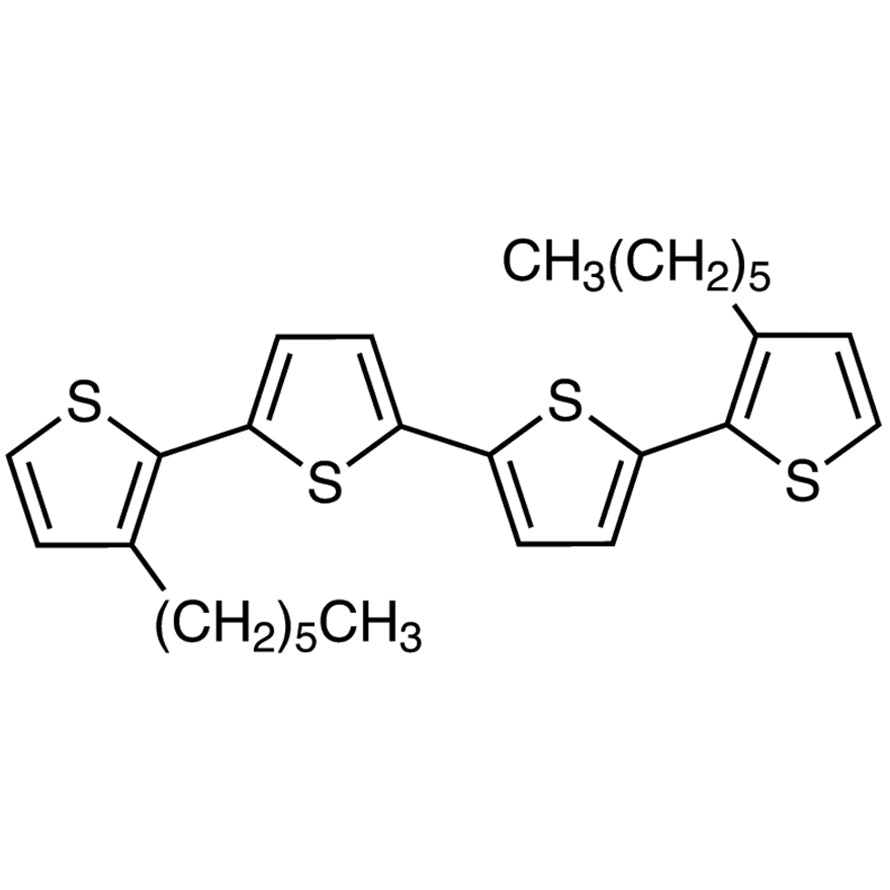
3,3'''-Dihexyl-2,2':5',2'':5'',2'''-quaterthiophene is an organic compound widely used in semiconductor material research. This compound plays a crucial role in the synthesis and characterization of organic conductive materials, particularly in the development of optoelectronic devices such as solar cells and light-emitting diodes. In the laboratory, it serves as a foundational building block for creating materials with high electrical conductivity and chemical stability. Its unique molecular structure enables it to be a key component in the design of advanced electronic materials.
The compound's molecular structure consists of four thiophene units connected by hexyl chains, which contribute to its high electronic conductivity and chemical stability. These properties make it a preferred choice for researchers working on organic semiconductors. The inclusion of up to 3% dichloromethane ensures the compound remains stable and free from unwanted contaminants, maintaining its integrity during experimental processes. This purity level is essential for accurate and reproducible results in material science studies.
In Indonesian laboratories, this compound is frequently used by researchers in the fields of materials science and semiconductor technology. It is a vital component in the development of new materials with unique electronic properties, especially in the energy sector. Its application supports innovation in sustainable and efficient electronic devices, making it an essential tool for scientific advancement in the region.
TCI brochures (PDF)
- Building Blocks for Organic Semiconductor 2026-03-24 · p. 26
Related TCI products
- TCI B5690 178931-63-0 5,5''-Bis(trimethylstannyl)-2,2':5',2''-terthiophene
- TCI T1805 7342-41-8 2,2':5',2''-Terthiophene-5-carboxaldehyde
- TCI B4050 105125-00-6 3'-Bromo-2,2':5',2''-terthiophene
- TCI B2058 161726-69-8 5''-Bromo-2,2':5',2''-terthiophene-5-carboxaldehyde
- TCI D4050 98057-08-0 5,5''-Dibromo-2,2':5',2''-terthiophene
- TCI D4184 214493-03-5 5,5'-Dibromo-4,4'-dihexyl-2,2'-bithiophene
- Organic Semiconductor Synthesis: This compound is ideal for creating organic semiconductors due to its high electronic conductivity and stable molecular structure.
- Optoelectronic Device Development: It is used in the fabrication of solar cells and LEDs, where its conductive properties are essential for efficient energy conversion and light emission.
- Material Characterization Studies: Researchers use it to analyze the electrical and chemical properties of new semiconductor materials under various conditions.
- Energy Research Applications: It supports the development of advanced materials for renewable energy technologies, contributing to sustainable energy solutions.
- Polymer Science Investigations: Its molecular structure makes it a valuable component in the study of polymer-based electronic materials and their performance characteristics.
| Brand | TCI |
|---|---|
| CAS number | 132814-91-6 |
| Molecular formula | — |
| Purity | — |
| Category | Materials Science > Material Building Blocks > Polymer/Macromolecule Semiconductor Building Blocks |
| Pack sizes | — |
| Physical form | — |
| Storage | Store in a cool, dry place away from light and moisture |
This compound should be stored in a cool, dry place, away from light and moisture to maintain its stability and prevent degradation. It is recommended to use airtight containers to minimize exposure to air and contaminants. Due to its chemical nature, it should be handled with appropriate personal protective equipment, such as gloves and safety goggles, to ensure laboratory safety. While it contains up to 3% dichloromethane, it is not classified as a hazardous material under standard laboratory conditions. Proper ventilation should be maintained when working with the compound to ensure a safe working environment. Regular monitoring of storage conditions is advised to maintain the integrity of the material for research purposes.
—
Product Categories
Produk Terkait
-
5,5''-Bis(trimethylstannyl)-2,2':5',2''-terthiophene TCI B5690
Regular price Rp 2.411.850,00Regular priceRp 1.702.050,00Sale price Rp 2.411.850,00 -
2,2':5',2''-Terthiophene-5-carboxaldehyde TCI T1805
Regular price Rp 5.194.350,00Regular priceRp 3.647.700,00Sale price Rp 5.194.350,00 -
3'-Bromo-2,2':5',2''-terthiophene TCI B4050
Regular price Rp 8.108.100,00Regular priceRp 5.685.750,00Sale price Rp 8.108.100,00 -
5''-Bromo-2,2':5',2''-terthiophene-5-carboxaldehyde TCI B2058
Regular price Rp 6.015.450,00Regular priceRp 4.222.050,00Sale price Rp 6.015.450,00 -
5,5''-Dibromo-2,2':5',2''-terthiophene TCI D4050
Regular price Rp 2.969.400,00Regular priceRp 2.091.600,00Sale price Rp 2.969.400,00 -
5,5'-Dibromo-4,4'-dihexyl-2,2'-bithiophene TCI D4184
Regular price Rp 3.232.950,00Regular priceRp 2.276.400,00Sale price Rp 3.232.950,00 -
5,5'-Dibromo-3,3'-dihexyl-2,2'-bithiophene TCI D4183
Regular price Rp 8.797.950,00Regular priceRp 6.167.700,00Sale price Rp 8.797.950,00 -
Thieno[3,2-b]thiophene-2-boronicAcid(containsvaryingamountsofAnhydride) TCI T2621
Regular price Rp 5.883.150,00Regular priceRp 4.129.650,00Sale price Rp 5.883.150,00


![160032-40-6 Thieno[3,2-b]thiophene-2-boronic Acid (contains varying amounts of Anhydride) - AMI Scientific](http://amiscientific.com/cdn/shop/files/TCI2510T2621.jpg?v=1768206488&width=533)