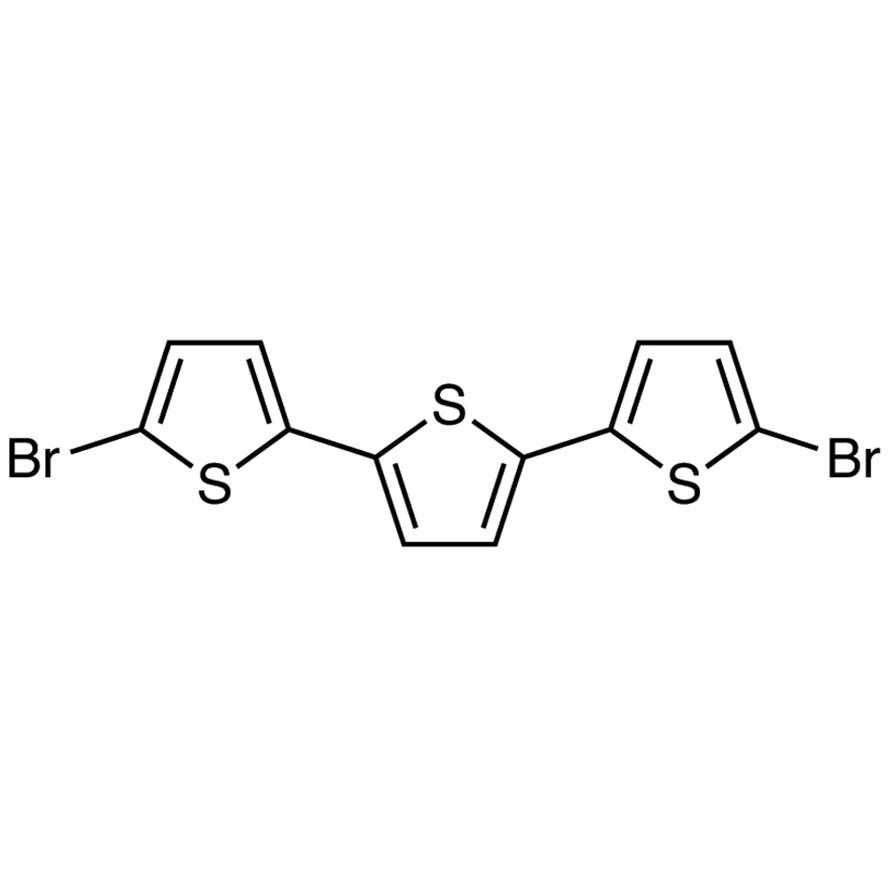
TCI D4050 5,5''-Dibromo-2,2':5',2''-terthiophene is a thiophene oligomer built from three thiophene rings joined in sequence, with a bromine atom attached at each end of the chain. The compound belongs to the family of building blocks for polymer and macromolecule semiconductors — starting materials designed specifically for constructing organic electronic materials. In a materials laboratory its role is highly specific: it supplies a long, conjugated electron-donor unit complete with two symmetrical reactive sites that are ready to be linked into polymer chains or large molecules through transition-metal-catalysed coupling reactions.
The main appeal of this compound lies in the combination of its pre-formed conjugation and the symmetry of its reactive groups. The terthiophene backbone provides an extended pi-electron system, which lowers the energy gap of the final material and strengthens interchain interactions, while the two bromine atoms at the terminal positions ensure that chain growth proceeds in a linear and directed manner. The molecular symmetry also simplifies analysis of the results, because coupling products tend to have a more regular structure. These properties are what make the terthiophene unit one of the well-established donor blocks in this field.
In Indonesian laboratories, this building block is typically used by university materials research groups, polymer chemistry laboratories, and institutional R&D units working on organic electronics. It is handled on a synthetic-chemistry bench where coupling reactions are set up under controlled conditions, then passed on for purification and structural characterisation. Because it is supplied as a defined, ready-to-use monomer, it lets researchers concentrate on polymerisation and device work rather than on preparing the core unit themselves.
Related TCI products
- TCI B5690 178931-63-0 5,5''-Bis(trimethylstannyl)-2,2':5',2''-terthiophene
- TCI D5492 132814-91-6 3,3'''-Dihexyl-2,2':5',2'':5'',2'''-quaterthiophene (contains 3% Dichloromethane at maximum)
- TCI B5462 1384281-49-5 9-Benzyl-2,7-dibromo-9H-carbazole
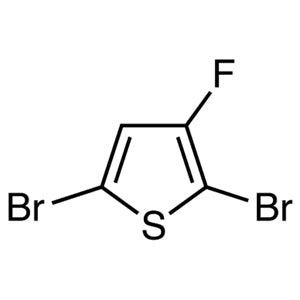
- TCI D5729 32431-85-9 2,5-Dibromo-3-fluorothiophene
- TCI D5448 132717-37-4 2,7-Dibromo-9-phenyl-9H-fluoren-9-ol
- TCI D5424 890653-54-0 3,6-Dibromo-9-(m-tolyl)-9H-carbazole
- Conjugated polymer synthesis: the two terminal bromine atoms act as symmetrical reactive handles, allowing controlled, linear chain growth into thiophene-based semiconducting polymers through transition-metal-catalysed coupling.
- Organic semiconductor material development: the extended terthiophene pi-system lowers the energy gap of the resulting material, making it a practical donor unit for organic electronic materials research.
- Donor–acceptor macromolecule construction: the compound serves as the electron-donor segment that can be coupled with acceptor units to build larger macromolecules with tailored electronic character.
- Coupling reaction methodology studies: its symmetrical dibromo structure gives a well-defined, reproducible substrate for developing and comparing transition-metal-catalysed coupling conditions in the laboratory.
- Structure–property investigations of thiophene oligomers: the regular products formed from this symmetrical monomer simplify structural analysis and support systematic study of interchain interactions.
| Brand | TCI (Tokyo Chemical Industry) |
|---|---|
| CAS number | 98057-08-0 |
| Molecular formula | — |
| Purity | — |
| Category | Materials Science > Material Building Blocks > Polymer/Macromolecule Semiconductor Building Blocks |
| Pack sizes | available in standard TCI research-scale packaging; please confirm the currently available pack size when ordering |
| Physical form | — |
| Storage | keep in the original tightly closed container, protected from light, in a cool and well-ventilated place |
- Chemical name: 5,5''-Dibromo-2,2':5',2''-terthiophene
- Product code: D4050
Store the material in its original tightly closed container in a cool, dry and well-ventilated area, away from direct sunlight, heat sources and incompatible substances. Amber glass or the manufacturer's supplied container is preferred, since protecting the compound from light and moisture helps preserve its quality over time. Always handle it inside a fume hood while wearing a laboratory coat, chemical-resistant gloves and safety goggles, and avoid inhaling dust or allowing contact with skin and eyes. Weigh and transfer the solid using clean, dry utensils to prevent contamination, close the container immediately after use, and label any secondary containers clearly. Consult the manufacturer's Safety Data Sheet before use, and dispose of residues and contaminated materials in accordance with applicable laboratory chemical waste procedures.
—
Produk Terkait
-
5,5''-Bis(trimethylstannyl)-2,2':5',2''-terthiophene TCI B5690
Regular price Rp 2.359.350,00Regular price -
3,3'''-Dihexyl-2,2':5',2'':5'',2'''-quaterthiophene(contains3%Dichloromethaneatmaximum) TCI D5492
Regular price Rp 2.466.450,00Regular price -
9-Benzyl-2,7-dibromo-9H-carbazole TCI B5462
Regular price From Rp 2.862.300,00Regular price -
2,5-Dibromo-3-fluorothiophene TCI D5729
Regular price From Rp 3.896.550,00Regular price -
2,7-Dibromo-9-phenyl-9H-fluoren-9-ol TCI D5448
Regular price From Rp 1.749.300,00Regular price -
3,6-Dibromo-9-(m-tolyl)-9H-carbazole TCI D5424
Regular price Rp 2.466.450,00Regular price -
3,6-Dibromo-9-(3,5-dimethylphenyl)-9H-carbazole TCI D5421
Regular price From Rp 1.060.500,00Regular price -
3,6-Dibromo-9-(3,4-dimethylphenyl)-9H-carbazole TCI D5420
Regular price Rp 3.525.900,00Regular price