

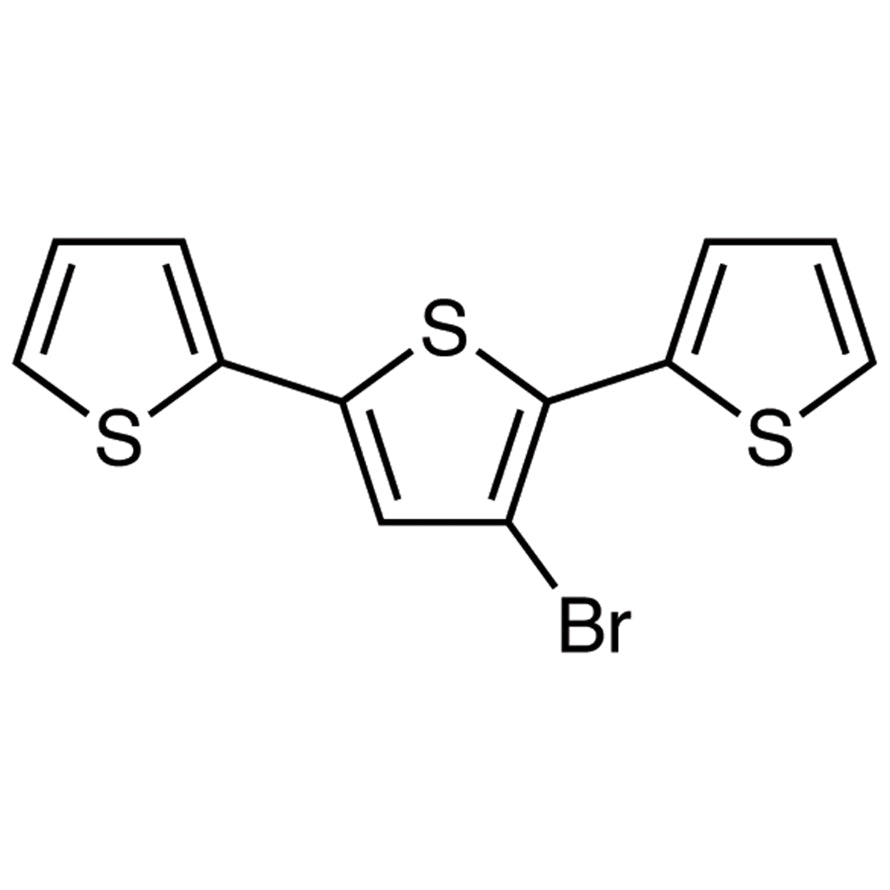
3'-Bromo-2,2':5',2''-terthiophene is a key organic compound used in semiconductor and optoelectronic material research. This compound plays a vital role in laboratories where scientists develop advanced materials for next-generation technologies. Its unique molecular structure enables precise tuning of electronic and optical properties, making it an essential building block for functional materials. Due to its versatility, it is widely used in both academic and industrial research settings to create innovative solutions for energy, communication, and sensing applications.
The compound's stability and controlled reactivity make it a preferred choice for researchers. The presence of a bromo group at the 3' position allows for further chemical modifications, which can tailor the material’s properties for specific applications. Its solubility in organic solvents ensures ease of use in synthesis and characterization processes. These characteristics make it ideal for creating materials with enhanced conductivity and optical response, which are critical in modern electronic devices.
In Indonesian laboratories, 3'-Bromo-2,2':5',2''-terthiophene is commonly used in material science research. It supports studies in optoelectronic devices, solar cells, and sensor development. Researchers rely on its predictable behavior and compatibility with various synthetic methods to advance their work in sustainable and high-performance material design.
TCI brochures (PDF)
- Thiophenes 2026-06-29 · p. 14
- Building Blocks for Organic Semiconductor 2026-03-24 · p. 25
Related TCI products
- TCI B2058 161726-69-8 5''-Bromo-2,2':5',2''-terthiophene-5-carboxaldehyde
- TCI T1805 7342-41-8 2,2':5',2''-Terthiophene-5-carboxaldehyde
- TCI B5690 178931-63-0 5,5''-Bis(trimethylstannyl)-2,2':5',2''-terthiophene
- TCI D5492 132814-91-6 3,3'''-Dihexyl-2,2':5',2'':5'',2'''-quaterthiophene (contains 3% Dichloromethane at maximum)
- TCI B5475 925899-21-4 2-Bromo-5-(2-ethylhexyl)thiophene
- TCI B5458 704890-84-6 2-[(5'-Bromo-[2,2'-bithiophen]-5-yl)methylene]malononitrile
- Used in optoelectronic material development due to its tunable electronic and optical properties, allowing for precise control over material behavior.
- Applied in solar cell research to enhance light absorption and charge transport properties, contributing to more efficient photovoltaic systems.
- Utilized in sensor development because of its sensitivity to light and ability to modify its properties through chemical reactions.
- Incorporated in LED fabrication to improve the performance of organic light-emitting diodes through structural and electronic customization.
- Employed in semiconductor material synthesis to create compounds with specific conductive and optical characteristics for advanced electronic applications.
| Brand | TCI |
|---|---|
| CAS number | 105125-00-6 |
| Molecular formula | — |
| Purity | — |
| Category | Materials Science > Material Building Blocks > Small Molecule Semiconductor Building Blocks |
| Pack sizes | As listed on product page |
| Physical form | Solid (as per standard product description) |
| Storage | Store in a cool, dry place away from light and moisture |
This compound should be stored in a cool, dry environment, away from direct light and moisture to maintain its stability and reactivity. It is recommended to use airtight containers made of glass or high-density polyethylene to prevent contamination and degradation. Due to its chemical nature, it should be handled with appropriate personal protective equipment, including gloves and safety goggles. In laboratory settings, it is important to ensure proper ventilation to minimize exposure. The compound should not be stored near incompatible substances such as strong oxidizers or acids. Regular monitoring of storage conditions is advised to ensure the material remains suitable for use in research applications.
—
Produk Terkait
-
5''-Bromo-2,2':5',2''-terthiophene-5-carboxaldehyde TCI B2058
Regular price From Rp 6.015.450,00Regular priceRp 4.222.050,00Sale price From Rp 6.015.450,00 -
2,2':5',2''-Terthiophene-5-carboxaldehyde TCI T1805
Regular price Rp 5.194.350,00Regular priceRp 3.647.700,00Sale price Rp 5.194.350,00 -
5,5''-Bis(trimethylstannyl)-2,2':5',2''-terthiophene TCI B5690
Regular price Rp 2.411.850,00Regular priceRp 1.702.050,00Sale price Rp 2.411.850,00 -
3,3'''-Dihexyl-2,2':5',2'':5'',2'''-quaterthiophene(contains3%Dichloromethaneatmaximum) TCI D5492
Regular price Rp 2.518.950,00Regular priceRp 1.776.600,00Sale price Rp 2.518.950,00 -
2-Bromo-5-(2-ethylhexyl)thiophene TCI B5475
Regular price From Rp 3.180.450,00Regular priceRp 2.239.650,00Sale price From Rp 3.180.450,00 -
2-[(5'-Bromo-[2,2'-bithiophen]-5-yl)methylene]malononitrile TCI B5458
Regular price From Rp 1.351.350,00Regular priceRp 960.750,00Sale price From Rp 1.351.350,00 -
5'-Bromo-[2,2'-bithiophene]-5-carbonitrile TCI B5457
Regular price From Rp 2.013.900,00Regular priceRp 1.423.800,00Sale price From Rp 2.013.900,00 -
3-(5-Bromo-2-thienyl)-2,5-bis(2-ethylhexyl)-6-(2-thienyl)pyrrolo[3,4-c]pyrrole-1,4-dione TCI B5456
Regular price Rp 7.075.950,00Regular priceRp 4.963.350,00Sale price Rp 7.075.950,00


