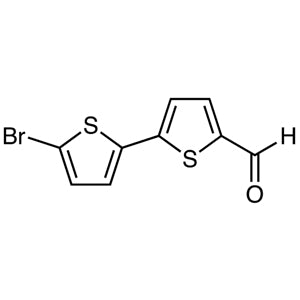
5''-Bromo-2,2':5',2''-terthiophene-5-carboxaldehyde is a key organic compound used in semiconductor material research. This compound plays a vital role in the development of advanced electronic materials, particularly in the field of organic optoelectronics. Its unique molecular structure, consisting of three thiophene units connected in a terthiophene configuration, makes it a valuable building block for creating materials with tailored electronic properties. This compound is widely utilized in scientific laboratories for its ability to contribute to the synthesis of functional materials with specific optical and electronic characteristics.
The compound's molecular design allows for precise control over its electronic behavior, which is essential for applications in modern technology. Its bromo and aldehyde functional groups provide versatility in chemical modifications, enabling researchers to fine-tune its properties for specific applications. The stability and reactivity of this material can be adjusted to meet the needs of various experimental setups, making it a preferred choice for material scientists and chemists working on cutting-edge research projects.
In Indonesian laboratories, this compound is a critical component in the development of new materials for optoelectronic devices and renewable energy technologies. It is commonly used in academic and research institutions to support innovation in electronics and energy-related fields. Its availability and reliability make it an essential resource for advancing scientific research in Indonesia.
TCI brochures (PDF)
- Thiophenes 2026-06-29 · p. 15
- Building Blocks for Organic Semiconductor 2026-03-24 · p. 25
Related TCI products
- TCI T1805 7342-41-8 2,2':5',2''-Terthiophene-5-carboxaldehyde
- TCI B4050 105125-00-6 3'-Bromo-2,2':5',2''-terthiophene
- TCI B5396 852054-42-3 7-Bromo-2,3-dihydrothieno[3,4-b][1,4]dioxine-5-carboxaldehyde
- TCI B1874 110046-60-1 5-Bromo-2,2'-bithiophene-5'-carboxaldehyde
- TCI B5690 178931-63-0 5,5''-Bis(trimethylstannyl)-2,2':5',2''-terthiophene
- TCI D5492 132814-91-6 3,3'''-Dihexyl-2,2':5',2'':5'',2'''-quaterthiophene (contains 3% Dichloromethane at maximum)
- Used in organic semiconductor synthesis for creating materials with tailored electronic properties, ideal for optoelectronic device development.
- Applied in the fabrication of organic solar cells to enhance charge transport and light absorption characteristics.
- Utilized in research on light-emitting diodes (LEDs) to improve efficiency and color purity through molecular design.
- Employed in the development of flexible electronic materials due to its compatibility with thin-film fabrication techniques.
- Integrated into studies on charge transport mechanisms in organic materials to support advancements in electronic device performance.
| Brand | TCI |
|---|---|
| CAS number | 161726-69-8 |
| Molecular formula | — |
| Purity | — |
| Category | Materials Science > Material Building Blocks > Small Molecule Semiconductor Building Blocks |
| Pack sizes | Available in standard laboratory quantities |
| Physical form | Solid |
| Storage | Store in a cool, dry place away from light and moisture |
This compound should be stored in a cool, dry environment, away from direct light and moisture to maintain its chemical integrity. It is recommended to use airtight containers made of glass or high-density polyethylene to prevent contamination and degradation. Due to its organic nature, it should be handled in a well-ventilated area, and appropriate personal protective equipment such as gloves and safety goggles should be worn. Avoid exposure to heat or open flames, as it may react with certain substances. Proper labeling and storage practices ensure safe handling and long-term stability of the material in laboratory settings.
—
Produk Terkait
-
2,2':5',2''-Terthiophene-5-carboxaldehyde TCI T1805
Regular price Rp 5.194.350,00Regular priceRp 3.647.700,00Sale price Rp 5.194.350,00 -
3'-Bromo-2,2':5',2''-terthiophene TCI B4050
Regular price Rp 8.108.100,00Regular priceRp 5.685.750,00Sale price Rp 8.108.100,00 -
7-Bromo-2,3-dihydrothieno[3,4-b][1,4]dioxine-5-carboxaldehyde TCI B5396
Regular price From Rp 1.696.800,00Regular priceRp 1.202.250,00Sale price From Rp 1.696.800,00 -
5-Bromo-2,2'-bithiophene-5'-carboxaldehyde TCI B1874
Regular price From Rp 2.173.500,00Regular priceRp 1.535.100,00Sale price From Rp 2.173.500,00 -
5,5''-Bis(trimethylstannyl)-2,2':5',2''-terthiophene TCI B5690
Regular price Rp 2.411.850,00Regular priceRp 1.702.050,00Sale price Rp 2.411.850,00 -
3,3'''-Dihexyl-2,2':5',2'':5'',2'''-quaterthiophene(contains3%Dichloromethaneatmaximum) TCI D5492
Regular price Rp 2.518.950,00Regular priceRp 1.776.600,00Sale price Rp 2.518.950,00 -
5-(4,4,5,5-Tetramethyl-1,3,2-dioxaborolan-2-yl)thiophene-2-carboxaldehyde TCI T3485
Regular price Rp 2.013.900,00Regular priceRp 1.423.800,00Sale price Rp 2.013.900,00 -
4-Bromothiophene-3-carboxaldehyde TCI B4126
Regular price Rp 8.320.200,00Regular priceRp 5.833.800,00Sale price Rp 8.320.200,00