

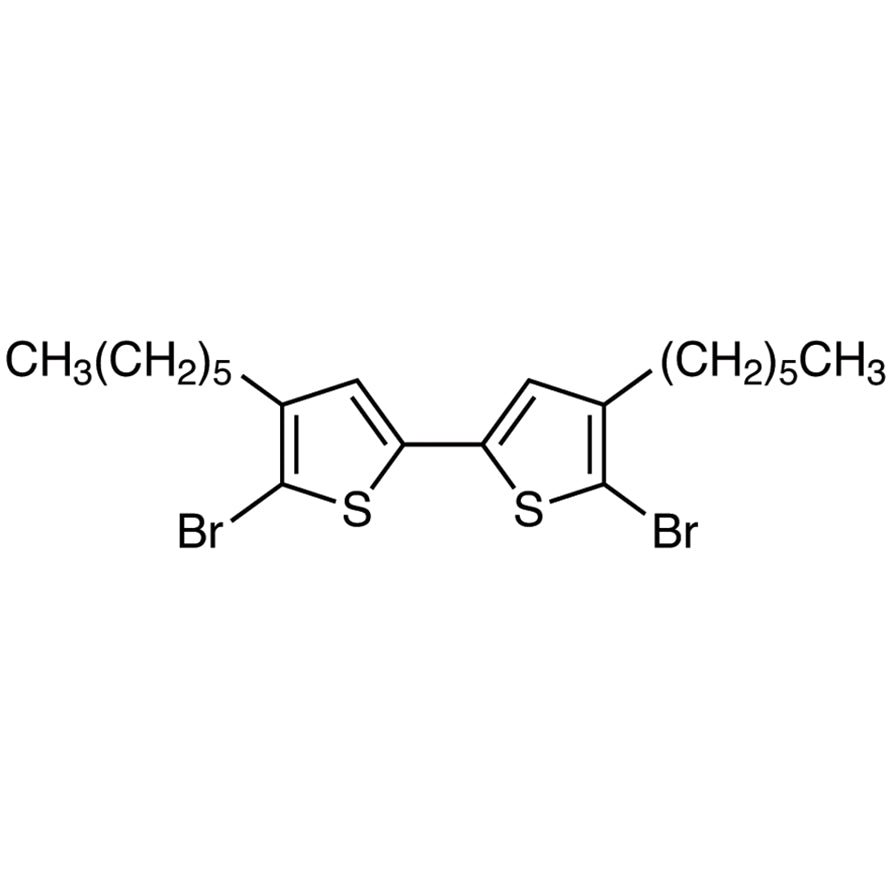
TCI D4184 is 5,5'-Dibromo-4,4'-dihexyl-2,2'-bithiophene, a bithiophene monomer carrying two bromine atoms at the alpha 5 and 5' positions and two hexyl chains at the 4 and 4' positions. The compound belongs to the polymer semiconductor building block family and serves as a polymerization-ready monomer for producing alkyl-substituted polythiophenes. In the laboratory, its availability shortens synthetic routes because researchers no longer need to carry out separate alkylation and bromination steps before assembling the conjugated polymer chain.
What distinguishes this compound from the 3,3'-dihexyl isomer is the placement of its alkyl chains further away from the inter-ring linking bond. Positioning at the 4 and 4' sites reduces steric hindrance around the connecting axis, so the two thiophene rings can arrange themselves in a more coplanar fashion. This coplanarity supports broader π-electron delocalization, which in turn influences the band gap, the absorption spectrum, and the chain packing tendency of the resulting polymer in thin films. Meanwhile, the bromine atoms at both alpha ends remain standard coupling points for Yamamoto, Stille, Suzuki, and Kumada polymerization, while the hexyl chains maintain polymer solubility so the material can be processed from solution.
In Indonesian laboratories, this monomer is typically used by organic electronics and polymer chemistry groups working on conjugated materials, whether in university research units or in materials development laboratories. It suits work where a ready-to-polymerize, pre-functionalized building block saves preparation time and improves batch-to-batch consistency, particularly for teams preparing thin-film samples for optical and electronic characterization.
- Polythiophene synthesis — the alpha-brominated ends provide standard coupling sites for building alkyl-substituted conjugated polymer chains without additional halogenation steps beforehand.
- Cross-coupling polymerization — the compound is directly compatible with Yamamoto, Stille, Suzuki, and Kumada routes, giving researchers flexibility in choosing the catalyst system that suits their setup.
- Conjugated copolymer preparation — the bifunctional dibromo structure allows the bithiophene unit to be alternated with other comonomers to tune the electronic character of the final polymer.
- Band gap and absorption studies — reduced steric hindrance at the 4 and 4' positions promotes coplanarity, making this monomer useful for investigating how ring geometry affects optical properties.
- Solution-processed thin film work — the hexyl side chains keep the resulting polymer soluble, so films can be deposited from solution for subsequent optical and electronic characterization.
| Brand | TCI |
|---|---|
| CAS number | 214493-03-5 |
| Molecular formula | — |
| Purity | — |
| Category | Materials Science > Material Building Blocks > Polymer/Macromolecule Semiconductor Building Blocks |
| Pack sizes | available in standard TCI catalogue pack sizes; please confirm the size required when ordering |
| Physical form | — |
| Storage | keep in the tightly closed original container, protected from light and moisture, and follow the storage conditions stated on the manufacturer's label and Safety Data Sheet |
- Chemical name: 5,5'-Dibromo-4,4'-dihexyl-2,2'-bithiophene
Store the material in its original tightly closed container in a cool, dry, and well-ventilated area, away from light, moisture, and sources of ignition, following the storage conditions given on the manufacturer's label and Safety Data Sheet. Amber glass or the supplied container is suitable for keeping the compound protected from light; avoid transferring it into containers that are not chemically compatible. As with all brominated organic building blocks, handle it inside a fume hood using gloves, safety goggles, and a laboratory coat, and avoid inhalation of dust or vapours and contact with skin and eyes. Keep the container closed when not in use to limit exposure to air and humidity, label any aliquots clearly, and dispose of residues and contaminated materials in accordance with the chemical waste procedures applied in your laboratory.
—
Produk Terkait
-
5,5'-Dibromo-3,3'-dihexyl-2,2'-bithiophene TCI D4183
Regular price From Rp 8.745.450,00Regular price -
3,3'-Dibromo-5,5'-bis(trimethylsilyl)-2,2'-bithiophene TCI D3941
Regular price From Rp 3.419.850,00Regular price -
3,3'-Dibromo-2,2'-bithiophene TCI D3798
Regular price From Rp 1.590.750,00Regular price -
5,5'-Dibromo-2,2'-bithiophene TCI D2755
Regular price From Rp 1.353.450,00Regular price -
5,5'-Bis(trimethylstannyl)-2,2'-bithiophene TCI B4854
Regular price From Rp 2.068.500,00Regular price -
5,5'-Bis(4,4,5,5-tetramethyl-1,3,2-dioxaborolan-2-yl)-2,2'-bithiophene TCI B3363
Regular price Rp 11.025.000,00Regular price -
(3,3'-Difluoro-[2,2'-bithiophene]-5,5'-diyl)bis(trimethylstannane) TCI D5436
Regular price Rp 6.916.350,00Regular price -
3,3'''-Dihexyl-2,2':5',2'':5'',2'''-quaterthiophene(contains3%Dichloromethaneatmaximum) TCI D5492
Regular price Rp 2.466.450,00Regular price


![(3,3'-Difluoro-[2,2'-bithiophene]-5,5'-diyl)bis(trimethylstannane) (CAS 1619967-09-7) - TCI D5436 - AMI Scientific](http://amiscientific.com/cdn/shop/files/TCI2510D5436.jpg?v=1769142108&width=533)
