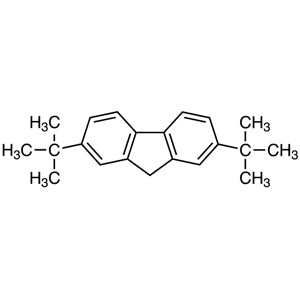
TCI D4084 with CAS number 58775-05-6 is 2,7-Di-tert-butylfluorene, a fluorene derivative carrying two tert-butyl groups at the 2 and 7 positions of the aromatic ring system. The compound belongs to the class of non-heterocyclic building blocks and is widely used as a core scaffold in organic materials chemistry. The fluorene core itself is a bridged biphenyl system that is rigid, fully conjugated, and characterised by distinctive blue fluorescence, which has made it one of the most popular motifs in the development of optoelectronic materials, fluorescence sensors, and conjugated polymers in materials research laboratories.
The property that makes this compound a preferred choice is the presence of the two tert-butyl groups, which work on two fronts at once. First, these groups improve solubility in common organic solvents, so that derivative products are easier to process through solution-based techniques such as spin coating. Second, the bulky tert-butyl groups provide steric hindrance that helps prevent intermolecular stacking, or aggregation, which is the cause of fluorescence quenching and unwanted spectral shifts. In addition, because the 2 and 7 positions are already substituted, subsequent reactions are directed toward the C-9 position on the methylene bridge, giving chemists predictable regiochemical control over further functionalisation.
In Indonesian laboratories, 2,7-Di-tert-butylfluorene is typically encountered in university and institutional research groups working on organic materials chemistry, particularly those developing optoelectronic materials, fluorescence-based sensors, and conjugated polymers. It is used as a starting scaffold in synthetic work rather than as a routine analytical reagent, so it is generally ordered in research-scale quantities by synthesis laboratories that already have facilities for handling organic building blocks and for solution processing of the resulting derivatives.
- Conjugated polymer synthesis — the rigid, fully conjugated fluorene core serves as a repeating unit, while the tert-butyl groups keep the resulting polymer soluble enough for solution processing.
- Optoelectronic materials development — the characteristic blue fluorescence of the fluorene system makes this building block a common starting point for emissive layer materials in research-scale device work.
- Fluorescence sensor construction — the intrinsic blue emission of the fluorene core provides the optical signal, and the tert-butyl substitution helps preserve emission intensity by limiting aggregation-driven quenching.
- C-9 selective functionalisation studies — with the 2 and 7 positions already occupied, subsequent chemistry is directed to the methylene bridge, giving predictable regiochemistry for building more complex scaffolds.
- Solution-processed thin film preparation — improved solubility in common organic solvents allows derivatives to be deposited by techniques such as spin coating without additional solubilising modifications.
| Brand | TCI |
|---|---|
| CAS number | 58775-05-6 |
| Molecular formula | — |
| Purity | — |
| Category | Chemistry > Building Blocks > Non-Heterocyclic Building Blocks |
| Pack sizes | available in research-scale laboratory pack sizes; please confirm the currently available packaging when ordering |
| Physical form | — |
| Storage | store according to the manufacturer's instructions on the product label and safety data sheet |
- Chemical name: 2,7-Di-tert-butylfluorene
- Catalogue reference: D4084
Store the product in its original tightly closed container in a cool, dry, well-ventilated area away from direct sunlight, heat sources, and incompatible materials, following the storage conditions stated by the manufacturer on the label and in the safety data sheet. Keep the container sealed when not in use to prevent moisture uptake and contamination of the material. Handle the compound in a fume hood using appropriate personal protective equipment, including safety glasses, gloves, and a laboratory coat, and avoid the generation and inhalation of dust during weighing and transfer. Use clean, dry spatulas and glassware suitable for organic solids, label all secondary containers clearly, and dispose of residues and contaminated materials in accordance with applicable laboratory chemical waste procedures. Always review the full safety data sheet before first use.
—
Produk Terkait
-
9,9-Di-n-octylfluorene TCI D3285
Regular price Rp 4.902.450,00Regular price -
1,2-Benzofluorene TCI B3931
Regular price From Rp 1.035.300,00Regular price -
2,3-Benzofluorene TCI B0059
Regular price From Rp 477.750,00Regular price -
Fluorene TCI F0017
Regular price From Rp 530.250,00Regular price -
7,7-Dimethyl-7H-benzo[c]fluorene TCI D5125
Regular price From Rp 2.174.550,00Regular price -
2,7-Bis(4,4,5,5-tetramethyl-1,3,2-dioxaborolan-2-yl)-9,9-dimethylfluorene TCI B5157
Regular price From Rp 2.809.800,00Regular price -
9,9-Dihexylfluorene TCI D4327
Regular price From Rp 1.724.100,00Regular price -
9,9-Dimethylfluorene(purifiedbysublimation) TCI D3810
Regular price Rp 2.227.050,00Regular price


![7,7-Dimethyl-7H-benzo[c]fluorene (CAS 112486-09-6) - TCI D5125 - AMI Scientific](http://amiscientific.com/cdn/shop/files/TCI2510D5125.jpg?v=1767108423&width=533)