

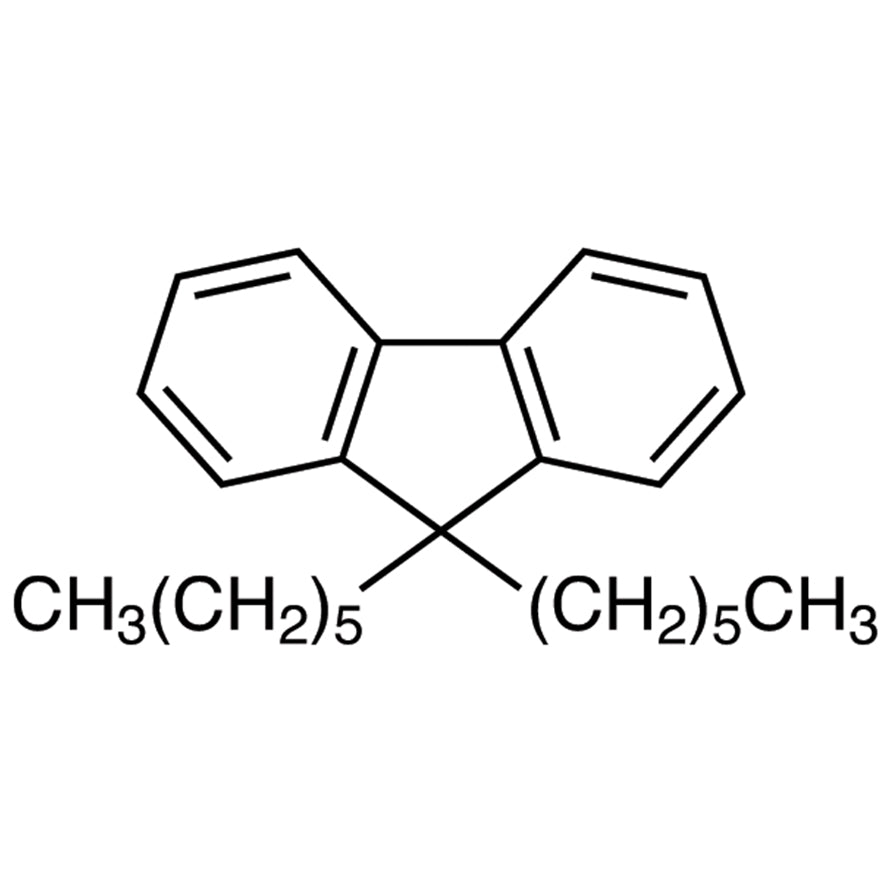
TCI D4327 9,9-Dihexylfluorene (CAS 123863-97-8) is a fluorene derivative carrying two hexyl chains at the 9-position. The compound belongs to the family of small molecule semiconductor building blocks and serves as an important base material in organic electronics research. The fluorene framework provides a biphenyl conjugated system that is locked into a coplanar geometry by a methylene bridge, giving rise to efficient blue emission and good charge carrier mobility. In the laboratory, this compound is used as a starting material that is subsequently halogenated, borylated, or polymerised into functional materials.
The characteristic that makes it a preferred choice is the role of the two hexyl chains on the C9 carbon. These alkyl chains project perpendicular to the plane of conjugation, so they do not disturb the electronic properties of the fluorene core, yet they dramatically improve solubility in organic solvents such as toluene, chloroform, and tetrahydrofuran. This good solubility is precisely what enables solution-based processing methods such as spin coating and inkjet printing during device fabrication. In addition, the double substitution at C9 prevents the formation of fluorenone groups through oxidation, a defect known to produce an undesirable green emission band.
In Indonesian laboratories, 9,9-dihexylfluorene is typically handled in university and institutional research groups working on organic electronics, polymer chemistry, and photonic materials. It is generally used at small synthetic scale inside a fume hood, as the entry point of a multi-step route toward monomers and conjugated polymers. Groups preparing thin films for optoelectronic testing rely on it where reproducible, solution-processable fluorene chemistry is required.
TCI brochures (PDF)
- Building Blocks for Organic Semiconductor 2026-03-24 · p. 14
Related TCI products
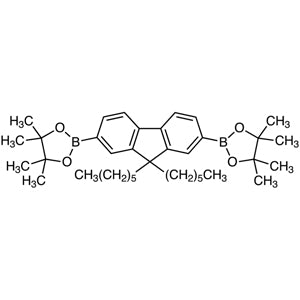
- TCI B4029 254755-24-3 2,7-Bis(4,4,5,5-tetramethyl-1,3,2-dioxaborolan-2-yl)-9,9-dihexylfluorene
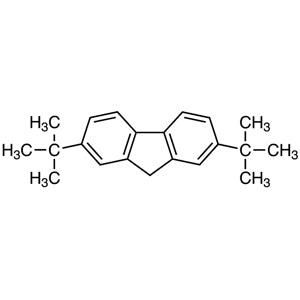
- TCI D4084 58775-05-6 2,7-Di-tert-butylfluorene
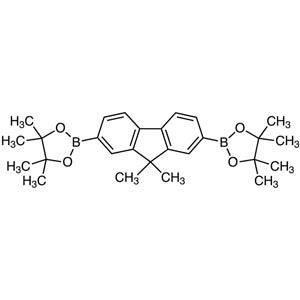
- TCI B5157 325129-69-9 2,7-Bis(4,4,5,5-tetramethyl-1,3,2-dioxaborolan-2-yl)-9,9-dimethylfluorene
- TCI D3586 20302-14-1 9,9-Diphenylfluorene
- TCI D3235 4569-45-3 9,9-Dimethylfluorene
- TCI T3249 4430-15-3 Truxenone
- Conjugated polymer synthesis: it acts as the parent fluorene unit that is functionalised into monomers and then polymerised, giving research groups a reliable entry point into polyfluorene chemistry.
- Blue-emitting material development: the coplanar fluorene framework provides efficient blue emission, so the compound underpins studies on emissive layers for organic light-emitting device research.
- Halogenation and borylation chemistry: the molecule is routinely brominated or converted to boronate esters, supplying the coupling partners needed for building larger conjugated architectures.
- Solution-processed thin film fabrication: the hexyl chains give solubility in toluene, chloroform, and tetrahydrofuran, allowing spin coating and inkjet printing of uniform semiconductor films.
- Charge transport and photophysics studies: good carrier mobility combined with resistance to fluorenone defect formation makes it suitable for investigating structure–property relationships in organic semiconductors.
| Brand | TCI (Tokyo Chemical Industry) |
|---|---|
| CAS number | 123863-97-8 |
| Molecular formula | — |
| Purity | — |
| Category | Materials Science > Material Building Blocks > Small Molecule Semiconductor Building Blocks |
| Pack sizes | available in standard TCI research-scale catalogue pack sizes; please confirm the required size when ordering |
| Physical form | — |
| Storage | keep in a tightly closed original container, protected from light and air |
- Chemical name: 9,9-Dihexylfluorene
Store the material in its original tightly closed container in a cool, dry, well-ventilated area away from light, heat, and sources of ignition. Amber glass or the supplier's sealed container is suitable, and headspace should be minimised for material intended for device work, since oxidative contamination can compromise optoelectronic performance. Handle and weigh the compound inside a fume hood, wearing safety glasses, a laboratory coat, and chemically resistant gloves. Avoid inhalation of dust and contact with skin and eyes, keep it separated from strong oxidising agents, and dispose of residues and contaminated consumables through the laboratory's chemical waste stream. Always consult the manufacturer's safety data sheet before first use.
—
Produk Terkait
-
2,7-Bis(4,4,5,5-tetramethyl-1,3,2-dioxaborolan-2-yl)-9,9-dihexylfluorene TCI B4029
Regular price Rp 7.871.850,00Regular price -
2,7-Di-tert-butylfluorene TCI D4084
Regular price From Rp 1.246.350,00Regular price -
2,7-Bis(4,4,5,5-tetramethyl-1,3,2-dioxaborolan-2-yl)-9,9-dimethylfluorene TCI B5157
Regular price From Rp 2.809.800,00Regular price -
9,9-Diphenylfluorene TCI D3586
Regular price From Rp 2.518.950,00Regular price -
9,9-Dimethylfluorene TCI D3235
Regular price From Rp 769.650,00Regular price -
Truxenone TCI T3249
Regular price Rp 7.049.700,00Regular price -
2-Bromo-13,13-dimethyl-6H-indeno[1,2-b]anthracene-6,11(13H)-dione TCI B4668
Regular price Rp 1.856.400,00Regular price -
11H-Benzo[a]fluoren-11-one TCI B3933
Regular price Rp 8.506.050,00Regular price


![1196107-73-9 2-Bromo-13,13-dimethyl-6H-indeno[1,2-b]anthracene-6,11(13H)-dione - AMI Scientific](http://amiscientific.com/cdn/shop/files/TCI2510B4668.jpg?v=1768815654&width=533)
![479-79-8 11H-Benzo[a]fluoren-11-one - AMI Scientific](http://amiscientific.com/cdn/shop/files/TCI2510B3933.jpg?v=1768359776&width=533)