

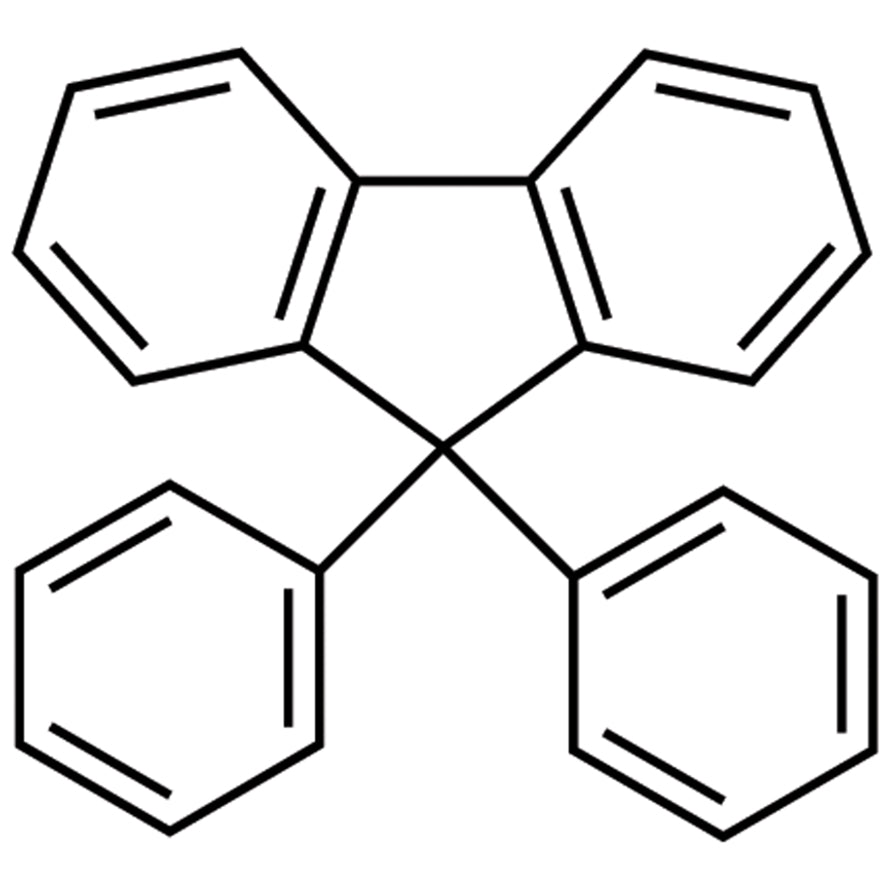
TCI D3586 9,9-Diphenylfluorene, CAS 20302-14-1, is an aromatic hydrocarbon compound built on a fluorene skeleton with two phenyl groups bonded to the carbon atom at the 9-position. The compound is an important building block in materials science, particularly for the development of organic semiconductors such as OLED materials, organic field-effect transistors, and organic solar cells. The fluorene framework provides a rigid conjugated system with strong emission in the blue region, while the diphenyl substitution at the 9-position locks the molecular conformation, prevents interchain aggregation, and suppresses the formation of ketone defects that commonly degrade the colour purity of blue emission.
The characteristics that make this material a widely preferred choice are its high thermal and morphological stability. The sp3 configuration at carbon 9, which binds two phenyl groups, produces a three-dimensional propeller-like geometry, so that the thin films formed tend to be amorphous and resistant to crystallisation during device operation. This property directly influences device service life. In addition, positions 2 and 7 on the fluorene skeleton remain open for halogenation, boronation, and cross-coupling reactions, making this compound a versatile synthetic starting point for constructing larger conjugated architectures.
In Indonesian laboratories, this compound is typically used in university and institutional research groups working on organic electronics, photophysics, and synthetic materials chemistry. It serves as a starting material in multi-step syntheses of functionalised fluorene derivatives, as a model compound in studies of blue emission and conformational effects, and as a reference structure in coursework and thesis-level research on conjugated small molecules and organic semiconductor design.
TCI brochures (PDF)
- Building Blocks for Organic Semiconductor 2026-03-24 · p. 14
Related TCI products
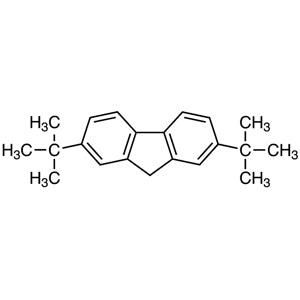
- TCI D4084 58775-05-6 2,7-Di-tert-butylfluorene
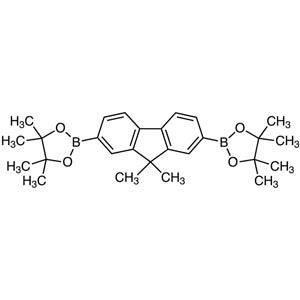
- TCI B5157 325129-69-9 2,7-Bis(4,4,5,5-tetramethyl-1,3,2-dioxaborolan-2-yl)-9,9-dimethylfluorene
- TCI D4327 123863-97-8 9,9-Dihexylfluorene
- TCI D3235 4569-45-3 9,9-Dimethylfluorene
- TCI T3249 4430-15-3 Truxenone
- TCI B4668 1196107-73-9 2-Bromo-13,13-dimethyl-6H-indeno[1,2-b]anthracene-6,11(13H)-dione
- OLED material development: the rigid fluorene core emits strongly in the blue region while the 9,9-diphenyl substitution suppresses ketone defect formation that degrades blue colour purity.
- Organic field-effect transistor research: the conjugated fluorene framework supports charge transport, and the amorphous, crystallisation-resistant film morphology helps maintain consistent device behaviour during operation.
- Organic solar cell studies: the compound functions as a conjugated building block for donor and acceptor architectures where thermal and morphological stability of the active layer matters.
- Cross-coupling and functionalisation chemistry: the open 2- and 7-positions on the fluorene skeleton accept halogenation, boronation, and cross-coupling reactions for building larger conjugated systems.
- Photophysical and conformational model studies: the propeller-like three-dimensional geometry at the sp3 carbon makes this an instructive reference compound for investigating aggregation suppression and conformational locking.
| Brand | TCI (Tokyo Chemical Industry) |
|---|---|
| CAS number | 20302-14-1 |
| Molecular formula | — |
| Purity | — |
| Category | Materials Science > Material Building Blocks > Small Molecule Semiconductor Building Blocks |
| Pack sizes | available in standard TCI research-scale packaging; please confirm the size required when ordering |
| Physical form | — |
| Storage | keep in a cool, dry place in the original tightly closed container |
- Product code: D3586
- Chemical name: 9,9-Diphenylfluorene
Store the container in a cool, dry, well-ventilated area away from direct sunlight, heat sources, and strong oxidising agents. Keep the material in its original tightly closed container, or in a clean amber glass or chemically compatible bottle if transferred, to limit exposure to moisture and light. Handle in a fume hood and use standard personal protective equipment, including safety glasses, nitrile gloves, and a laboratory coat. Avoid generating and inhaling dust when weighing the solid, and clean spills promptly using dry collection methods. Wash hands thoroughly after handling, keep the container clearly labelled, and always consult the manufacturer's safety data sheet before use and before disposal of residues.
—
Produk Terkait
-
2,7-Di-tert-butylfluorene TCI D4084
Regular price From Rp 1.246.350,00Regular price -
2,7-Bis(4,4,5,5-tetramethyl-1,3,2-dioxaborolan-2-yl)-9,9-dimethylfluorene TCI B5157
Regular price From Rp 2.809.800,00Regular price -
9,9-Dihexylfluorene TCI D4327
Regular price From Rp 1.724.100,00Regular price -
9,9-Dimethylfluorene TCI D3235
Regular price From Rp 769.650,00Regular price -
Truxenone TCI T3249
Regular price Rp 7.049.700,00Regular price -
2-Bromo-13,13-dimethyl-6H-indeno[1,2-b]anthracene-6,11(13H)-dione TCI B4668
Regular price Rp 1.856.400,00Regular price -
11H-Benzo[a]fluoren-11-one TCI B3933
Regular price Rp 8.506.050,00Regular price -
11H-Benzo[b]fluoren-11-one TCI B3932
Regular price Rp 5.300.400,00Regular price


![1196107-73-9 2-Bromo-13,13-dimethyl-6H-indeno[1,2-b]anthracene-6,11(13H)-dione - AMI Scientific](http://amiscientific.com/cdn/shop/files/TCI2510B4668.jpg?v=1768815654&width=533)
![479-79-8 11H-Benzo[a]fluoren-11-one - AMI Scientific](http://amiscientific.com/cdn/shop/files/TCI2510B3933.jpg?v=1768359776&width=533)
![3074-03-1 11H-Benzo[b]fluoren-11-one - AMI Scientific](http://amiscientific.com/cdn/shop/files/TCI2510B3932.jpg?v=1769179937&width=533)