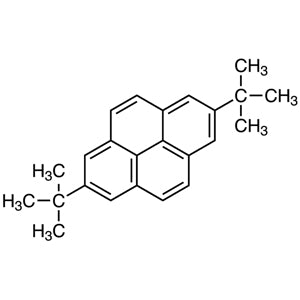
TCI D4185 is 2,7-Di-tert-butylpyrene, a pyrene derivative carrying two tert-butyl groups at the 2 and 7 positions of the four-ring aromatic framework. As a non-heterocyclic building block, this compound serves as an important starting material in pyrene chemistry, a field that exploits the strong luminescence and π-stacking tendency of the pyrene skeleton. In the laboratory, the material is used to construct fluorophores, light-emitting materials, and molecular sensors, as well as constituent units for conjugated organic materials and porous materials.
The particular value of this compound lies in the role of the tert-butyl groups as reaction directors. Unsubstituted pyrene tends to react at positions 1, 3, 6, and 8, making other positions difficult to access selectively. With bulky tert-butyl groups installed at positions 2 and 7, the reactivity pattern changes and electrophilic substitution reactions can be directed toward the K-region edge positions, namely 4, 5, 9, and 10. This opens synthetic routes to substituted pyrenes that were previously difficult to prepare. In addition, the bulky tert-butyl groups improve solubility in organic solvents and hinder excessive molecular stacking, so fluorescence quenching from aggregation is reduced.
In Indonesian laboratories, this building block is typically handled in university research groups and institutional laboratories working on organic synthesis, photophysics, and organic electronic materials. It is used at small preparative scale for multi-step synthesis, where the material is weighed out, dissolved in organic solvent, and carried through functionalization steps before purification and spectroscopic characterization. Work is normally carried out in a fume hood with standard organic synthesis glassware, and the remaining material is returned to controlled storage between experiments.
- Fluorophore synthesis — the pyrene core provides strong intrinsic luminescence, and the tert-butyl substituents keep the resulting dyes soluble and less prone to aggregation-induced quenching.
- Light-emitting material development — the compound acts as an emissive building unit whose defined substitution pattern allows researchers to extend conjugation in a controlled, reproducible manner.
- Molecular sensor construction — pyrene's fluorescence response and π-stacking behaviour make this derivative a practical scaffold for probes that report binding events through emission changes.
- Regioselective functionalization studies — the 2,7-di-tert-butyl arrangement redirects electrophilic substitution to the K-region positions 4, 5, 9, and 10, enabling access to otherwise difficult substitution patterns.
- Conjugated and porous organic material preparation — the rigid, planar four-ring framework serves as a node or linker unit when building extended conjugated networks and porous organic frameworks.
| Brand | TCI |
|---|---|
| CAS number | 24300-91-2 |
| Molecular formula | — |
| Purity | — |
| Category | Chemistry > Building Blocks > Non-Heterocyclic Building Blocks |
| Pack sizes | available in standard TCI research-scale packaging; please confirm the required pack size when ordering |
| Physical form | — |
| Storage | keep in the original tightly closed container, protected from light, in a cool and well-ventilated area |
- Chemical name: 2,7-Di-tert-butylpyrene
Store the material in its original tightly closed container in a cool, dry, well-ventilated place, away from direct sunlight, heat sources, and ignition sources. Amber glass or the manufacturer's supplied container is preferred, since polycyclic aromatic fluorophores are best protected from prolonged light exposure. Handle the solid in a fume hood to avoid generating or inhaling dust, and wear a laboratory coat, safety goggles, and chemically resistant gloves. Use clean, dry spatulas and weighing vessels to prevent contamination, close the container promptly after weighing, and keep it separated from strong oxidizing agents. Always consult the manufacturer's safety data sheet before use, and dispose of residues and contaminated consumables through the laboratory's chemical waste procedure.
—
Produk Terkait
-
1-Methylpyrene TCI M0620
Regular price Rp 1.298.850,00Regular price -
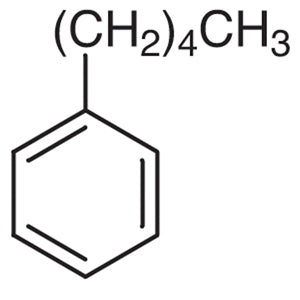
Amylbenzene TCI A0449
Regular price From Rp 1.353.450,00Regular price -
Anthracene TCI A0495
Regular price From Rp 584.850,00Regular price -
Acenaphthylene TCI A0005
Regular price From Rp 769.650,00Regular price -
Acenaphthene TCI A0003
Regular price From Rp 769.650,00Regular price -
9-Vinylanthracene TCI V0130
Regular price From Rp 2.545.200,00Regular price -
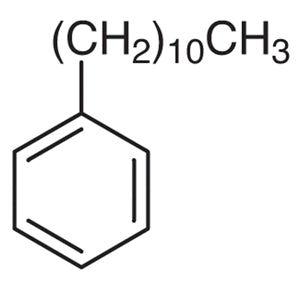
Undecylbenzene TCI U0010
Regular price From Rp 1.140.300,00Regular price -
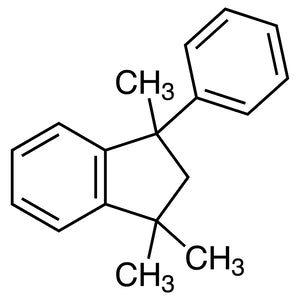
1,1,3-Trimethyl-3-phenylindane TCI T4097
Regular price From Rp 955.500,00Regular price