Pembayaran hanya melalui request quotation dan dilakukan setelah tim kami menghubungi Anda. Mohon cantumkan nomor WhatsApp aktif untuk konfirmasi pesanan & pembuatan invoice. Estimasi pengiriman 4-5 minggu setelah pembayaran.
Description
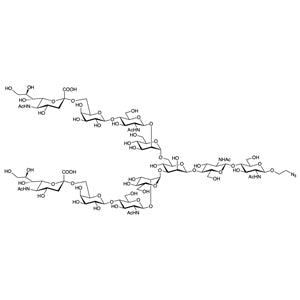
TCI D4217 Disialylnonasaccharide-beta-ethylazide is a complex branched oligosaccharide built from nine sugar units, carrying two sialic acid residues at the ends of its chains and an azide group on an ethyl linker at the beta position. The structure mimics the sialylated biantennary N-type glycans commonly found on human glycoproteins. In the laboratory, this compound serves as a ready-to-conjugate glycan: researchers can attach it to proteins, peptides, chip surfaces, nanoparticles, or fluorescent probes through click chemistry, obtaining glycoconjugate models that are very precisely defined.
The reason this material is chosen comes down to two things at once. First, the sialylated nonasaccharide framework is an important biological recognition motif — for example, in interactions with influenza virus receptors, with lectins of the siglec family, and with the machinery that regulates glycoprotein circulatory half-life. Second, the azide group provides a bio-orthogonal reaction handle, meaning the azide reacts only with alkyne or cyclooctyne partners and does not interfere with the natural functional groups present on proteins or on cells. Together these features give conjugation that is clean and site-directed.
In Indonesian laboratories, this type of reagent is typically used in glycobiology, biochemistry, and chemical biology work where a well-defined glycan structure is required rather than a heterogeneous mixture. It supports research groups building glycoconjugate models, preparing glycan-functionalized surfaces and particles, and studying carbohydrate-protein recognition, as well as method development work in which click chemistry is used to attach a defined sugar structure to a chosen carrier molecule or detection probe.
Laboratory Applications
- Glycoprotein and glycopeptide model construction — the defined nonasaccharide can be clicked onto proteins or peptides to produce homogeneous glycoconjugates instead of heterogeneous natural glycoforms.
- Influenza virus receptor interaction studies — the terminal sialic acid residues represent the recognition motif engaged by influenza receptors, making the glycan suitable for binding investigations.
- Siglec family lectin binding research — the sialylated biantennary structure serves as a defined ligand for probing recognition by siglec-type carbohydrate-binding proteins in controlled experiments.
- Glycan array and chip surface functionalization — the azide handle allows the sugar to be immobilized on alkyne- or cyclooctyne-modified chip surfaces for screening carbohydrate-protein interactions.
- Nanoparticle and fluorescent probe labeling — click conjugation attaches the glycan to particles or fluorophores without disturbing native functional groups, yielding traceable glycan-presenting constructs.
Specifications
- Brand: TCI
- CAS number: 1621001-68-0
- Category: Chemistry > Chemical Biology > Conjugation Chemistry / Click Chemistry
- Product code: D4217
- Pack sizes: available in the pack sizes listed on this product page
- Storage: refer to the storage conditions stated on the manufacturer's label and product documentation
Handling and Storage
Store this reagent according to the conditions given on the manufacturer's label and safety data sheet, keeping the container tightly closed and protected from moisture, since complex oligosaccharides are generally hygroscopic. Keep the material in its original supplied container or in a clean, chemically compatible vial that is clearly labelled, and allow refrigerated or frozen stock to warm to room temperature before opening to avoid condensation. Handle in a well-ventilated area or fume hood using gloves, safety glasses, and a laboratory coat. As with all organic azides, avoid heat, shock, and contact with strong acids or heavy metal salts. Weigh and transfer the compound with clean, dry spatulas to prevent cross-contamination, prepare stock solutions only as needed, and dispose of residues and contaminated consumables through the laboratory's chemical waste route.