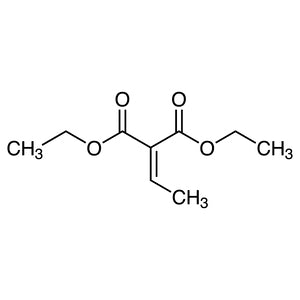
TCI D4827 is Diethyl Ethylidenemalonate, an unsaturated malonate ester that carries a conjugated carbon–carbon double bond flanked by two ethyl ester groups. As a non-heterocyclic building block, this compound belongs to the family of Michael acceptors — materials specifically designed to receive nucleophilic attack at the beta position relative to the carbonyl groups. In the organic synthesis laboratory, reagents of this type are highly useful for extending carbon chains, introducing two ester groups in a single operation, and constructing molecular frameworks that can subsequently be cyclized into a variety of ring structures.
The main property that makes this compound a preferred choice is the dual activation of its double bond. The two flanking ester groups render the beta carbon strongly electron-poor, so conjugate addition proceeds readily with a broad range of nucleophiles, from amines and thiols through to stabilized carbanions. Once addition has taken place, the resulting malonate moiety can be hydrolyzed and decarboxylated, or used directly for cyclic condensation. The methyl group at the ethylidene position adds one potential stereogenic center to the addition product, an aspect of particular interest in asymmetric synthesis research.
In Indonesian laboratories, a building block of this kind is typically used in university and institutional organic synthesis work, in medicinal chemistry and heterocycle research, and in method development where a reliable Michael acceptor is required as a starting point. It is normally handled at bench scale in research quantities, drawn on as needed for multi-step synthetic routes, and specified as a TCI catalogue item so that the same defined material can be reordered consistently across a research programme.
Related TCI products
- Michael conjugate addition reactions — the doubly activated double bond makes the beta carbon strongly electrophilic, allowing clean addition of amines, thiols, and stabilized carbanions.
- Carbon chain extension — the reagent lengthens an existing carbon skeleton while simultaneously delivering two ethyl ester groups in a single synthetic operation.
- Precursor for cyclization chemistry — addition products retain a malonate moiety that can undergo cyclic condensation to build a variety of ring frameworks.
- Malonate hydrolysis and decarboxylation sequences — after conjugate addition, the diester can be hydrolyzed and decarboxylated to reach the corresponding mono-acid products.
- Asymmetric synthesis studies — the methyl group at the ethylidene position introduces a potential stereogenic center, making it useful for investigating stereoselective addition.
| Brand | TCI |
|---|---|
| CAS number | 1462-12-0 |
| Molecular formula | — |
| Purity | — |
| Category | Chemistry > Building Blocks > Non-Heterocyclic Building Blocks |
| Pack sizes | available in standard TCI research and laboratory pack sizes; please confirm the size required when ordering. |
| Physical form | — |
| Storage | keep in the closed original container under the conditions stated on the manufacturer's label and safety data sheet. |
- Product code: D4827
Store the material in its tightly closed original container in a cool, dry, well-ventilated place, away from heat, direct sunlight, ignition sources, and strong oxidizing agents, and follow the specific conditions given on the manufacturer's label and safety data sheet. Chemically compatible glass or the supplied packaging is suitable for storage; avoid unlabeled or damaged containers. As with any reactive ester and Michael acceptor, handle the compound in a fume hood using safety glasses, gloves, and a laboratory coat, avoid inhalation of vapors and contact with skin and eyes, keep containers closed when not in use to limit exposure to moisture and air, and dispose of residues and contaminated materials through the laboratory's chemical waste procedures. Review the safety data sheet before first use.
—
Produk Terkait
-
DiethylBenzylidenemalonate TCI B0420
Regular price From Rp 610.050,00Regular price -
DiethylIsopropylidenemalonate TCI D3942
Regular price Rp 2.016.000,00Regular price -
DiethylAllylmalonate TCI A0231
Regular price From Rp 2.068.500,00Regular price -
DiethylAcetylenedicarboxylate TCI A0089
Regular price From Rp 2.837.100,00Regular price -
Diethyl1,3-Acetonedicarboxylate TCI A0055
Regular price From Rp 1.140.300,00Regular price -
TerephthalaldehydeMono(diethylAcetal) TCI T1401
Regular price Rp 3.578.400,00Regular price -
Diethyl(5-Bromopentyl)malonate TCI B2083
Regular price From Rp 2.254.350,00Regular price -
Diethyltrans-3-Hexenedioate TCI B1592
Regular price Rp 5.062.050,00Regular price