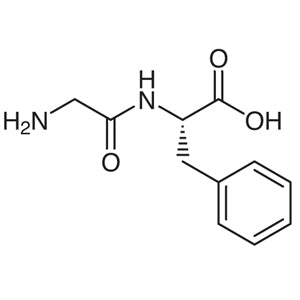
Glycyl-L-phenylalanine is a stereochemically pure dipeptide composed of glycine at the amino terminus and L-phenylalanine at the carboxyl terminus, supplied by TCI under catalogue number G0136 with CAS number 3321-03-7. Unlike its racemic counterpart, this product contains only the L configuration, the form that occurs naturally in the proteins of living organisms. That makes it the most representative substrate available for studying the action of protein-digesting enzymes, peptide transport systems in cell membranes, and molecular recognition processes within the body. The simplicity of its structure means experimental results can be traced all the way down to the mechanistic level.
The principal property that drives its selection is stereochemical purity. Because only a single enantiomer is present, researchers obtain enzyme kinetic data free of interference from the D form, which is either unrecognised by the enzyme or acts as an outright inhibitor, so the parameter values obtained are more accurate. The aromatic ring of phenylalanine provides ultraviolet absorbance for direct reaction monitoring while simultaneously serving as the hydrophobic recognition point for the active-site pockets of many proteases. The free amine group on glycine permits derivatisation with labelling reagents, and the solid form is straightforward to handle and weigh.
In Indonesian laboratories this dipeptide is typically used in university biochemistry departments, enzymology research groups, and institutional analytical facilities that characterise proteases and peptidases. It suits teaching laboratories demonstrating peptide bond hydrolysis, as well as research programmes investigating peptide uptake and molecular recognition. Because it is a defined, simple substrate that behaves predictably, it works equally well for routine method verification and for exploratory mechanistic studies where result interpretation must remain unambiguous.
- Protease and peptidase activity assays — the single defined peptide bond is cleaved cleanly, so hydrolysis rates directly reflect enzyme activity without competing side reactions confusing the measurement.
- Enzyme kinetics determination — stereochemical purity removes D-form interference entirely, allowing kinetic parameters to be calculated from data that reflect only the enzyme's genuine interaction with its natural substrate.
- Peptide transporter studies — as a small natural dipeptide it is recognised by membrane peptide transport systems, making it suitable for investigating uptake mechanisms across cell membranes in physiological research.
- Ultraviolet-monitored reaction studies — the phenylalanine aromatic ring absorbs ultraviolet light, permitting reaction progress to be followed directly and continuously without requiring additional chromogenic labelling steps.
- Derivatisation and labelling chemistry — the free amine group on the glycine terminus provides a reactive handle for coupling with marker reagents in analytical method development and detection work.
| Brand | TCI (Tokyo Chemical Industry), catalogue number G0136 |
|---|---|
| CAS number | 3321-03-7 |
| Molecular formula | — |
| Purity | — |
| Category | Life Science > Biochemicals and Reagents > Peptides |
| Pack sizes | available in standard TCI research quantities; please confirm the current pack options when ordering |
| Physical form | solid, suitable for direct weighing |
| Storage | — |
- Chemical class: dipeptide, glycine linked to L-phenylalanine, single L configuration
Store the container tightly closed in a cool, dry place away from direct sunlight, moisture, and sources of heat, following the storage conditions stated on the manufacturer's label and safety data sheet. Keep the material in its original TCI container or transfer it to a clean, dry, well-sealed glass or chemically compatible vial, clearly labelled with the substance name and catalogue number. Allow refrigerated or chilled containers to equilibrate to room temperature before opening to prevent moisture condensation on the solid. Handle in a well-ventilated area or fume hood while wearing a laboratory coat, safety goggles, and suitable gloves. Avoid generating dust, avoid contact with skin and eyes, and wash hands thoroughly after handling. Use clean spatulas to prevent cross-contamination, and dispose of waste in accordance with institutional and local regulations.
—
Produk Terkait
-
Glycyl-DL-phenylalanine TCI G0135
Regular price Rp 2.094.750,00Regular price -
Glycyl-DL-tryptophan TCI G0190
Regular price Rp 2.809.800,00Regular price -
Glycyl-L-tyrosineHydrate TCI G0145
Regular price From Rp 1.590.750,00Regular price -
Glycyl-L-tryptophan TCI G0144
Regular price From Rp 1.008.000,00Regular price -
Glycyl-L-proline TCI G0137
Regular price Rp 3.021.900,00Regular price -
DL-Alanyl-DL-phenylalanine TCI A0223
Regular price Rp 3.419.850,00Regular price -
L-alpha-Aspartyl-L-phenylalanine TCI A3489
Regular price From Rp 1.353.450,00Regular price -
L-Phenylalanyl-L-phenylalanine TCI P2580
Regular price From Rp 2.332.050,00Regular price