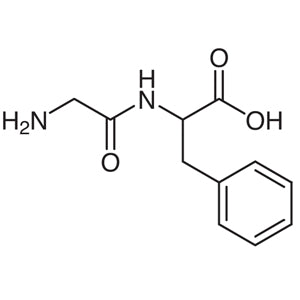
Glycyl-DL-phenylalanine is a dipeptide composed of glycine and phenylalanine, supplied in racemic form at the chiral centre of the phenylalanine residue, and offered by TCI under catalogue number G0135 with CAS number 721-66-4. In biochemistry laboratories, simple dipeptides of this kind serve as model substrates for studying enzymes that cleave peptide bonds, particularly peptidases and aminopeptidases. The molecule is short enough to be characterised exhaustively, yet it still carries the amide linkage and the aromatic side chain that are characteristic of naturally occurring proteins. It also has an established role as a reference material in the development of peptide analysis methods.
The property that makes this material a preferred choice is the presence of both phenylalanine enantiomers within a single substance, which is an advantage when a researcher wishes to test the stereoselectivity of an enzyme or a catalyst in one single experiment. A stereospecific enzyme will process only the L-form, so the residual D-form can be measured to assess the precision of enzymatic recognition. The aromatic ring of the phenylalanine residue provides ultraviolet absorbance that simplifies detection in liquid chromatography, while the glycine residue at the amino terminus supplies a free amine group that is readily available for derivatisation.
In Indonesian laboratories, this dipeptide is typically used in university biochemistry teaching and research settings, in enzymology groups examining protease and aminopeptidase behaviour, and in analytical laboratories that are establishing or validating chromatographic methods for peptides. Its defined and compact structure makes it a practical reference point when method conditions are being set up, and its dual-enantiomer composition allows a single purchase to support both routine substrate work and stereoselectivity investigations without the need for separate enantiopure materials.
- Peptidase and aminopeptidase activity assays: the single amide bond gives a clean, unambiguous cleavage point, so released products can be quantified without interference from competing hydrolysis sites within a longer chain.
- Enzyme stereoselectivity screening: because both D- and L-phenylalanine configurations are present together, a single incubation reveals whether a given enzyme or catalyst discriminates between the two forms during hydrolysis.
- Liquid chromatography method development for peptides: the aromatic phenylalanine ring absorbs ultraviolet light, allowing straightforward detection while separation conditions, gradients and column chemistries are being optimised.
- Reference standard in peptide analytical work: its short, well defined structure makes it a dependable comparison point when retention behaviour, response factors or system suitability need to be established.
- Derivatisation chemistry and amine labelling studies: the free amine group at the glycine terminus offers a readily accessible reactive site for coupling with labelling reagents prior to chromatographic or spectroscopic detection.
| Brand | TCI (catalogue number G0135) |
|---|---|
| CAS number | 721-66-4 |
| Molecular formula | — |
| Purity | — |
| Category | Life Science > Biochemicals and Reagents > Peptides |
| Pack sizes | available in the pack sizes listed by TCI for this catalogue number; please confirm the required size when ordering |
| Physical form | — |
| Storage | store as indicated on the manufacturer's label and accompanying documentation |
- Chemical class: dipeptide of glycine and phenylalanine, racemic at the phenylalanine chiral centre
Store the container tightly closed in a cool, dry place, away from direct sunlight, moisture and sources of heat, following the storage conditions stated on the manufacturer's label. Keep the material in its original container or in a clean, well sealed glass or chemically compatible vessel, clearly labelled with the product name and catalogue number. Handle the substance in a well ventilated area or fume hood, wearing a laboratory coat, safety glasses and suitable gloves, and avoid generating or inhaling dust during weighing. Use clean, dry spatulas to prevent contamination and moisture uptake, close the container promptly after use, and consult the manufacturer's safety data sheet before handling or disposal.
—
Produk Terkait
-
Glycyl-L-phenylalanine TCI G0136
Regular price From Rp 477.750,00Regular price -
Glycyl-DL-tryptophan TCI G0190
Regular price Rp 2.809.800,00Regular price -
Glycyl-L-tyrosineHydrate TCI G0145
Regular price From Rp 1.590.750,00Regular price -
Glycyl-L-tryptophan TCI G0144
Regular price From Rp 1.008.000,00Regular price -
Glycyl-L-proline TCI G0137
Regular price Rp 3.021.900,00Regular price -
DL-Alanyl-DL-phenylalanine TCI A0223
Regular price Rp 3.419.850,00Regular price -
L-alpha-Aspartyl-L-phenylalanine TCI A3489
Regular price From Rp 1.353.450,00Regular price -
L-Phenylalanyl-L-phenylalanine TCI P2580
Regular price From Rp 2.332.050,00Regular price