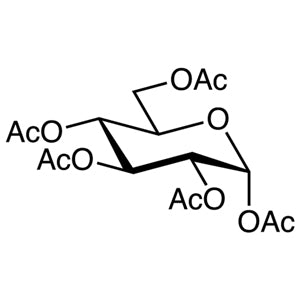
Penta-O-acetyl-alpha-D-glucopyranose is a form of glucose in which every hydroxyl group, including the anomeric hydroxyl, has been acetylated, producing a compound with a defined alpha configuration. It is one of the most fundamental starting materials in carbohydrate chemistry because it serves as the entry point to almost every protected glucose derivative. In the laboratory this material functions as a glycosyl donor precursor: once activated, it can deliver a glucose unit to an acceptor molecule to form a glycosidic bond. Its role is central to the synthesis of oligosaccharides, glycosides, and glycoconjugates that form the core of modern glycobiology research.
The characteristics that lead researchers to select this compound begin with its high stability as a fully protected solid, which makes it far easier to store and handle than free glucose, a substance that is hygroscopic and undergoes mutarotation. The acetyl protecting groups are straightforward to install and equally straightforward to remove again under mild basic conditions such as sodium methoxide, which makes them highly practical within stepwise synthetic strategies. The defined alpha configuration at the anomeric center provides a reliable stereochemical starting point, so that subsequent transformations begin from a single, well-characterized anomeric form rather than from an equilibrating mixture.
In Indonesian laboratories, this material is typically used in university and institutional research groups working on carbohydrate synthesis, natural product chemistry, and glycobiology. It commonly appears in graduate research projects, in synthetic organic chemistry laboratories preparing protected sugar intermediates, and in analytical work that requires a well-defined carbohydrate building block. Because it is supplied as a stable protected solid, it suits laboratories that store reagents over extended periods between experimental campaigns.
- Glycosyl donor preparation: after suitable activation at the anomeric position, this fully acetylated glucose delivers its glucose unit to acceptor molecules, making it the standard entry material for glycosylation chemistry.
- Oligosaccharide synthesis: the defined alpha configuration and complete hydroxyl protection allow chemists to build sugar chains in a controlled, stepwise manner without unwanted side reactions at free hydroxyl positions.
- Glycoside synthesis: the compound serves as the glucose source for attaching sugar units to aglycone partners, a transformation central to preparing glycosides for chemical and biological study.
- Glycoconjugate research: laboratories investigating carbohydrate-protein and carbohydrate-lipid conjugates rely on this material as the protected glucose building block from which conjugate structures are assembled.
- Protected carbohydrate intermediate preparation: because the acetyl groups can be removed under mild basic conditions such as sodium methoxide, it acts as a convenient starting point for a wide range of downstream glucose derivatives.
| Brand | TCI |
|---|---|
| CAS number | 604-68-2 |
| Molecular formula | — |
| Purity | — |
| Category | Chemistry > Chemical Biology > Glycoscience |
| Pack sizes | available in standard TCI research-scale packaging; please confirm the required size when ordering |
| Physical form | solid, fully protected (peracetylated) carbohydrate |
| Storage | store as a dry solid in a closed container, following the manufacturer's stated conditions on the product label |
- Product code: G0225
Store this material as a dry solid in a tightly closed container, protected from moisture, and keep it in a cool location in accordance with the conditions stated by the manufacturer on the product label. Original manufacturer containers, or clean glass vials with well-sealing caps, are suitable for storage and for dispensing smaller working quantities. Although the fully acetylated form is considerably more stable than free glucose, good laboratory practice still applies: handle the solid in a well-ventilated area or fume hood, avoid generating dust, wear gloves, safety glasses, and a laboratory coat, and avoid contact with skin and eyes. Allow refrigerated or cooled containers to warm to room temperature before opening so that atmospheric moisture does not condense onto the contents. Consult the manufacturer's safety data sheet before first use.
—
Produk Terkait
-
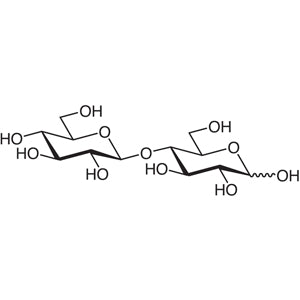
D-(+)-Cellobiose TCI C0056
Regular price From Rp 875.700,00Regular price -
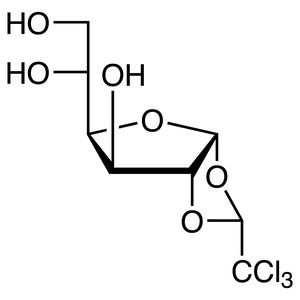
alpha-Chloralose(containsbeta-isomer) TCI C0074
Regular price Rp 848.400,00Regular price -
ChondroitinSulfateSodiumSalt TCI C0335
Regular price From Rp 2.068.500,00Regular price -
alpha-Cyclodextrin TCI C0776
Regular price From Rp 689.850,00Regular price -
beta-Cyclodextrin TCI C0777
Regular price From Rp 2.094.750,00Regular price -
alpha-D-CellobioseOctaacetate TCI C0861
Regular price Rp 2.518.950,00Regular price -
gamma-Cyclodextrin TCI C0869
Regular price From Rp 1.087.800,00Regular price -
beta-Cyclodextrin TCI C0900
Regular price From Rp 505.050,00Regular price