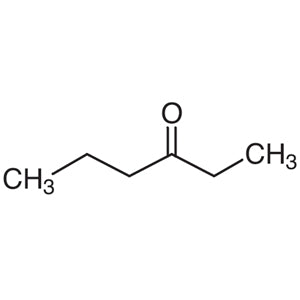
TCI H0115 3-Hexanone, also known as ethyl propyl ketone, is an aliphatic ketone supplied as a colourless liquid in which the carbonyl group sits at the third position of a six-carbon chain. This more central placement of the carbonyl clearly distinguishes it from the isomer 2-Hexanone and makes it an important reference material for researchers who want to understand how the position of a functional group influences reactivity, polarity, and the chromatographic behaviour of a molecule. In the laboratory the compound serves as a starting material for organic synthesis, as a small-scale solvent, and as a comparison compound in analytical work and aroma research.
The property that makes 3-Hexanone a frequent choice is the balance it strikes between volatility and chemical stability. As a ketone it does not oxidise further as readily as an aldehyde, yet it remains highly responsive to organometallic reagents, reducing hydrides, aldol condensation, and the formation of carbonyl derivatives. Its almost symmetrical structure around the carbonyl gives rise to a characteristic and easily recognised mass spectrometric fragmentation pattern, which makes it a useful reference compound for analysts. Reagent-grade quality from TCI helps ensure that results obtained with this material remain consistent from one experiment to the next.
In Indonesian laboratories, 3-Hexanone is typically found in university organic chemistry and instrumental analysis facilities, in research institute laboratories, and in industrial laboratories working on flavour, fragrance, and analytical method development. It is commonly used in teaching exercises on carbonyl chemistry, in the preparation of standards for gas chromatography and GC-MS, and in small-scale synthetic work where a well-characterised aliphatic ketone of known identity is required as a building block or a point of comparison.
- Organic synthesis building block: the reactive carbonyl centre readily undergoes addition with organometallic reagents and hydride reductions, allowing chemists to construct more complex non-heterocyclic structures from a simple, well-defined aliphatic ketone.
- Gas chromatography reference compound: its predictable volatility and distinctive retention behaviour make it a dependable marker when analysts calibrate columns, verify separations, or confirm the elution order of related ketone isomers.
- Mass spectrometry identification standard: the nearly symmetrical arrangement around the carbonyl produces a characteristic fragmentation pattern that analysts use to confirm instrument performance and to support the identification of unknown carbonyl compounds.
- Isomer comparison studies: placed alongside 2-Hexanone, this material lets researchers demonstrate directly how carbonyl position alters reactivity, polarity, and chromatographic behaviour within an otherwise identical six-carbon framework.
- Aroma and flavour research: as a volatile aliphatic ketone of known identity and reagent-grade quality, it functions as a comparison compound when investigators profile, match, or characterise carbonyl constituents in aroma work.
| Brand | TCI (Tokyo Chemical Industry) |
|---|---|
| CAS number | 589-38-8 |
| Molecular formula | — |
| Purity | — |
| Category | Chemistry > Building Blocks > Non-Heterocyclic Building Blocks |
| Pack sizes | available in standard TCI reagent pack sizes; please confirm the packaging option required when ordering |
| Physical form | colourless liquid (aliphatic ketone) |
| Storage | keep tightly closed in a cool, well-ventilated place away from ignition sources |
- Product code: H0115
Store 3-Hexanone in a cool, dry, and well-ventilated area, away from heat, open flames, and other sources of ignition. Keep the container tightly closed at all times to limit evaporation and the escape of vapour, and retain the material in its original tightly sealed reagent bottle or in another chemically compatible closed container reserved for volatile organic solvents. Handle the compound inside a fume hood to avoid inhaling vapour, and wear safety goggles, a laboratory coat, and chemically resistant gloves. Keep it separated from strong oxidising agents, ground and bond containers when transferring larger volumes, and consult the manufacturer's safety data sheet before use and for disposal guidance.
—
Produk Terkait
-
2-Methyl-3-hexanone TCI M0570
Regular price Rp 1.565.550,00Regular price -
3-Methyl-2-hexanone TCI M0234
Regular price Rp 8.851.500,00Regular price -
2-Hexanone TCI H0114
Regular price From Rp 955.500,00Regular price -
6-Chloro-2-hexanone TCI C1333
Regular price From Rp 2.969.400,00Regular price