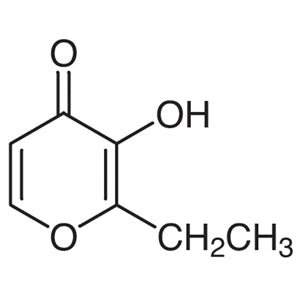
TCI H0550 2-Ethyl-3-hydroxy-4-pyrone is a six-membered heterocyclic compound containing an oxygen atom within the ring, bearing a ketone group at position 4, a hydroxyl group at position 3, and an ethyl substituent at position 2. Chemists widely recognise it as a pyranone derivative with a dual role: it serves as a heterocyclic building block in organic synthesis and, at the same time, as a chelating ligand capable of binding metal ions. In the laboratory, this material provides a practical starting point for constructing substituted pyranone frameworks and for preparing model metal complexes in coordination chemistry and food chemistry studies.
The property that makes it a frequent choice is the α-hydroxyketone motif on the pyranone ring, which presents a paired set of oxygen donor sites so that the compound forms stable bidentate chelates with a wide range of transition metal and main-group metal ions. The enolic hydroxyl group is sufficiently acidic to be deprotonated readily and then selectively alkylated or acylated, opening a route to many derivatives. The ethyl substituent adds lipophilicity compared with its methyl analogue, which influences solubility, uptake into organic matrices, and the general handling behaviour of the compound in preparative work.
In Indonesian laboratories, this pyranone derivative is typically found in university organic synthesis and coordination chemistry groups, in food and flavour chemistry research units, and in industrial R&D laboratories developing ligands and chelate systems. It is commonly used on a small preparative scale for building substituted heterocyclic scaffolds, for preparing reference metal complexes, and as a supporting reagent in method development work where a well-characterised bidentate oxygen donor is required.
Related TCI products
- TCI M0673 118-71-8 3-Hydroxy-2-methyl-4-pyrone
- TCI H1019 2029-49-4 3-Hydroxy-2,6-bis(hydroxymethyl)-4-pyrone
- TCI D0794 1004-36-0 2,6-Dimethyl-gamma-pyrone
- TCI A1470 732304-23-3 4-Amino-6-hydroxy-2-methylpyrimidine Hydrate
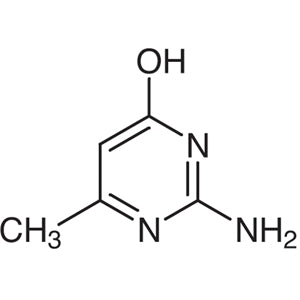
- TCI A1204 3977-29-5 2-Amino-4-hydroxy-6-methylpyrimidine
- TCI A0791 1004-40-6 4-Amino-6-hydroxy-2-mercaptopyrimidine
- Heterocyclic synthesis: serves as a ready-made pyranone core for building substituted heterocyclic scaffolds, sparing the laboratory the effort of constructing the oxygen-containing ring from simpler precursors.
- Coordination chemistry studies: the paired oxygen donor sites form stable bidentate chelates with transition and main-group metal ions, making it well suited to preparing model complexes for structural investigation.
- Ligand derivatisation work: the acidic enolic hydroxyl group is easily deprotonated and then selectively alkylated or acylated, allowing researchers to generate families of related ligands from one starting material.
- Food and flavour chemistry research: as a well-known pyranone derivative in this field, it supports laboratory studies of pyranone behaviour and reference preparation within food chemistry investigations.
- Method development and reference work: its defined structure and predictable chelating behaviour make it a dependable material when analytical or synthetic procedures must be established and validated.
| Brand | TCI (Tokyo Chemical Industry) |
|---|---|
| CAS number | 4940-11-8 |
| Molecular formula | — |
| Purity | — |
| Category | Chemistry > Building Blocks > Heterocyclic Building Blocks |
| Pack sizes | available in standard laboratory catalogue pack sizes; please confirm the pack size when ordering |
| Physical form | — |
| Storage | store in a tightly closed container in a cool, dry, well-ventilated place |
- Chemical name: 2-Ethyl-3-hydroxy-4-pyrone
Store the container tightly closed in a cool, dry and well-ventilated area, away from direct sunlight, heat sources and incompatible materials. The original supplier container is the most suitable option for storage; where transfer is necessary, use a clean, dry, well-sealed glass or chemically compatible plastic container with a clear label. Handle the material in a fume hood, wearing safety goggles, gloves and a laboratory coat, and avoid generating dust or allowing contact with skin and eyes. Because the enolic hydroxyl group can interact with metal ions, avoid contamination with metal residues in weighing and transfer equipment. Always consult the manufacturer's Safety Data Sheet before use and dispose of residues in accordance with applicable laboratory waste procedures.
—
Produk Terkait
-
3-Hydroxy-2-methyl-4-pyrone TCI M0673
Regular price From Rp 928.200,00Regular price -
3-Hydroxy-2,6-bis(hydroxymethyl)-4-pyrone TCI H1019
Regular price From Rp 1.298.850,00Regular price -
2,6-Dimethyl-gamma-pyrone TCI D0794
Regular price Rp 1.881.600,00Regular price -
4-Amino-6-hydroxy-2-methylpyrimidineHydrate TCI A1470
Regular price From Rp 743.400,00Regular price -
2-Amino-4-hydroxy-6-methylpyrimidine TCI A1204
Regular price From Rp 928.200,00Regular price -
4-Amino-6-hydroxy-2-mercaptopyrimidine TCI A0791
Regular price Rp 1.140.300,00Regular price -
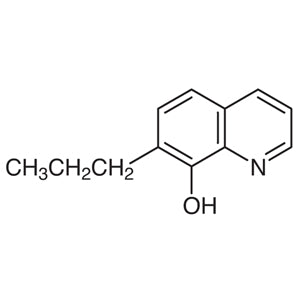
8-Hydroxy-7-propylquinoline TCI P0531
Regular price From Rp 4.877.250,00Regular price -
Methyl3-Hydroxy-2-thiophenecarboxylate TCI M2716
Regular price From Rp 1.035.300,00Regular price