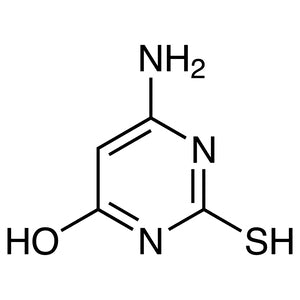
4-Amino-6-hydroxy-2-mercaptopyrimidine is a versatile organic compound widely used in laboratory settings for its role in synthetic chemistry. This compound is a key building block in the creation of heterocyclic structures, which are fundamental in pharmaceutical and industrial chemistry. Its unique molecular structure, incorporating nitrogen, oxygen, and sulfur atoms, allows it to participate in a variety of chemical reactions, making it an essential reagent for chemists working on complex molecule synthesis. Due to its reactivity and structural complexity, it is frequently employed in the development of bioactive compounds and functional materials.
The compound’s chemical stability under controlled conditions, along with its ability to undergo substitution and ring-opening reactions, makes it a preferred choice for synthetic applications. Its solubility in organic solvents further enhances its utility, enabling efficient purification and reaction processes. These properties ensure that it remains a reliable and effective reagent in both academic and industrial research environments. The compound’s versatility is particularly valuable in applications requiring high reactivity and precise chemical control.
In Indonesian laboratories, 4-Amino-6-hydroxy-2-mercaptopyrimidine is commonly used in research related to organic chemistry, pharmacology, and biochemistry. It is a key component in the development of new compounds and is frequently utilized by research institutions and universities. Its availability and chemical properties make it a standard reagent in many laboratory workflows, supporting ongoing scientific innovation and discovery.
Related TCI products
- TCI M0937 1450-85-7 2-Mercaptopyrimidine
- TCI D2063 1004-39-3 4,6-Diamino-2-mercaptopyrimidine
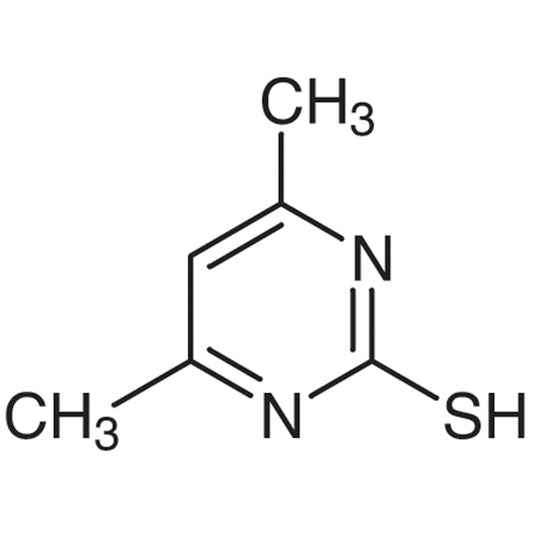
- TCI D1580 22325-27-5 4,6-Dimethyl-2-mercaptopyrimidine
- TCI A1470 732304-23-3 4-Amino-6-hydroxy-2-methylpyrimidine Hydrate
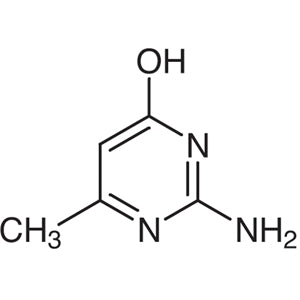
- TCI A1204 3977-29-5 2-Amino-4-hydroxy-6-methylpyrimidine
- TCI M2950 38521-06-1 2-Mercaptopyrazine
- Organic synthesis applications benefit from this compound’s ability to participate in ring-opening and substitution reactions, enabling the creation of complex heterocyclic structures.
- Pharmaceutical research relies on this reagent for the synthesis of bioactive compounds, as its molecular structure can be modified to produce drug-like molecules.
- Industrial chemical development utilizes this compound for the production of functional materials due to its reactivity and structural versatility.
- Biochemical studies incorporate this compound to investigate its role in molecular interactions and biological activity.
- Academic research in chemistry and pharmacology frequently uses this compound as a fundamental building block for new compound development.
| Brand | TCI |
|---|---|
| CAS number | 1004-40-6 |
| Molecular formula | — |
| Purity | — |
| Category | Chemistry > Building Blocks > Heterocyclic Building Blocks |
| Pack sizes | Available in various quantities as per supplier specifications |
| Physical form | Solid (as per standard product description) |
| Storage | Store in a cool, dry place away from moisture and direct sunlight |
This compound should be stored in a cool, dry environment to maintain its chemical stability. It is recommended to keep it in a tightly sealed container to prevent exposure to moisture and air. Due to its reactivity, it should be handled with care in a well-ventilated laboratory setting. Avoid contact with incompatible substances such as strong oxidizing agents. Proper personal protective equipment, including gloves and safety goggles, should be worn during handling. The compound is not classified as hazardous under standard laboratory conditions, but standard safety protocols should be followed to ensure safe usage and storage.
—
Produk Terkait
-
2-Mercaptopyrimidine TCI M0937
Regular price Rp 2.013.900,00Regular priceRp 1.423.800,00Sale price Rp 2.013.900,00 -
4,6-Diamino-2-mercaptopyrimidine TCI D2063
Regular price Rp 2.650.200,00Regular priceRp 1.869.000,00Sale price Rp 2.650.200,00 -
4,6-Dimethyl-2-mercaptopyrimidine TCI D1580
Regular price Rp 1.881.600,00Regular priceRp 1.331.400,00Sale price Rp 1.881.600,00 -
4-Amino-6-hydroxy-2-methylpyrimidineHydrate TCI A1470
Regular price Rp 795.900,00Regular priceRp 572.250,00Sale price Rp 795.900,00 -
2-Amino-4-hydroxy-6-methylpyrimidine TCI A1204
Regular price Rp 980.700,00Regular priceRp 701.400,00Sale price Rp 980.700,00 -
2-Mercaptopyrazine TCI M2950
Regular price Rp 5.988.150,00Regular priceRp 4.203.150,00Sale price Rp 5.988.150,00 -
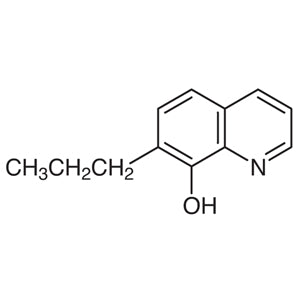
8-Hydroxy-7-propylquinoline TCI P0531
Regular price Rp 4.929.750,00Regular priceRp 3.462.900,00Sale price Rp 4.929.750,00 -
Methyl3-Hydroxy-2-thiophenecarboxylate TCI M2716
Regular price Rp 1.087.800,00Regular priceRp 775.950,00Sale price Rp 1.087.800,00