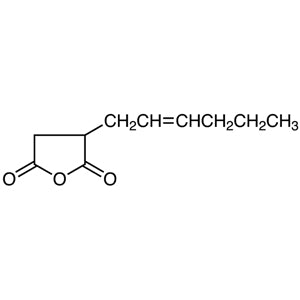
TCI H0616 2-Hexen-1-ylsuccinic Anhydride is a succinic anhydride bearing an unsaturated hexenyl chain, supplied as a mixture of cis and trans isomers. The compound belongs to the alkenyl succinic anhydride family, widely recognised as both a coupling reagent and a surface-modifying agent. Its strained anhydride ring is highly reactive toward nucleophiles such as water, alcohols, and amines, opening a route to ester or amide bond formation accompanied by the appearance of a free carboxylic acid group. In the laboratory, this behaviour is exploited to attach hydrophobic chains onto a wide range of substrates.
The characteristics that make this reagent a preferred choice are the combination of high reactivity and a reaction outcome that is inherently two-sided. Once the ring has opened, the molecule contributes an unsaturated, hydrophobic hydrocarbon tail together with a polar, ionisable carboxylic acid group, so the resulting product carries an amphiphilic character that is useful for tuning surface properties. The double bond on the hexenyl chain also provides an additional reactive site for addition, epoxidation, or thiol-ene chemistry. Its liquid form makes volumetric transfer straightforward, although it demands care against vapour exposure during handling.
In Indonesian laboratories, this building block is typically encountered in synthetic and materials chemistry groups working on surface modification, polymer and coating research, and preparative organic synthesis. Because the material is a liquid, it is usually dispensed by syringe or pipette inside a fume hood and returned promptly to controlled storage. Research institutes, university chemistry departments, and industrial R&D units generally order it in small quantities suited to bench-scale reactions rather than bulk process work.
- Surface modification of solid substrates, where ring opening by surface hydroxyl or amine groups anchors the hexenyl chain and leaves a free carboxylic acid at the interface.
- Preparation of amphiphilic derivatives, since a single reaction step installs both a hydrophobic hydrocarbon tail and a polar ionisable carboxylate on the target molecule.
- Ester and amide bond formation in preparative organic synthesis, exploiting the strained anhydride ring that reacts readily with alcohols and amines under mild conditions.
- Thiol-ene and addition chemistry on the pendant double bond, which provides a second, independent reactive handle for further functionalisation after the anhydride has reacted.
- Epoxidation studies on the unsaturated hexenyl chain, giving access to oxygenated derivatives while the succinic anhydride or acid portion remains available for coupling.
| Brand | TCI (Tokyo Chemical Industry) |
|---|---|
| CAS number | 10500-34-2 |
| Molecular formula | — |
| Purity | — |
| Category | Chemistry > Building Blocks > Non-Heterocyclic Building Blocks |
| Pack sizes | available in standard TCI research-scale packaging; please confirm the size required when ordering |
| Physical form | liquid, allowing convenient volumetric transfer |
| Storage | keep in a closed container under the conditions stated on the manufacturer's label |
- Isomer composition: supplied as a mixture of cis and trans isomers
Store the container tightly closed in a cool, dry, and well-ventilated area, away from moisture, since the anhydride ring reacts readily with water. Glass bottles with chemically resistant closures are appropriate, and the original manufacturer's container should be retained wherever possible. Because the material is a liquid that reacts with nucleophiles, all transfers should be carried out in a fume hood using dry syringes or pipettes, with the container resealed immediately afterwards to limit vapour release and moisture ingress. Laboratory personnel should wear safety goggles, chemically resistant gloves, and a laboratory coat, avoiding contact with skin, eyes, and inhalation of vapour. Keep the reagent away from incompatible materials such as strong bases, alcohols, and amines unless these are intended reaction partners, and always consult the manufacturer's safety data sheet before use.
—
Produk Terkait
-
2-Buten-1-ylsuccinicAnhydride TCI B1613
Regular price From Rp 2.439.150,00Regular price -
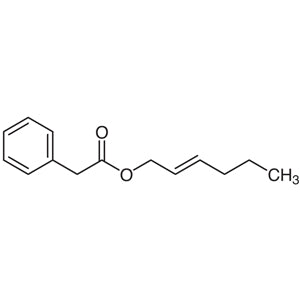
trans-2-Hexen-1-ylPhenylacetate TCI P1045
Regular price Rp 1.298.850,00Regular price -
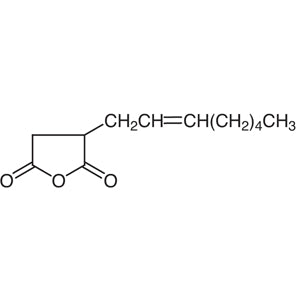
2-OctenylsuccinicAnhydride(cis-andtrans-mixture) TCI O0040
Regular price From Rp 1.087.800,00Regular price -
4-Methylcyclohexane-1,2-dicarboxylicAnhydride(cis-andtrans-mixture) TCI M0567
Regular price From Rp 530.250,00Regular price -
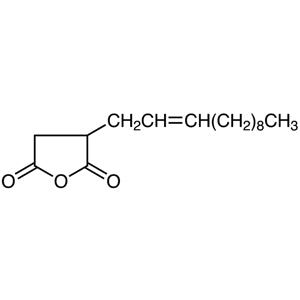
2-Dodecen-1-ylsuccinicAnhydride(cis-andtrans-mixture) TCI D0976
Regular price From Rp 610.050,00Regular price -
TetrapropenylsuccinicAnhydride(mixtureofbranchedchainisomers) TCI T0170
Regular price From Rp 505.050,00Regular price -
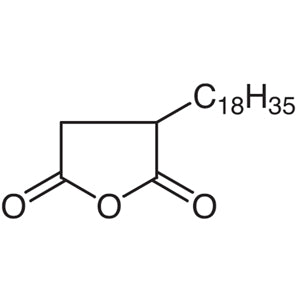
OctadecenylsuccinicAnhydride(mixtureofisomers) TCI O0013
Regular price From Rp 1.087.800,00Regular price -
NonenylsuccinicAnhydride(mixtureofbranchedchainisomers) TCI N0350
Regular price From Rp 823.200,00Regular price