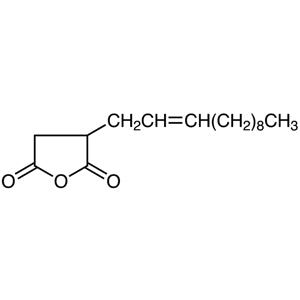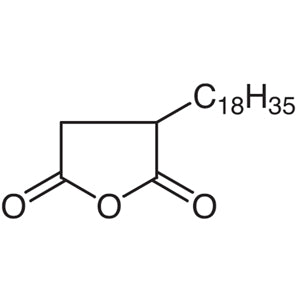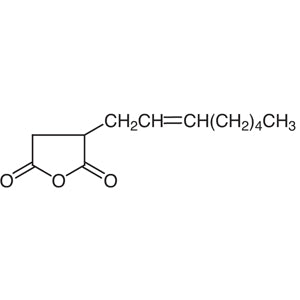
2-Octenylsuccinic Anhydride (cis- and trans- mixture), also known as TCI O0040, is a chemical compound widely used in laboratory settings for the synthesis of complex organic molecules. It belongs to the category of non-heterocyclic building blocks and is particularly valuable in organic chemistry due to its ability to undergo esterification reactions with various alcohols. This property makes it a versatile reagent for the production of ester derivatives, which are essential in many chemical processes. Its role as a building block is critical in the development of new compounds, especially in pharmaceutical and organic chemistry research.
The compound's anhydride structure provides it with reactivity that is well-suited for a range of synthetic applications. Its stability under certain conditions allows for controlled use in laboratory experiments, while its reactivity ensures that it can participate in multiple chemical transformations. As a mixture of cis- and trans-isomers, it offers structural diversity, which is advantageous in creating a wide range of molecular structures. This characteristic makes it a preferred choice for researchers aiming to explore different synthetic pathways and molecular variations.
In Indonesian laboratories, this compound is commonly used in organic chemistry research, particularly in the development of new chemical compounds. It is frequently employed in experiments involving the synthesis of esters and their derivatives. Its availability and chemical properties make it a standard reagent in academic and industrial research settings, supporting both teaching and innovation in the field of chemistry.
Related TCI products
- TCI M0567 19438-60-9 4-Methylcyclohexane-1,2-dicarboxylic Anhydride (cis- and trans- mixture)
- TCI H0616 10500-34-2 2-Hexen-1-ylsuccinic Anhydride (cis- and trans- mixture)
- TCI D0976 19780-11-1 2-Dodecen-1-ylsuccinic Anhydride (cis- and trans- mixture)
- TCI T0170 26544-38-7 Tetrapropenylsuccinic Anhydride (mixture of branched chain isomers)
- TCI O0013 28777-98-2 Octadecenylsuccinic Anhydride (mixture of isomers)
- TCI N0350 28928-97-4 Nonenylsuccinic Anhydride (mixture of branched chain isomers)
- Ester Synthesis: This compound is ideal for esterification reactions due to its anhydride structure, which readily reacts with alcohols to form esters, essential in pharmaceutical and organic chemistry.
- Organic Compound Development: Its structural versatility allows for the creation of diverse molecular structures, making it a key reagent in the synthesis of new organic compounds.
- Pharmaceutical Research: The ability to form ester derivatives makes it useful in the development of drug molecules and other bioactive compounds.
- Academic Teaching: It is commonly used in educational settings to demonstrate esterification reactions and the role of anhydrides in organic synthesis.
- Industrial Chemical Production: Its reactivity and availability make it suitable for large-scale chemical processes requiring ester-based intermediates.
| Brand | TCI |
|---|---|
| CAS number | 42482-06-4 |
| Molecular formula | — |
| Purity | — |
| Category | Chemistry > Building Blocks > Non-Heterocyclic Building Blocks |
| Pack sizes | Available in various quantities as per supplier specifications |
| Physical form | Solid |
| Storage | Store in a cool, dry place away from moisture and direct sunlight |
This compound should be stored in a cool, dry environment to maintain its chemical stability. It is recommended to keep it in a tightly sealed container to prevent exposure to moisture and air. Due to its reactive nature, it should be handled with appropriate personal protective equipment, such as gloves and safety goggles. Storage should be in a well-ventilated area to minimize the risk of inhalation of vapors. It is important to avoid contact with incompatible materials, such as strong bases or acids, to ensure safe handling in the laboratory. Proper labeling and storage conditions are essential to maintain the integrity of the compound and ensure safe use in laboratory settings.
—
Produk Terkait
-
4-Methylcyclohexane-1,2-dicarboxylicAnhydride(cis-andtrans-mixture) TCI M0567
Regular price From Rp 530.250,00Regular price -
2-Hexen-1-ylsuccinicAnhydride(cis-andtrans-mixture) TCI H0616
Regular price Rp 4.213.650,00Regular price -
2-Dodecen-1-ylsuccinicAnhydride(cis-andtrans-mixture) TCI D0976
Regular price From Rp 610.050,00Regular price -
TetrapropenylsuccinicAnhydride(mixtureofbranchedchainisomers) TCI T0170
Regular price From Rp 505.050,00Regular price -
OctadecenylsuccinicAnhydride(mixtureofisomers) TCI O0013
Regular price From Rp 1.087.800,00Regular price -
NonenylsuccinicAnhydride(mixtureofbranchedchainisomers) TCI N0350
Regular price From Rp 823.200,00Regular price -
Methyl-5-norbornene-2,3-dicarboxylicAnhydride(mixtureofisomers) TCI M0690
Regular price From Rp 505.050,00Regular price -
Methylcyclohexene-1,2-dicarboxylicAnhydride(mixtureofisomers) TCI M0683
Regular price From Rp 875.700,00Regular price