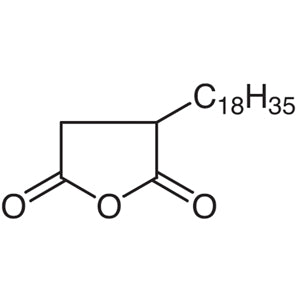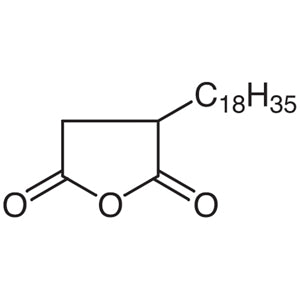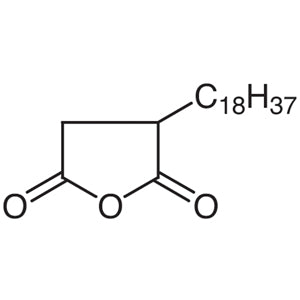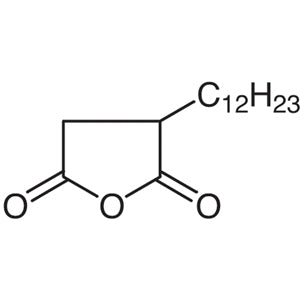
Tetrapropenylsuccinic Anhydride from TCI is a succinic anhydride carrying a branched alkenyl chain derived from propylene oligomerization. It is supplied as a mixture of branched-chain isomers. The compound belongs to the alkenyl succinic anhydride family, a class of materials that pair a reactive anhydride group with a long, hydrophobic hydrocarbon tail. In the laboratory it serves as a building block, as a curing agent for epoxy resins, and as a reagent for modifying the surface and hydrophobic character of materials.
Researchers choose this material because it combines two useful properties in one molecule. The cyclic anhydride group reacts readily with alcohols, amines, and hydroxyl groups to form esters or amides, and these reactions do not release water as a by-product. The branched alkenyl chain adds flexibility, improves solubility in nonpolar media, and makes the product water-repellent. In epoxy formulations, the long chain helps produce more flexible materials than short-chain anhydride curing agents do. This pairing of reactivity and hydrophobicity makes it a versatile reagent for both synthesis and materials work.
In Indonesia, this material is relevant to polymer laboratories, agricultural technology groups, and biomass-based materials research. Many researchers use it to modify starch, cellulose, and other biopolymers so they become more hydrophobic or more compatible with nonpolar matrices. Universities and research institutes that study local natural resources can use it to turn renewable feedstocks into functional materials. Its use as an epoxy curing agent also supports coatings and composites research.
Related TCI products
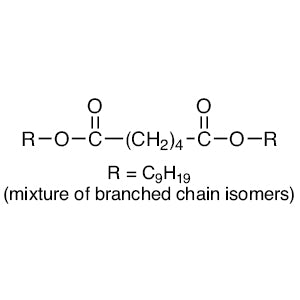
- TCI A1387 33703-08-1 Diisononyl Adipate (mixture of branched chain isomers)
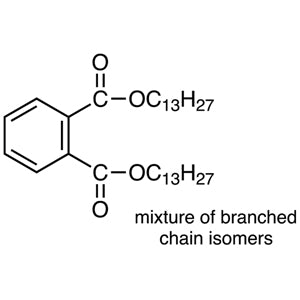
- TCI P0307 75359-31-8 Ditridecyl Phthalate (mixture of branched chain isomers)
- TCI O0013 28777-98-2 Octadecenylsuccinic Anhydride (mixture of isomers)
- TCI N0350 28928-97-4 Nonenylsuccinic Anhydride (mixture of branched chain isomers)
- TCI M0690 25134-21-8 Methyl-5-norbornene-2,3-dicarboxylic Anhydride (mixture of isomers)
- TCI M0683 11070-44-3 Methylcyclohexene-1,2-dicarboxylic Anhydride (mixture of isomers)
- Synthetic building block: the reactive cyclic anhydride couples with alcohols and amines to form esters and amides, which lets chemists attach a branched hydrophobic chain to target molecules.
- Epoxy resin curing: the anhydride group crosslinks epoxy systems, and the long branched alkenyl chain gives cured materials more flexibility than short-chain anhydride curing agents.
- Biopolymer modification: researchers esterify hydroxyl groups on starch, cellulose, and similar polysaccharides to make these renewable materials more hydrophobic and more compatible with nonpolar matrices.
- Surface hydrophobization: grafting onto hydroxyl-bearing surfaces adds a water-repellent hydrocarbon layer, which is useful in studies of coatings, fillers, and materials that need lower water uptake.
- Studies of amphiphilic derivatives: the reactive polar head and hydrophobic tail make it a convenient precursor for amphiphilic compounds in formulation and interfacial chemistry research.
| Brand | TCI (product code T0170) |
|---|---|
| CAS number | 26544-38-7 |
| Molecular formula | — |
| Purity | — |
| Category | Chemistry > Building Blocks > Non-Heterocyclic Building Blocks |
| Pack sizes | standard TCI pack sizes; see the product page for current options |
| Physical form | — |
| Storage | keep tightly closed in a cool, dry place, protected from moisture |
- Composition: mixture of branched-chain isomers
Store Tetrapropenylsuccinic Anhydride in its original, tightly sealed container in a cool, dry, well-ventilated area, away from heat sources and direct sunlight. Like other anhydrides, it reacts with water, so keep it away from moisture. Close the container right after each use, and consider an inert-gas blanket for long-term storage. Keep it separate from strong bases, amines, alcohols, and oxidizing agents unless they are being used in a planned reaction. Handle it in a fume hood while wearing chemical-resistant gloves, safety goggles, and a lab coat. Avoid contact with skin and eyes and avoid inhaling vapors. Always check the supplier's Safety Data Sheet for specific hazard and disposal information.
—
Produk Terkait
-
DiisononylAdipate(mixtureofbranchedchainisomers) TCI A1387
Regular price From Rp 584.850,00Regular price -
DitridecylPhthalate(mixtureofbranchedchainisomers) TCI P0307
Regular price Rp 477.750,00Regular price -
OctadecenylsuccinicAnhydride(mixtureofisomers) TCI O0013
Regular price From Rp 1.087.800,00Regular price -
NonenylsuccinicAnhydride(mixtureofbranchedchainisomers) TCI N0350
Regular price From Rp 823.200,00Regular price -
Methyl-5-norbornene-2,3-dicarboxylicAnhydride(mixtureofisomers) TCI M0690
Regular price From Rp 505.050,00Regular price -
Methylcyclohexene-1,2-dicarboxylicAnhydride(mixtureofisomers) TCI M0683
Regular price From Rp 875.700,00Regular price -
IsooctadecenylsuccinicAnhydride(mixtureofbranchedchainisomers) TCI I0237
Regular price From Rp 1.378.650,00Regular price -
IsooctadecylsuccinicAnhydride(mixtureofbranchedchainisomers) TCI I0146
Regular price Rp 3.021.900,00Regular price