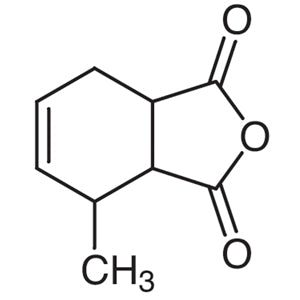
Methylcyclohexene-1,2-dicarboxylic Anhydride (mixture of isomers) is a chemical compound widely used in laboratory settings for the synthesis of complex molecules. As a building block in organic chemistry, it plays a crucial role in the development of heterocyclic and organic compounds. This compound is particularly valued for its versatility and reactivity, making it an essential tool for chemists engaged in research and development. Its anhydride structure allows it to participate in a variety of chemical reactions, including esterification and acylation, which are fundamental in organic synthesis.
The compound's high reactivity, especially towards water and polar solvents, makes it a preferred choice for applications requiring precise control over reaction conditions. Its ability to form stable intermediates under controlled environments enhances its utility in synthetic pathways. Additionally, its high boiling point and compatibility with various functional groups make it suitable for reactions that require elevated temperatures and dry conditions. These properties ensure that it remains a reliable and efficient reagent in modern chemical laboratories.
In Indonesian laboratories, Methylcyclohexene-1,2-dicarboxylic Anhydride is commonly used by researchers in chemistry, pharmaceuticals, and related industries. Its role in the synthesis of complex molecules aligns with the growing demand for advanced chemical compounds in both academic and industrial research. The compound's stability under certain conditions further supports its use in long-term storage and repeated experimentation, making it a valuable asset in the laboratory environment.
- Used in organic synthesis for creating complex heterocyclic compounds due to its reactivity and functional group compatibility.
- Applied in pharmaceutical research for the development of new drug molecules through esterification and acylation reactions.
- Utilized in polymer chemistry for modifying polymer structures by introducing functional groups through anhydride reactions.
- Employed in analytical chemistry for the preparation of standard solutions and reagents for spectroscopic and chromatographic analyses.
- Integrated into industrial chemical processes for the production of specialty chemicals requiring controlled reaction conditions and high reactivity.
| Brand | TCI |
|---|---|
| CAS number | 11070-44-3 |
| Molecular formula | — |
| Purity | — |
| Category | Chemistry > Building Blocks > Non-Heterocyclic Building Blocks |
| Pack sizes | Available in various quantities as per supplier specifications |
| Physical form | Solid or liquid, depending on the specific isomer mixture |
| Storage | Store in a cool, dry place away from moisture and direct sunlight |
This compound should be stored in a cool, dry environment to maintain its stability and prevent degradation. It is recommended to use airtight containers to minimize exposure to moisture and air, which can affect its reactivity. Due to its high reactivity towards water and polar solvents, it should be handled in a fume hood to ensure proper ventilation and safety. Avoid contact with incompatible materials such as strong acids or bases. Always wear appropriate personal protective equipment, including gloves and safety goggles, when handling this substance. Proper labeling and storage conditions are essential to ensure safe handling and long-term usability in laboratory settings.
—
Produk Terkait
-
Bicyclo[2.2.2]oct-5-ene-2,3-dicarboxylicAnhydride TCI B3038
Regular price Rp 3.605.700,00Regular price -
TetrapropenylsuccinicAnhydride(mixtureofbranchedchainisomers) TCI T0170
Regular price From Rp 505.050,00Regular price -
OctadecenylsuccinicAnhydride(mixtureofisomers) TCI O0013
Regular price From Rp 1.087.800,00Regular price -
NonenylsuccinicAnhydride(mixtureofbranchedchainisomers) TCI N0350
Regular price From Rp 823.200,00Regular price -
5-Norbornene-2,3-dicarboxylicAnhydride TCI N0331
Regular price From Rp 477.750,00Regular price -
3-Methyl-4-cyclohexene-1,2-dicarboxylicAnhydride TCI M1190
Regular price From Rp 4.877.250,00Regular price -
Methyl-5-norbornene-2,3-dicarboxylicAnhydride(mixtureofisomers) TCI M0690
Regular price From Rp 505.050,00Regular price -
4-Methylcyclohexane-1,2-dicarboxylicAnhydride(cis-andtrans-mixture) TCI M0567
Regular price From Rp 530.250,00Regular price
![6708-37-8 Bicyclo[2.2.2]oct-5-ene-2,3-dicarboxylic Anhydride - AMI Scientific](http://amiscientific.com/cdn/shop/files/TCI2510B3038.jpg?v=1767089273&width=533)