

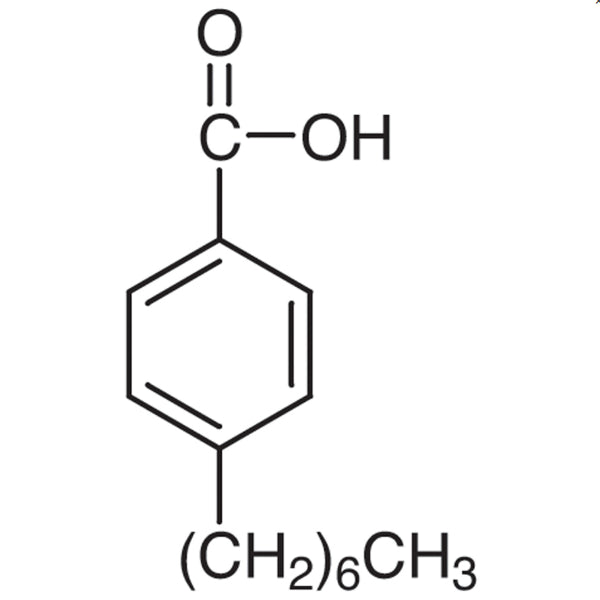
4-Heptylbenzoic Acid is a chemical compound widely used in scientific research, particularly in the fields of material science and liquid crystal technology. This compound plays a crucial role in the development of advanced materials with unique optical and electronic properties. Its molecular structure, featuring a heptyl chain, contributes to its polarity and solubility characteristics, making it essential for creating materials that respond to external stimuli such as electric or magnetic fields. In laboratory settings, it is a key component in the synthesis of liquid crystal materials, enabling the design of materials with anisotropic properties.
The compound is valued for its stable melting point and solubility, which ensure consistent performance in various experimental conditions. These physical and chemical properties make it a preferred choice for researchers requiring precision and reliability in their work. Its predictable behavior under different conditions allows for accurate experimentation and reproducibility, which are fundamental in scientific research. The compound’s versatility supports a wide range of applications, from material development to molecular structure analysis.
In Indonesian laboratories, 4-Heptylbenzoic Acid is commonly used in applied research projects focused on liquid crystal development for display technologies, optical sensors, and electronic components. It is also integral to studies involving molecular structure and thermal properties, supporting both fundamental and applied scientific investigations. Its presence in these research areas highlights its importance in advancing material science and technology in the region.
- Liquid Crystal Development: This compound is ideal for creating liquid crystal materials due to its molecular structure and anisotropic properties, enabling precise control over material behavior in electric and magnetic fields.
- Optical Sensor Research: Its unique solubility and polarity make it suitable for developing sensors that respond to light or temperature changes, enhancing detection accuracy in optical systems.
- Electronic Material Synthesis: The compound supports the creation of electronic components with responsive properties, contributing to the advancement of display technologies and semiconductor research.
- Molecular Structure Analysis: Its stable physical properties allow for consistent results in spectroscopic and thermal analysis, aiding in the study of molecular interactions and material behavior.
- Thermal Property Studies: The compound’s predictable melting point and solubility make it a reliable material for investigating thermal stability and phase transitions in various substances.
| Brand | TCI |
|---|---|
| CAS number | 38350-87-7 |
| Molecular formula | — |
| Purity | — |
| Category | Materials Science > Material Building Blocks > Liquid Crystal (LC) Building Blocks |
| Pack sizes | Available in standard laboratory quantities as per supplier specifications |
| Physical form | Liquid or crystalline, depending on temperature and purity |
| Storage | Store in a cool, dry place away from direct sunlight and moisture |
4-Heptylbenzoic Acid should be stored in a cool, dry environment to maintain its stability and prevent degradation. It is recommended to keep the compound in airtight containers to avoid exposure to moisture and air, which can affect its solubility and chemical integrity. Laboratory personnel should handle the material with care, using appropriate personal protective equipment such as gloves and safety goggles to minimize direct contact. Proper ventilation is essential when working with the compound to ensure safe handling and prevent inhalation of vapors. The compound should be stored away from incompatible substances to avoid any potential chemical reactions. Regular monitoring of storage conditions ensures the material remains suitable for use in scientific research.
—
Produk Terkait
-
Harmine TCI H0001
Regular price Rp 2.096.850,00Regular price -
HarmineHydrochloride TCI H0002
Regular price From Rp 886.200,00Regular price -
Hecogenin TCI H0003
Regular price From Rp 1.063.650,00Regular price -
HeneicosanoicAcid TCI H0010
Regular price From Rp 4.222.050,00Regular price -
Hentriacontane TCI H0012
Regular price From Rp 4.103.400,00Regular price -
1,1,1,2,2,3,3-Heptachloropropane TCI H0015
Regular price Rp 5.755.050,00Regular price -
1,1,1,2,3,3,3-Heptachloropropane TCI H0016
Regular price Rp 3.541.650,00Regular price -
Heptacosane TCI H0017
Regular price From Rp 3.807.300,00Regular price


