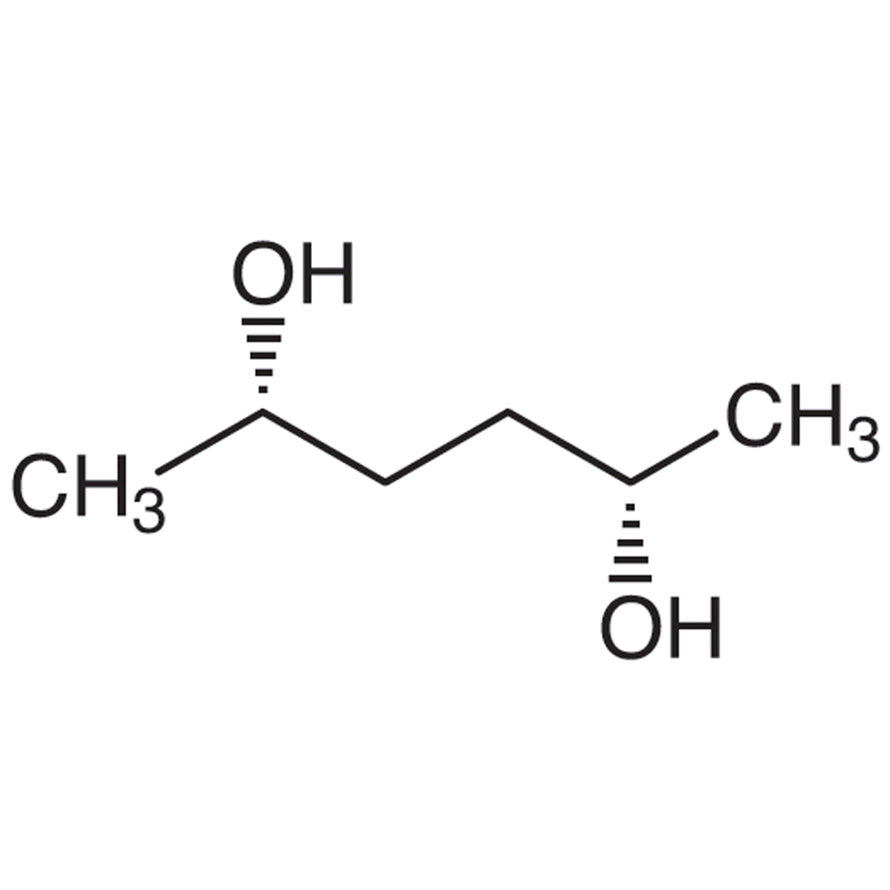
(2S,5S)-2,5-Hexanediol is a chiral six-carbon diol bearing two secondary hydroxyl groups at positions 2 and 5, both with the S configuration. The molecule possesses C2 symmetry, meaning that its two ends are chemically identical while the molecule as a whole remains non-superimposable on its mirror image. In the laboratory it serves as a chiral building block: an enantiopure starting material used to transfer chirality information into other molecules, either through the formation of chiral auxiliaries or through the preparation of ligands for asymmetric catalysis.
The property that makes this compound so highly valued is the combination of C2 symmetry with a defined enantiomeric purity. C2 symmetry is critically important in catalyst design because it reduces the number of transition states that can form, so reaction selectivity improves and enantiomeric outcomes become easier to predict. The two secondary hydroxyl groups are equivalent to one another, readily converted into leaving groups such as mesylates or tosylates, and then displaced by nucleophiles to build chiral five-membered rings. This route is what gives rise to methyl-substituted pyrrolidine, tetrahydrofuran, and phospholane derivatives.
In Indonesian laboratories, this diol is typically found in university and institutional research groups working on asymmetric synthesis, in organic chemistry laboratories preparing chiral ligands and auxiliaries in-house, and in pharmaceutical and fine chemical research units where single-enantiomer intermediates are required. It is generally purchased in small research quantities, since the scale of work in stereoselective methodology development and ligand preparation is usually on the milligram to gram level rather than bulk production.
- Chiral ligand synthesis: the C2-symmetric backbone is converted into phospholane and related ligands that give predictable, highly selective outcomes in asymmetric metal-catalysed transformations.
- Chiral auxiliary preparation: the enantiopure diol is attached to a prochiral substrate to direct the facial approach of reagents, then cleaved after the stereocentre has been set.
- Asymmetric methodology development: researchers use it as a well-defined enantiopure reference substrate when testing new stereoselective reactions and comparing enantiomeric outcomes between conditions.
- Chiral heterocycle construction: both equivalent hydroxyls are activated as mesylates or tosylates and displaced by nucleophiles to close chiral pyrrolidine and tetrahydrofuran rings.
- Pharmaceutical intermediate research: single-enantiomer building blocks of this type are required where the biological activity of a target depends on a defined stereochemical configuration.
| Brand | TCI |
|---|---|
| CAS number | 34338-96-0 |
| Molecular formula | — |
| Purity | — |
| Category | Chemistry > Asymmetric Synthesis > Chiral Building Blocks |
| Pack sizes | available in research-scale packaging; please refer to the current catalogue listing for the sizes offered |
| Physical form | — |
| Storage | store in a tightly closed container in a cool, dry place away from incompatible materials |
- Catalogue code: H0969
Store the container tightly closed in a cool, dry, well-ventilated area, protected from direct sunlight and away from heat sources, ignition sources, and strong oxidising agents. Keep the material in its original supplier container or in a compatible, clearly labelled glass container with a secure closure; avoid leaving the container open to the atmosphere, as prolonged exposure to air and moisture may affect the quality of the material. Handle in a fume hood, wear appropriate personal protective equipment including safety glasses, gloves, and a laboratory coat, and avoid contact with skin and eyes as well as inhalation of any vapour. Use clean, dry spatulas or pipettes when taking portions in order to avoid contaminating the stock. Always consult the manufacturer's Safety Data Sheet before handling, and dispose of waste and contaminated materials in accordance with applicable laboratory waste procedures.
—
Produk Terkait
-
(2R,5R)-2,5-Hexanediol TCI H1032
Regular price Rp 1.856.400,00Regular price -
2,2,3,3,4,4,5,5-Octafluoro-1,6-hexanediol TCI O0294
Regular price From Rp 1.829.100,00Regular price -
1,6-HexanediolDimethacrylate(stabilizedwithMEHQ) TCI H1369
Regular price Rp 557.550,00Regular price -
1,2-Hexanediol TCI H0688
Regular price From Rp 955.500,00Regular price -
2,5-Hexanediol TCI H0100
Regular price From Rp 1.298.850,00Regular price -
1,6-Hexanediol TCI H0099
Regular price From Rp 477.750,00Regular price -
2-Ethyl-1,3-hexanediol(mixtureofdiastereoisomers) TCI E0119
Regular price From Rp 557.550,00Regular price -
2,5-Dimethyl-2,5-hexanediol TCI D1167
Regular price From Rp 505.050,00Regular price