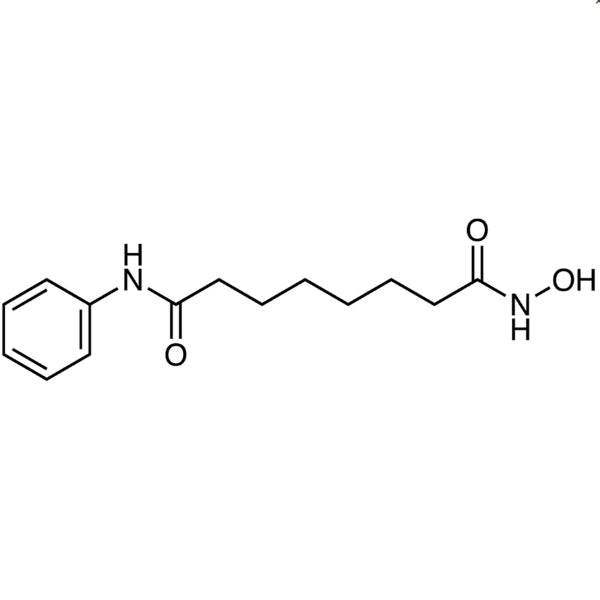
TCI H1388 N-Hydroxy-N'-phenyloctanediamide is a hydroxamic acid compound built around an eight-carbon diamide chain carrying an anilide terminus at one end and a hydroxamate group at the other. It is widely recognised among molecular biology researchers as a pharmaceutical research reagent for experimental use, particularly in studies of epigenetic regulatory mechanisms. Its role in the laboratory is that of a research tool, allowing investigators to observe the consequences of inhibiting specific enzymes on cell behaviour, gene expression, and the patterns of histone protein modification.
The principal characteristics that lead researchers to select this compound begin with its hydroxamic acid group, which binds metal ions at the enzyme active site with considerable strength. This is combined with an aliphatic linker chain of precisely appropriate length and an aromatic terminus that provides good complementarity with the enzyme binding pocket. This three-part architecture has made the molecule a classical reference point in the design of enzyme inhibitors, and for that reason it is frequently employed as a positive control in comparative assays evaluating newly synthesised candidate compounds.
In Indonesian laboratories, the compound is typically handled in university research groups, biomedical institutes, and molecular biology facilities engaged in epigenetics work. Because its solubility in water is limited, researchers generally prepare a stock solution in a suitable organic solvent before diluting into the experimental medium. This practice is standard in cell culture and enzyme assay workflows, and it allows the reagent to be introduced reproducibly across the concentration ranges required by a given study design.
TCI brochures (PDF)
- Epigenetics Research Reagents 2024-11-22 · p. 1
- Regenerative Medicine Research Reagents 2016-03-18 · p. 2
- Cancer Research Reagents 2025-04-01 · p. 8
- Antimicrobials and Antitumor Agents for Research and Experimental Use 2025-04-24 · p. 18
- Pharmaceutical Ingredients for Research and Experimental Use 2026-03-09 · p. 19
- Reagents for Biological Research 2025-03-11 · p. 62
- Epigenetic mechanism studies: the compound serves as a research tool for observing how inhibition of specific enzymes alters histone protein modification patterns within experimental cell systems.
- Gene expression research: investigators apply it to examine the downstream consequences that enzyme inhibition produces on transcriptional activity and the broader regulation of gene expression.
- Positive control in comparative assays: its status as a classical reference in enzyme inhibitor design makes it a dependable benchmark against which newly synthesised candidate compounds are measured.
- Cell behaviour investigations: researchers use it to follow the effects of targeted enzyme inhibition on cellular behaviour, providing a controlled means of probing regulatory pathways experimentally.
- Enzyme inhibitor design reference: the hydroxamate, aliphatic linker, and aromatic terminus architecture offers a well-characterised structural model for teams developing new inhibitor scaffolds.
| Brand | TCI |
|---|---|
| CAS number | 149647-78-9 |
| Molecular formula | — |
| Purity | — |
| Category | Life Science > Biochemicals and Reagents > Pharmaceutical Research Reagents (for Experimental Use) |
| Pack sizes | available in the standard catalogue pack sizes offered by TCI; please confirm the required quantity when ordering |
| Physical form | — |
| Storage | store according to the conditions stated on the manufacturer label and accompanying documentation |
- Catalogue number: H1388
- Chemical name: N-Hydroxy-N'-phenyloctanediamide
Store the container according to the conditions specified on the manufacturer label, keeping it tightly closed in its original packaging and protected from moisture and direct light. Suitable containers include the original sealed vial or an equivalent chemically resistant, well-sealed vessel. Because the material has limited water solubility, any stock solution prepared in an organic solvent should be labelled clearly with its contents and preparation date, then stored under conditions appropriate to that solvent. As with all pharmaceutical research reagents intended for experimental use, handle the compound in a well-ventilated area or fume hood, wear gloves, a laboratory coat, and eye protection, avoid the generation of dust, and wash hands thoroughly after handling. This product is for laboratory research use only and should not be used for diagnostic or therapeutic purposes. Dispose of residues and contaminated consumables in accordance with the institution's chemical waste procedures.
—
Product Categories
- Biochemicals and ReagentsPharmaceutical Research Reagents (for Experimental Use)Antitumor Research Reagents (for Experimental Use)
- Biochemicals and Reagents
- Molecular BiologyEpigeneticsBioactive Small Molecules for Epigenetic Research
- Pharmaceutical Development and Drug Discovery ResearchPharmaceutical Research Reagents (for Experimental Use)Antitumor Research Reagents (for Experimental Use)
Produk Terkait
-
N-Hydroxy-3-[1-(phenylthio)methyl-1H-1,2,3-triazol-4-yl]benzamide TCI H1340
Regular price Rp 6.148.800,00Regular price -
Imatinib TCI I0906
Regular price From Rp 1.326.150,00Regular price -
Zebularine TCI Z0022
Regular price From Rp 2.969.400,00Regular price -
SunitinibMalate TCI U0095
Regular price Rp 3.021.900,00Regular price -
(+/-)-Thalidomide TCI T2524
Regular price From Rp 2.969.400,00Regular price -
Trifluorothymidine TCI T2511
Regular price From Rp 3.180.450,00Regular price -
TrichostatinA TCI T2477
Regular price From Rp 10.387.650,00Regular price -
Bexarotene TCI B4798
Regular price Rp 5.034.750,00Regular price
![1316652-41-1 N-Hydroxy-3-[1-(phenylthio)methyl-1H-1,2,3-triazol-4-yl]benzamide - AMI Scientific](http://amiscientific.com/cdn/shop/files/TCI2510H1340.jpg?v=1769142603&width=533)