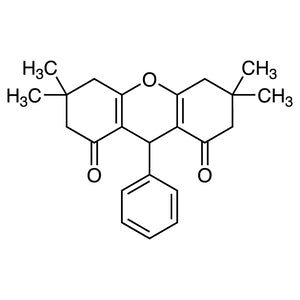
3,3,6,6-Tetramethyl-9-phenyl-3,4,5,6,7,9-hexahydro-1H-xanthene-1,8(2H)-dione is a heterocyclic compound built on a partially hydrogenated xanthene skeleton, structurally the product of joining two dimedone units with a single aromatic aldehyde. The compound is very well known in synthetic organic chemistry as the benchmark product of multicomponent condensation reactions, and for that reason it is often present in the laboratory not only as an intermediate but also as a reference compound used to verify that a newly developed synthetic method has worked or that a catalyst under development is performing as intended.
Its main appeal lies in the rigid, symmetrical xanthene-1,8-dione framework, complemented by two gem-dimethyl groups that impart conformational stability together with a characteristic and readily recognizable NMR signal pattern. These clear-cut spectral features make the compound ideal as a comparison standard when researchers match data from their own synthetic work against authentic material. The xanthene framework itself is an important motif that serves as the parent structure of a range of fluorescent dyes and biologically active compounds, so the material also has value as a starting point for developing derivatives with optical or pharmacological properties.
In Indonesian laboratories, this TCI product typically finds its place in university and institutional research groups working on organic synthesis methodology, green chemistry, and catalyst development, where an authentic sample is needed to confirm identity and reaction outcome. It is also useful in postgraduate teaching laboratories that introduce multicomponent condensation reactions, and in materials- or dye-oriented groups exploring the xanthene motif as a scaffold for further functionalization.
Related TCI products
- TCI B3707 188975-88-4 N-Boc-hexahydro-1H-azepin-4-one
- TCI H1830 67705-41-3 Hexahydro-1H,4H,7H-3a,6a,9a-triazaphenalene
- TCI H1673 50492-22-3 Hexahydro-4-azepinone Hydrochloride
- TCI G0415 1222-05-5 1,3,4,6,7,8-Hexahydro-4,6,6,7,8,8-hexamethylcyclopenta[g]-2-benzopyran (ca 50% in Diethyl Phthalate)
- TCI X0031 82-07-5 Xanthene-9-carboxylic Acid
- TCI X0003 92-83-1 Xanthene
- Reference standard for multicomponent reactions: the compound is the classical condensation product of two dimedone units with an aromatic aldehyde, so an authentic sample lets researchers confirm that their own reaction has genuinely produced the intended target.
- Catalyst performance evaluation: because the condensation forming this xanthenedione is a widely used benchmark transformation, the compound serves as the reference product against which the activity of newly developed catalysts is judged.
- Spectroscopic comparison and method validation: the distinctive NMR signal pattern arising from the gem-dimethyl groups gives an unambiguous fingerprint for matching self-synthesized material against authentic reference data during structure confirmation.
- Heterocyclic building block in synthesis: the rigid, symmetrical xanthene-1,8-dione core provides a stable platform for constructing more elaborate heterocyclic targets in exploratory organic synthesis programmes.
- Scaffold for dye and bioactive derivative development: since the xanthene framework is the parent motif of many fluorescent dyes and biologically active compounds, this material is a practical starting point for preparing derivatives with tailored optical or pharmacological behaviour.
| Brand | TCI (product code H1885) |
|---|---|
| CAS number | 19744-83-3 |
| Molecular formula | — |
| Purity | — |
| Category | Chemistry > Building Blocks > Heterocyclic Building Blocks |
| Pack sizes | available in standard TCI research-scale packaging; please confirm the required size when ordering |
| Physical form | — |
| Storage | keep in the tightly closed original container, in a cool, dry and well-ventilated place |
- Chemical class: partially hydrogenated xanthene-1,8-dione heterocyclic building block
Store the material in its original tightly closed container in a cool, dry, well-ventilated area, away from direct sunlight, moisture, heat sources and incompatible chemicals. Amber glass or the supplier's own packaging is suitable for keeping the solid protected from light and humidity, and containers should be resealed promptly after each use to limit exposure to air. Handle the compound in a well-ventilated laboratory or fume hood using standard personal protective equipment, including a laboratory coat, chemical-resistant gloves and safety glasses. Avoid generating or inhaling dust when weighing out the solid, and wash hands thoroughly after handling. Always consult the manufacturer's safety data sheet before use, and dispose of residues and contaminated materials in accordance with applicable laboratory waste regulations.
—
Produk Terkait
-
N-Boc-hexahydro-1H-azepin-4-one TCI B3707
Regular price Rp 4.902.450,00Regular price -
Hexahydro-1H,4H,7H-3a,6a,9a-triazaphenalene TCI H1830
Regular price From Rp 3.340.050,00Regular price -
Hexahydro-4-azepinoneHydrochloride TCI H1673
Regular price From Rp 689.850,00Regular price -
1,3,4,6,7,8-Hexahydro-4,6,6,7,8,8-hexamethylcyclopenta[g]-2-benzopyran(ca50%inDiethylPhthalate) TCI G0415
Regular price From Rp 689.850,00Regular price -
Xanthene-9-carboxylicAcid TCI X0031
Regular price From Rp 1.008.000,00Regular price -
Xanthene TCI X0003
Regular price Rp 4.188.450,00Regular price -
9,9-Dimethyl-9H-xanthene(purifiedbysublimation) TCI D5731
Regular price Rp 2.332.050,00Regular price -
1,3,5-Triazinane-2,4-dione TCI T3800
Regular price From Rp 2.332.050,00Regular price


![1,3,4,6,7,8-Hexahydro-4,6,6,7,8,8-hexamethylcyclopenta[g]-2-benzopyran (ca. 50% in Diethyl Phthalate) (CAS 1222-05-5) - TCI G0415 - AMI Scientific](http://amiscientific.com/cdn/shop/files/TCI2510G0415.jpg?v=1767115181&width=533)