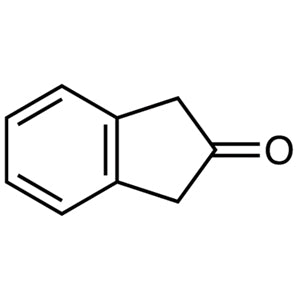
2-Indanone is a bicyclic ketone composed of a benzene ring fused to a cyclopentanone ring, with the carbonyl group positioned at the second carbon of the indane skeleton. The compound is a well-established building block in organic synthesis, because the indane framework appears in a broad range of valuable molecules, from pharmaceutical agents through to functional materials. In the laboratory, 2-indanone serves as a practical starting point for constructing substituted indane derivatives that would otherwise be difficult to reach through longer and less direct synthetic routes.
The particular strength of this compound lies in the reactivity of its carbonyl group combined with the acidity of the protons at the alpha position. The methylene group flanked by the carbonyl and the aromatic ring is sufficiently acidic to be deprotonated readily, forming an enolate and opening the way to alkylation, aldol reactions, Knoevenagel condensation, and enamine formation. The carbonyl group itself is ready to undergo reductive amination toward aminoindanes, reduction to the corresponding alcohol, or Wittig reaction to form alkenes. The rigidity of the bicyclic framework gives the molecule a defined shape, a property highly valued in medicinal chemistry when researchers wish to lock the orientation of functional groups on a scaffold.
In Indonesian laboratories, 2-indanone is typically handled in university research groups, pharmaceutical development units, and contract synthesis facilities where indane-based scaffolds are being assembled and screened. It is generally used on a small to moderate scale in multi-step synthetic sequences, with the isolated intermediate carried forward to further functionalisation. Standard fume hood practice, ordinary glassware for organic synthesis, and routine chromatographic or spectroscopic follow-up are the usual context for its use.
- Synthesis of substituted indane derivatives: the compound provides a ready-made bicyclic core, sparing the chemist the longer route of building the fused ring system from simpler aromatic precursors.
- Enolate alkylation chemistry: the acidic alpha methylene sits between the carbonyl and the aromatic ring, so deprotonation is straightforward and the resulting enolate accepts a range of electrophiles cleanly.
- Aldol and Knoevenagel condensation work: the same alpha position condenses with aldehydes and other carbonyl partners, giving access to extended and conjugated indane-based structures for further elaboration.
- Reductive amination toward aminoindanes: the carbonyl group converts efficiently to the corresponding amine, a transformation frequently exploited when preparing amine-bearing scaffolds for medicinal chemistry programmes.
- Wittig olefination and carbonyl reduction: the ketone responds well to phosphorus ylides to form alkenes and to reducing agents to give the alcohol, broadening the range of accessible derivatives.
| Brand | TCI |
|---|---|
| CAS number | 615-13-4 |
| Molecular formula | — |
| Purity | — |
| Category | Chemistry > Building Blocks > Non-Heterocyclic Building Blocks |
| Pack sizes | available in the standard research-scale pack sizes offered by TCI for this catalogue item |
| Physical form | — |
| Storage | store according to the conditions stated on the manufacturer label and in the accompanying safety data sheet |
- Catalogue number: I0649
Store the container tightly closed in a cool, dry, and well ventilated area, away from heat sources, direct sunlight, and incompatible materials such as strong oxidising agents. The original manufacturer container is the most suitable packaging; where transfer is necessary, use clean, dry, tightly sealed glass containers that are clearly labelled with the compound name and CAS number. Handle the material inside a fume hood, wearing safety goggles, chemically resistant gloves, and a laboratory coat. Keep the container closed when not in use to limit exposure to air and moisture, avoid generating dust or vapour, and consult the manufacturer safety data sheet before first use and before any disposal of residues.
—
Produk Terkait
-
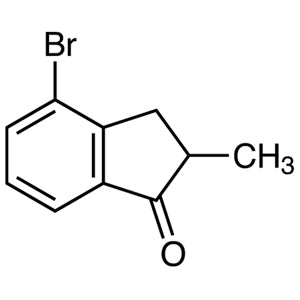
4-Bromo-2-methyl-1-indanone TCI B5096
Regular price From Rp 1.670.550,00Regular price -
4-Bromo-1-indanone TCI B3801
Regular price From Rp 769.650,00Regular price -
6-Bromo-1-indanone TCI B3711
Regular price From Rp 1.510.950,00Regular price -
5-Bromo-1-indanone TCI B2342
Regular price From Rp 743.400,00Regular price -
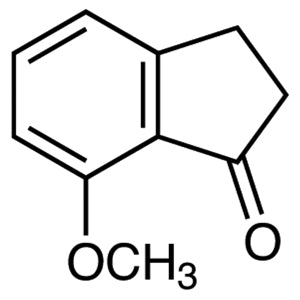
7-Methoxy-1-indanone TCI M3126
Regular price From Rp 1.458.450,00Regular price -
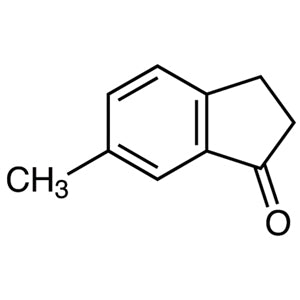
6-Methyl-1-indanone TCI M1901
Regular price Rp 1.644.300,00Regular price -
6-Methoxy-1-indanone TCI M1535
Regular price From Rp 2.359.350,00Regular price -
5-Methoxy-1-indanone TCI M1467
Regular price From Rp 1.565.550,00Regular price