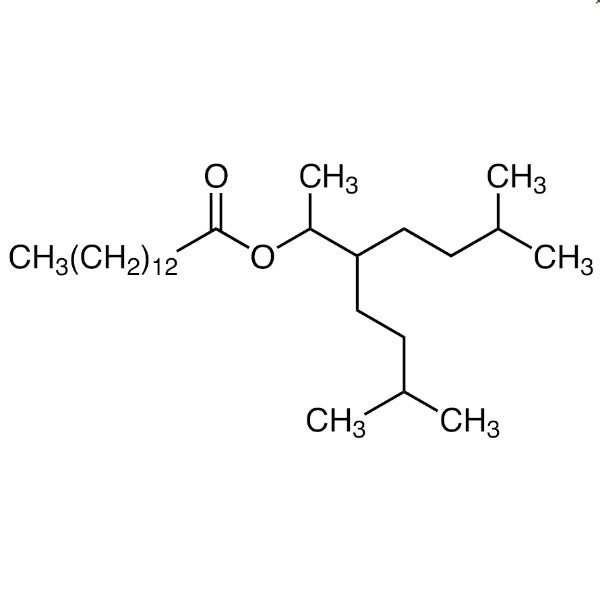
TCI I0662 3-Isoamyl-6-methyl-2-heptyl Myristate is a synthetic lipid ester formed from myristic acid, a fourteen-carbon fatty acid, combined with a long-chain branched alcohol. The compound is classified within the lipid category of the biochemicals and reagents range. In the laboratory, materials of this type serve as model lipids, as comparison standards in fatty acid ester analysis, and as carrier components in formulation research that requires an oil phase with particular characteristics that can be reproduced consistently from one experiment to the next.
The characteristics that form the main consideration behind its use are the branched alkyl chain structure, which makes the molecules difficult to arrange in an orderly fashion. This branching generally lowers the tendency of the material to solidify and yields an ester with good flow properties together with a smooth emollient character. Its nonpolar character is high, so it dissolves well in nonpolar organic solvents and is practically immiscible with water, a property that is exploited when researchers prepare two-phase systems, emulsions, or solvent media for lipophilic substances in laboratory testing.
In Indonesian laboratories, lipid esters of this kind are handled as reference and working materials within academic, formulation, and analytical settings. Researchers rely on them where a defined, reproducible oil phase is needed across repeated runs, and where comparison against a known branched-chain ester supports the interpretation of fatty acid ester data. Consistent material behaviour between experiments is a practical requirement in this work, and a catalogued ester supports that requirement directly.
- Model lipid studies: the defined ester structure allows researchers to represent branched-chain lipid behaviour under controlled conditions rather than relying on variable natural lipid mixtures.
- Fatty acid ester analysis: serves as a comparison material during analytical work, giving a known branched myristate reference against which sample chromatographic or spectroscopic data can be interpreted.
- Formulation research carrier: acts as an oil-phase component where a reproducible, smooth-flowing ester is required to keep formulation behaviour consistent between successive experimental batches.
- Emulsion and two-phase system preparation: its high nonpolar character and practical immiscibility with water make it suitable for building and studying defined oil-and-water phase systems.
- Lipophilic substance dissolution media: dissolves well in nonpolar organic solvents, so it functions as a solvent medium for lipophilic test substances during laboratory evaluation and handling.
| Brand | TCI |
|---|---|
| CAS number | 88332-30-3 |
| Molecular formula | — |
| Purity | — |
| Category | Life Science > Biochemicals and Reagents > Lipids |
| Pack sizes | available in standard catalogue pack sizes; please confirm the pack option required at the time of ordering. |
| Physical form | — |
| Storage | store according to the conditions stated on the manufacturer label and accompanying documentation. |
- Catalogue number: I0662
Store the container tightly closed in a cool, dry, well-ventilated area, away from direct sunlight, heat sources, and strong oxidising agents, and follow the storage conditions given on the manufacturer label and safety data sheet. Keep the material in its original container or in a chemically compatible sealed glass or suitable plastic vessel, clearly labelled with the product name and catalogue number. Handle in a fume hood or a well-ventilated laboratory area using safety goggles, gloves, and a laboratory coat. Avoid contact with skin and eyes, avoid the generation of aerosols, and allow cold containers to reach room temperature before opening to limit moisture condensation. Dispose of residues and contaminated materials in accordance with institutional chemical waste procedures.
—
Produk Terkait
-
HeptylAcetate TCI A0904
Regular price From Rp 477.750,00Regular price -
2-NaphthylMyristate TCI M0780
Regular price Rp 4.240.950,00Regular price -
IsobutylMyristate TCI M0555
Regular price Rp 2.174.550,00Regular price -
SodiumMyristate TCI M0483
Regular price From Rp 1.326.150,00Regular price -
MethylMyristate TCI M0482
Regular price From Rp 477.750,00Regular price -
IsopropylMyristate TCI M0481
Regular price From Rp 477.750,00Regular price -
EthylMyristate TCI M0479
Regular price From Rp 664.650,00Regular price -
ButylMyristate TCI M0477
Regular price From Rp 1.590.750,00Regular price