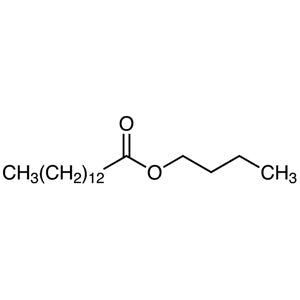
Butyl Myristate (TCI M0477), with CAS number 110-36-1, is a chemical compound widely used as a building block in various laboratory applications. It serves as a versatile reagent in organic synthesis, offering stability and compatibility with a range of chemical processes. Its non-polar nature makes it suitable for use as a solvent or emulsifier, allowing it to blend well with both polar and non-polar substances. This characteristic is particularly valuable in experiments requiring controlled mixing or reaction conditions.
The compound's stability under a variety of conditions is a key factor in its popularity among chemists. It exhibits good resistance to temperature and humidity, ensuring consistent performance in different laboratory environments. Its low reactivity also contributes to its safety profile, making it a reliable choice for routine use. Additionally, its moderate viscosity simplifies handling and mixing, enhancing its practicality in both research and industrial settings.
In Indonesian laboratories, Butyl Myristate is commonly used in the development of cosmetic, pharmaceutical, and industrial products. Its availability and stable properties make it a preferred material for researchers and manufacturers alike. It plays a crucial role in experiments focused on physical and chemical properties of compounds, supporting both academic and applied research. Its widespread use reflects its importance in the chemical industry and scientific community in Indonesia.
TCI brochures (PDF)
- Lipids 2025-12-17 · p. 13
- Cosmetic formulation where it acts as a skin-conditioning agent and emollient due to its non-polar nature and compatibility with various ingredients.
- Pharmaceutical research for its role in drug delivery systems as a carrier or excipient due to its stability and low reactivity.
- Organic synthesis experiments where it functions as a solvent or reaction medium because of its moderate viscosity and solubility properties.
- Industrial chemical production for its use as a lubricant or additive in polymer and coating applications due to its physical and chemical stability.
- Physical property analysis where it serves as a test medium for studying surface tension, viscosity, and solubility parameters in different conditions.
| Brand | TCI |
|---|---|
| CAS number | 110-36-1 |
| Molecular formula | — |
| Purity | — |
| Category | Chemistry > Building Blocks > Non-Heterocyclic Building Blocks |
| Pack sizes | Available in various sizes as per supplier specifications |
| Physical form | Liquid |
| Storage | Store in a cool, dry place away from direct sunlight |
Butyl Myristate should be stored in a cool, dry location, away from direct sunlight and sources of heat. It is recommended to use airtight containers to prevent contamination and maintain its stability. Due to its non-polar nature, it is advisable to store it in containers made of materials that are chemically inert, such as glass or stainless steel. In laboratory settings, it is important to ensure proper ventilation when handling the compound to avoid inhalation of vapors. Regular monitoring of storage conditions is recommended to maintain the integrity of the material. Always follow standard laboratory safety protocols when working with this compound to ensure a safe and controlled environment.
—
Produk Terkait
-
2-NaphthylMyristate TCI M0780
Regular price Rp 4.240.950,00Regular price -
IsobutylMyristate TCI M0555
Regular price Rp 2.174.550,00Regular price -
SodiumMyristate TCI M0483
Regular price From Rp 1.326.150,00Regular price -
IsopropylMyristate TCI M0481
Regular price From Rp 477.750,00Regular price -
EthylMyristate TCI M0479
Regular price From Rp 664.650,00Regular price -
MethylMyristate TCI M0482
Regular price From Rp 477.750,00Regular price -
3-Isoamyl-6-methyl-2-heptylMyristate TCI I0662
Regular price From Rp 848.400,00Regular price -
CholesterolMyristate TCI C0675
Regular price From Rp 2.094.750,00Regular price