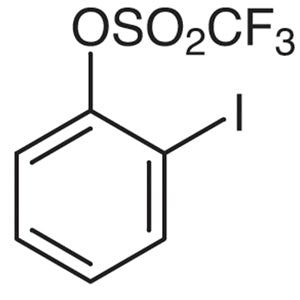
TCI I0770 2-Iodophenyl Trifluoromethanesulfonate is an aromatic building block that carries two different leaving groups at adjacent positions on the benzene ring: an iodine atom and a triflate (trifluoromethanesulfonate) group. The presence of two reactive groups with distinctly different levels of reactivity is precisely what makes this compound so valuable in the modern organic synthesis laboratory. Chemists can exploit that difference to carry out two sequential cross-coupling reactions on the very same aromatic ring, producing doubly substituted benzene compounds with a precisely controlled ortho substitution pattern.
The key characteristic that makes it a preferred choice is the orthogonal nature of these two groups. The carbon–iodine bond undergoes oxidative addition to palladium far more rapidly than the carbon–oxygen bond of the triflate, so the first reaction can be directed exclusively at the iodine position simply by selecting the appropriate conditions. Afterwards, the remaining triflate group stays ready to be reacted in a second step with a different coupling partner. The triflate group itself is an excellent leaving group thanks to the strong electron withdrawal of its three fluorine atoms.
In Indonesian laboratories, this reagent is typically used in university and institutional research groups working on organic synthesis, medicinal chemistry, and materials chemistry, where sequential functionalisation of an aromatic core is required. It is normally handled in small quantities on the bench scale, within methodology development projects or the preparation of intermediates, and is supplied by AMI Scientific to academic, government and industrial research laboratories requiring reliable fluorinated building blocks.
Related TCI products
- TCI Z0057-5G 54010-75-2 Zinc(II) Trifluoromethanesulfonate [for Electrolyte]
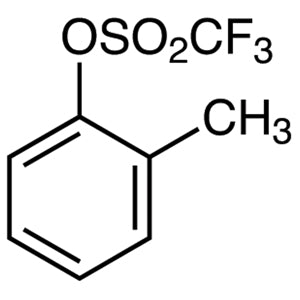
- TCI T3357 66107-34-4 o-Tolyl Trifluoromethanesulfonate
- TCI T2606 29540-83-8 p-Tolyl Trifluoromethanesulfonate
- TCI T1709 109613-00-5 4-Acetylphenyl Trifluoromethanesulfonate
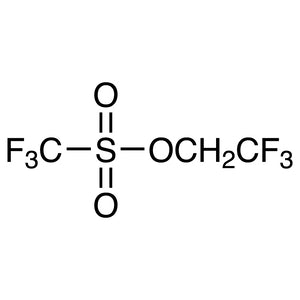
- TCI T1604 6226-25-1 2,2,2-Trifluoroethyl Trifluoromethanesulfonate
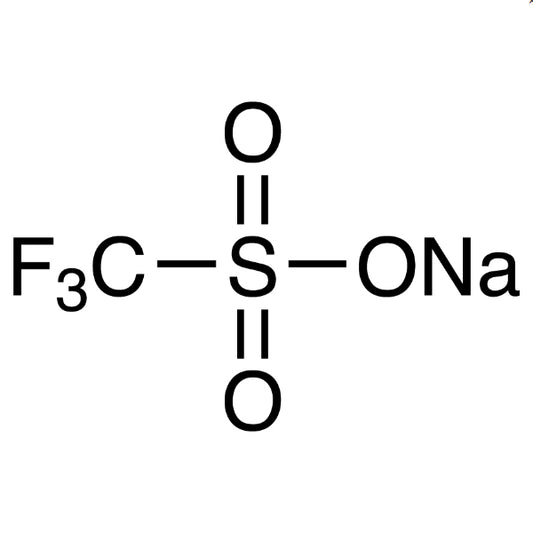
- TCI T1550 2926-30-9 Sodium Trifluoromethanesulfonate
- Sequential cross-coupling synthesis: the differing reactivity of the iodine and triflate groups allows two distinct coupling partners to be installed on one aromatic ring in a controlled order.
- Ortho-disubstituted benzene preparation: the two leaving groups sit at adjacent positions, giving direct and precise access to ortho substitution patterns that are otherwise difficult to control.
- Palladium-catalysed methodology development: the clear reactivity gap between the carbon–iodine and carbon–oxygen triflate bonds makes this compound a useful substrate for probing selectivity in catalytic systems.
- Medicinal chemistry intermediate synthesis: the stepwise, selective functionalisation available from this building block supports the construction of complex substituted aromatic scaffolds for research programmes.
- Fluorinated building block chemistry: the trifluoromethanesulfonate group contributes strong electron withdrawal, making the compound suitable for studies requiring an excellent leaving group on an aromatic ring.
| Brand | TCI |
|---|---|
| CAS number | 129112-26-1 |
| Molecular formula | — |
| Purity | — |
| Category | Chemistry > Building Blocks > Fluorinated Building Blocks |
| Pack sizes | available in standard TCI research-scale packaging; please confirm the required pack size when ordering. |
| Physical form | — |
| Storage | store according to the conditions stated on the manufacturer label and accompanying safety data sheet. |
- Product code: I0770
Store the container tightly closed in a cool, dry, well-ventilated area away from direct sunlight, heat sources and incompatible materials, following the storage conditions specified on the product label and the safety data sheet. Keep the material in its original supplier container, or in a clean, chemically compatible, well-sealed vessel that is clearly labelled. Handle in a fume hood using appropriate personal protective equipment, including safety goggles, chemical-resistant gloves and a laboratory coat. Avoid contact with skin and eyes and avoid inhaling any vapour or dust. Transfer the material carefully to limit exposure to moisture and air, close the container promptly after use, and dispose of any residues and contaminated materials in accordance with local chemical waste regulations.
—
Produk Terkait
-
Zinc(II)Trifluoromethanesulfonate[forElectrolyte] TCI Z0057-5G
Regular price Rp 1.326.150,00Regular price -
o-TolylTrifluoromethanesulfonate TCI T3357
Regular price From Rp 2.491.650,00Regular price -
p-TolylTrifluoromethanesulfonate TCI T2606
Regular price Rp 2.491.650,00Regular price -
4-AcetylphenylTrifluoromethanesulfonate TCI T1709
Regular price Rp 2.041.200,00Regular price -
2,2,2-TrifluoroethylTrifluoromethanesulfonate TCI T1604
Regular price From Rp 3.232.950,00Regular price -
SodiumTrifluoromethanesulfonate TCI T1550
Regular price From Rp 637.350,00Regular price -
PotassiumTrifluoromethanesulfonate TCI T1549
Regular price Rp 1.644.300,00Regular price -
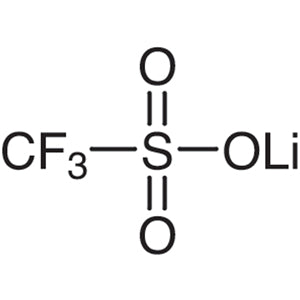
LithiumTrifluoromethanesulfonate TCI T1548
Regular price Rp 1.485.750,00Regular price
![54010-75-2 Zinc(II) Trifluoromethanesulfonate [for Electrolyte] - AMI Scientific](http://amiscientific.com/cdn/shop/files/TCI2510Z0057_9ad4d559-5f76-4c77-b1e0-21de52a28b66.jpg?v=1769181390&width=533)