

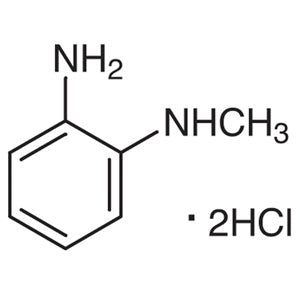
TCI M1754 N-Methyl-1,2-phenylenediamine Dihydrochloride is the dihydrochloride salt of an ortho-phenylenediamine in which one of the two amino groups carries a methyl substituent. The molecule presents two neighbouring amine functions on a benzene ring: one primary amine and one N-methylated secondary amine. This arrangement makes it a classic building block for the construction of fused five-membered rings, most notably benzimidazoles and closely related scaffolds. Supplied as the hydrochloride salt, the material is considerably easier to handle than the corresponding free base, which is sensitive to oxidation by air.
The properties that make this salt a preferred choice are its storage stability and the convenience with which it can be measured out. Free aromatic diamines tend to darken over time as oxidation proceeds, whereas the salt form is a more stable solid that weighs out cleanly and does not discolour rapidly under reasonable storage conditions. The salt also dissolves well in water and in protic solvents, which suits it to aqueous reactions and to acid-catalysed condensations alike; where the free base is required, it can be generated in situ by adding a suitable base. The presence of the N-methyl group allows cyclisation to deliver nitrogen-substituted products in a controlled manner.
In Indonesian laboratories, this reagent typically appears in synthetic organic chemistry groups and in research units that prepare heterocyclic compounds on a bench scale. Its role is that of a starting material for ring-forming steps, where a reliable, well-behaved diamine source is more valuable than a free base that must be purified before each use. The salt form fits ordinary local laboratory conditions, where ambient humidity and warmth would otherwise accelerate the degradation of a free aromatic diamine.
- Benzimidazole synthesis — the adjacent primary and secondary amines condense readily with carboxylic acid derivatives to close the fused five-membered ring in a single, well-defined step.
- Preparation of N-substituted heterocyclic scaffolds — the existing N-methyl group fixes the substitution pattern on ring nitrogen, giving controlled regiochemistry without a separate alkylation stage afterwards.
- Acid-catalysed condensation chemistry — because the compound is already an ammonium salt, it dissolves and reacts directly under the acidic conditions that many cyclisation protocols require.
- Aqueous-phase reaction work — good solubility in water and protic solvents lets the diamine be introduced from aqueous stock solutions rather than from awkward organic suspensions.
- Medicinal and materials chemistry research — as a non-heterocyclic building block it serves as the entry point to nitrogen-containing ring systems studied in discovery and structure-activity programmes.
| Brand | TCI |
|---|---|
| CAS number | 25148-68-9 |
| Molecular formula | — |
| Purity | — |
| Category | Chemistry > Building Blocks > Non-Heterocyclic Building Blocks |
| Pack sizes | available in the standard TCI catalogue pack sizes for this item |
| Physical form | solid dihydrochloride salt |
| Storage | keep in a tightly closed container, protected from air and moisture |
Store the container tightly closed in a cool, dry, well-ventilated place away from direct sunlight and sources of heat. The original manufacturer's container is the most suitable vessel; if the material is transferred, use a clean, dry, tightly sealing glass or chemically compatible plastic container and label it clearly. Weigh out portions promptly and reseal the container to limit exposure to air and atmospheric moisture, as prolonged exposure encourages discolouration. Handle in a fume hood using gloves, safety glasses and a laboratory coat, avoid generating dust, and wash hands after use. Keep away from strong oxidising agents and consult the manufacturer's safety data sheet before work begins.
—
Produk Terkait
-
N,N,N',N'-Tetramethyl-1,4-phenylenediamineDihydrochloride TCI T0151
Regular price From Rp 584.850,00Regular price -
1,2-PhenylenediamineDihydrochloride[forBiochemicalResearch] TCI P1144
Regular price Rp 610.050,00Regular price -
1,3-PhenylenediamineDihydrochloride TCI P0172
Regular price From Rp 689.850,00Regular price -
1,2-PhenylenediamineDihydrochloride TCI P0171
Regular price From Rp 795.900,00Regular price -
1,4-PhenylenediamineDihydrochloride TCI P0152
Regular price From Rp 848.400,00Regular price -
N,N-Dimethyl-1,4-phenylenediamineDihydrochloride TCI D0780
Regular price Rp 2.889.600,00Regular price -
N,N-Diethyl-1,4-phenylenediamineDihydrochloride TCI D0519
Regular price From Rp 1.353.450,00Regular price -
N,N,N',N'-Tetrakis[4-(diisobutylamino)phenyl]-1,4-phenylenediamine TCI T3770
Regular price From Rp 2.094.750,00Regular price

![615-28-1 1,2-Phenylenediamine Dihydrochloride [for Biochemical Research] - AMI Scientific](http://amiscientific.com/cdn/shop/files/TCI2510P1144.jpg?v=1767134361&width=533)



![485831-34-3 N,N,N',N'-Tetrakis[4-(diisobutylamino)phenyl]-1,4-phenylenediamine - AMI Scientific](http://amiscientific.com/cdn/shop/files/TCI2510T3770.jpg?v=1767144326&width=533)