

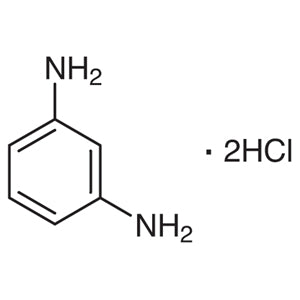
1,3-Phenylenediamine Dihydrochloride from TCI is the dihydrochloride salt of m-phenylenediamine, an aromatic diamine with two amino groups in the meta positions of a benzene ring. It belongs to the non-heterocyclic building blocks and is used to synthesise dyes, polymers and a range of nitrogen-containing organic compounds. As a salt, it supplies m-phenylenediamine in a form that is easier to handle, especially for reactions in aqueous media. It also serves as an analytical reagent in some colorimetric methods, such as nitrite detection through the formation of a coloured azo compound.
Because the two amino groups sit in the meta positions, the molecule has an angled geometry that sets it apart from the ortho and para isomers. This geometry affects the shape and properties of the polymers or materials made from it. In polymers, the meta arrangement gives more flexible chains, which are usually more soluble than polymers made from the para isomer. The dihydrochloride form dissolves well in water and resists air oxidation better than the free base, so it keeps longer in storage. When a synthesis needs the free amino groups, adding a base releases them easily.
In Indonesia, this material is useful to university research laboratories, chemistry departments and industrial R&D facilities that work on organic synthesis, dye chemistry and polymer development. Analytical laboratories that run colorimetric tests, including nitrite determination in water and environmental samples, can also use it as a reagent. The salt is more stable during storage than the free base, which helps laboratories that keep reagents on hand for long periods. That matters in the tropical climate, where humidity and heat put extra demands on how chemicals are kept.
- Dye synthesis: as a meta-substituted aromatic diamine, this compound is a precursor for azo dyes and other colourants, because both amino groups can be functionalised in diazotisation and coupling reactions.
- Polymer preparation: the angled meta geometry gives polymers more flexible chains, which are usually more soluble than polymers from the para isomer, so it suits research on processable materials.
- Colorimetric nitrite detection: the compound reacts with nitrite to form a coloured azo compound, so analysts can use it as a reagent in some established colorimetric methods.
- Synthesis of nitrogen-containing organic compounds: as a non-heterocyclic building block, it provides two reactive amino groups for building amides, imines and other nitrogen-bearing structures in organic synthesis.
- Reactions in aqueous media: the dihydrochloride salt dissolves well in water, so chemists can run water-based reactions and then release the free amine by adding a base when the procedure requires it.
| Brand | TCI (product code P0172) |
|---|---|
| CAS number | 541-69-5 |
| Molecular formula | — |
| Purity | — |
| Category | Chemistry > Building Blocks > Non-Heterocyclic Building Blocks |
| Pack sizes | as listed for this product on the page |
| Physical form | — |
| Storage | the salt resists air oxidation better than the free base; keep the container tightly closed |
- Form: dihydrochloride salt of m-phenylenediamine, readily soluble in water
Store 1,3-Phenylenediamine Dihydrochloride in its original, tightly closed container in a cool, dry, well-ventilated area, away from direct light, moisture and incompatible substances such as strong oxidising agents and strong bases. The salt resists air oxidation better than the free base, but limiting exposure to air and humidity after opening still helps preserve its quality. Aromatic amines need careful handling. Wear suitable gloves, safety glasses and a lab coat. Work in a fume hood to avoid inhaling dust, and avoid contact with skin and eyes. Before use, read the supplier's Safety Data Sheet for full hazard, first-aid and disposal information, and follow local regulations for chemical waste.
—
Produk Terkait
-
N,N,N',N'-Tetramethyl-1,4-phenylenediamineDihydrochloride TCI T0151
Regular price From Rp 584.850,00Regular price -
1,2-PhenylenediamineDihydrochloride[forBiochemicalResearch] TCI P1144
Regular price Rp 610.050,00Regular price -
1,2-PhenylenediamineDihydrochloride TCI P0171
Regular price From Rp 795.900,00Regular price -
1,4-PhenylenediamineDihydrochloride TCI P0152
Regular price From Rp 848.400,00Regular price -
N-Methyl-1,2-phenylenediamineDihydrochloride TCI M1754
Regular price Rp 2.359.350,00Regular price -
N,N-Dimethyl-1,4-phenylenediamineDihydrochloride TCI D0780
Regular price Rp 2.889.600,00Regular price -
N,N-Diethyl-1,4-phenylenediamineDihydrochloride TCI D0519
Regular price From Rp 1.353.450,00Regular price -
N,N,N',N'-Tetrakis[4-(diisobutylamino)phenyl]-1,4-phenylenediamine TCI T3770
Regular price From Rp 2.094.750,00Regular price

![615-28-1 1,2-Phenylenediamine Dihydrochloride [for Biochemical Research] - AMI Scientific](http://amiscientific.com/cdn/shop/files/TCI2510P1144.jpg?v=1767134361&width=533)


![485831-34-3 N,N,N',N'-Tetrakis[4-(diisobutylamino)phenyl]-1,4-phenylenediamine - AMI Scientific](http://amiscientific.com/cdn/shop/files/TCI2510T3770.jpg?v=1767144326&width=533)