

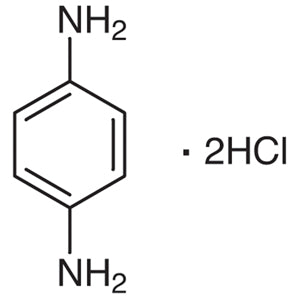
1,4-Phenylenediamine Dihydrochloride from TCI is the dihydrochloride salt of p-phenylenediamine, an aromatic diamine with two amino groups at the para positions of a benzene ring. As a non-heterocyclic building block, it is widely used as a precursor for polymers, dyes and redox-active compounds. Laboratories often prefer this salt form because it is easier to handle and store than the free base, which tends to oxidize quickly and discolor when exposed to air. When the free base is needed, chemists can generate it by neutralizing the salt.
The salt has two key properties. It resists air oxidation better than the free base, and it dissolves in water, so researchers can easily prepare aqueous solutions for synthetic reactions or biochemical assays. The p-phenylenediamine core is itself redox-active. It oxidizes readily to coloured quinonediimine species, and this behaviour is the basis of many enzymatic and colorimetric assays. Its two amine groups sit in symmetrical positions, which makes it a strong monomer for polycondensation. Examples include the formation of aromatic polyamides, conjugated polymers and covalent organic frameworks.
In Indonesian laboratories, this compound suits university chemistry departments, materials science groups and research institutes that work on polymer synthesis, functional materials and dye chemistry. Analytical and biochemistry laboratories can also use it in colour-forming redox assays that rely on the oxidation of the p-phenylenediamine core. A stable, water-soluble salt from a well-known brand such as TCI helps teaching, research and quality-control laboratories get consistent, reproducible results from one experiment to the next.
TCI brochures (PDF)
- Biomaterials Research Reagents 2025-02-19 · p. 18
- Monomers 2025-05-28 · p. 32
- Polymer synthesis: the two symmetrical para amino groups make this compound a good diamine monomer for polycondensation, including the preparation of aromatic polyamides and related high-performance polymers.
- Covalent organic frameworks: its rigid, linear diamine geometry suits reticular chemistry, where it serves as a linker that condenses with suitable partners to build ordered, porous framework structures.
- Conjugated and conductive polymers: the redox-active p-phenylenediamine core can be built into conjugated polymer backbones, so it is useful in research on electroactive and functional organic materials.
- Enzymatic and colorimetric assays: the core oxidizes readily to coloured quinonediimine species, which allows it to act as a chromogenic substrate in redox-based enzyme assays and colour-development tests.
- Dye and intermediate chemistry: as an established precursor for dyes and redox-active compounds, it gives synthetic chemists a convenient, storable source of p-phenylenediamine, and they can liberate the free base by neutralization when needed.
| Brand | TCI (product code P0152) |
|---|---|
| CAS number | 624-18-0 |
| Molecular formula | — |
| Purity | — |
| Category | Chemistry > Building Blocks > Non-Heterocyclic Building Blocks |
| Pack sizes | please refer to the pack options available on the product page |
| Physical form | solid dihydrochloride salt, soluble in water |
| Storage | keep tightly closed and protected from air, moisture and light to preserve quality |
Store 1,4-Phenylenediamine Dihydrochloride in its original, tightly sealed container in a cool, dry, well-ventilated area, away from direct light and strong oxidizing agents. The salt resists oxidation better than the free base, but limiting exposure to air and moisture still helps prevent gradual discoloration. Reseal containers promptly after each use, and use glass or other chemically compatible containers for any material you transfer or any solution you prepare. Aromatic amines can be harmful and may cause skin sensitization, so wear suitable gloves, safety glasses and a lab coat. Weigh and handle the powder in a fume hood or ventilated enclosure to avoid inhaling dust. Always consult the supplier's Safety Data Sheet before use, and dispose of waste according to local regulations.
—
Product Categories
Produk Terkait
-
1,4-Phenylenediamine TCI P0170
Regular price From Rp 557.550,00Regular price -
1,3-Phenylenediamine TCI P1911
Regular price From Rp 1.193.850,00Regular price -
1,3-Phenylenediamine TCI P1892
Regular price From Rp 505.050,00Regular price -
1,3-DiaminopropaneDihydrochloride TCI T0613
Regular price From Rp 1.749.300,00Regular price -
EthylenediamineDihydrochloride TCI E0078
Regular price From Rp 505.050,00Regular price -
1,5-DiaminopentaneDihydrochloride TCI D0099
Regular price From Rp 1.458.450,00Regular price -
1,6-DiaminohexaneDihydrochloride TCI D0096
Regular price From Rp 1.273.650,00Regular price -
1,4-DiaminobutaneDihydrochloride TCI D0081
Regular price From Rp 1.538.250,00Regular price


