


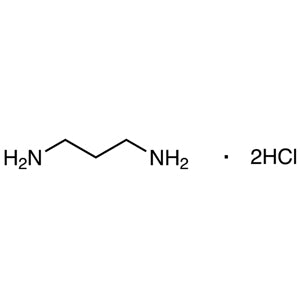
1,3-Diaminopropane Dihydrochloride is a versatile chemical compound widely used in laboratory settings for its reactivity and structural adaptability. As a non-heterocyclic building block, it plays a crucial role in organic synthesis by enabling the formation of complex molecules through substitution and condensation reactions. This compound is particularly valuable for researchers aiming to construct both heterocyclic and non-heterocyclic structures, making it an essential reagent in chemical experimentation. Its ability to participate in a variety of chemical processes enhances its utility across different research fields.
The compound's high reactivity and two amine groups make it a preferred choice in chemical synthesis. These functional groups allow it to act as an electron donor, facilitating reactions such as reduction, condensation, and bond formation. Its reactivity ensures that it can be effectively used in a wide range of applications, from the development of new compounds to the study of molecular structures. The flexibility of its chemical properties makes it suitable for both fundamental and applied research in chemistry.
In Indonesian laboratories, 1,3-Diaminopropane Dihydrochloride is commonly used in chemical research and development. It is frequently employed in the synthesis of new compounds, drug development, and molecular structure studies. Its availability and effectiveness make it a popular choice among educational institutions and research organizations in Indonesia. The compound's role in advancing scientific knowledge and innovation is well recognized in the local scientific community.
TCI brochures (PDF)
- Polyamines 2025-10-21 · p. 3
- Biomaterials Research Reagents 2025-02-19 · p. 19
- Monomers 2025-05-28 · p. 32
Related TCI products
- Organic synthesis applications benefit from this compound's reactivity and ability to form complex structures through substitution reactions.
- Drug development processes utilize its electron-donating properties to facilitate the formation of essential molecular bonds.
- Molecular structure studies rely on its versatility in participating in condensation and reduction reactions.
- Educational institutions use it for teaching and research in chemical synthesis and reaction mechanisms.
- Research laboratories employ it in the development of new compounds and materials through various chemical transformations.
| Brand | TCI |
|---|---|
| CAS number | 10517-44-9 |
| Molecular formula | — |
| Purity | — |
| Category | Chemistry > Building Blocks > Non-Heterocyclic Building Blocks |
| Pack sizes | Available in various quantities as per standard laboratory supply |
| Physical form | Solid |
| Storage | Store in a cool, dry place away from moisture and direct sunlight |
This compound should be stored in a cool, dry place, away from moisture and direct sunlight to maintain its chemical integrity. It is recommended to use airtight containers to prevent exposure to air and humidity, which may affect its reactivity. Due to its reactive nature, it should be handled with care in a well-ventilated area to minimize inhalation risks. Proper personal protective equipment, such as gloves and safety goggles, should be worn when handling this material. It is important to keep it away from incompatible substances to ensure safe storage and usage in laboratory environments.
—
Product Categories
Produk Terkait
-
1,3-Diaminopropane TCI D0114
Regular price From Rp 477.750,00Regular priceRp 333.900,00Sale price From Rp 477.750,00 -
1,2-Diaminopropane TCI D0113
Regular price From Rp 477.750,00Regular priceRp 333.900,00Sale price From Rp 477.750,00 -
1,4-PhenylenediamineDihydrochloride TCI P0152
Regular price From Rp 848.400,00Regular priceRp 593.250,00Sale price From Rp 848.400,00 -
EthylenediamineDihydrochloride TCI E0078
Regular price From Rp 505.050,00Regular priceRp 352.800,00Sale price From Rp 505.050,00 -
1,5-DiaminopentaneDihydrochloride TCI D0099
Regular price From Rp 1.458.450,00Regular priceRp 1.019.550,00Sale price From Rp 1.458.450,00 -
1,6-DiaminohexaneDihydrochloride TCI D0096
Regular price From Rp 1.273.650,00Regular priceRp 890.400,00Sale price From Rp 1.273.650,00 -
1,4-DiaminobutaneDihydrochloride TCI D0081
Regular price From Rp 1.538.250,00Regular priceRp 1.075.200,00Sale price From Rp 1.538.250,00 -
N,N'-Bis(3-aminopropyl)ethylenediamine TCI B1952
Regular price From Rp 610.050,00Regular priceRp 426.300,00Sale price From Rp 610.050,00


