

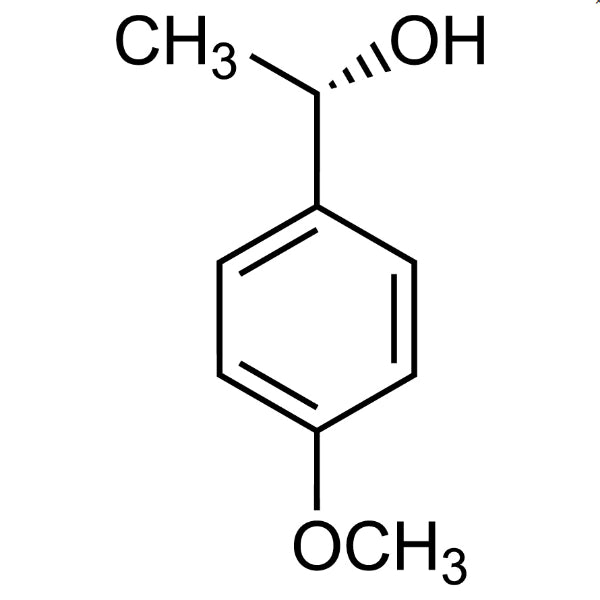
TCI M3895 (S)-1-(4-Methoxyphenyl)ethanol is a chiral secondary benzylic alcohol with the S configuration, built from a benzene ring bearing a methoxy substituent at the para position attached to a stereogenic carbon that carries both a hydroxyl group and a methyl group. The compound is a classic chiral building block and, at the same time, one of the best-known model substrates in studies of asymmetric synthesis and biocatalysis. In the laboratory, having access to this single enantiomer allows researchers to construct target molecules with controlled stereochemistry and to evaluate the performance of catalysts and enzymes quantitatively.
The properties that make this material a preferred choice are its combination of stereochemical purity, structural simplicity, and ease of detection. The methoxy group at the para position strengthens ultraviolet absorption, so enantiomeric content is readily measured by liquid chromatography on a chiral column, while the benzylic hydroxyl group is ready to be converted into esters, ethers, halides, or sulfonate leaving groups for subsequent substitution reactions. The electron-rich ring also stabilises the benzylic carbocation, a factor that must be taken into account so that racemisation does not occur under acidic conditions. For that reason the compound is frequently used to demonstrate stereochemical outcomes clearly.
In Indonesian laboratories, this enantiomer typically appears in university and institutional research settings where asymmetric synthesis, organocatalysis, and enzyme-mediated transformations are being studied. It serves both as a starting material for building stereochemically defined targets and as a reference compound against which the selectivity of a newly developed catalyst or biocatalyst can be benchmarked. Its straightforward analysis on chiral stationary phases makes it well suited to teaching and method-development work as well as to routine research use.
Related TCI products
- TCI T1521 60646-30-2 (S)-(+)-2,2,2-Trifluoro-1-(9-anthryl)ethanol [ee Determination Reagent by NMR]
- TCI T1520 53531-34-3 (R)-(-)-2,2,2-Trifluoro-1-(9-anthryl)ethanol [e.e. Determination Reagent by NMR]
- TCI B5244 225920-05-8 (S)-1-[3,5-Bis(trifluoromethyl)phenyl]ethanol
- TCI B4131 127852-28-2 (R)-1-[3,5-Bis(trifluoromethyl)phenyl]ethanol
- TCI N1063 15914-84-8 (S)-(-)-1-(1-Naphthyl)ethanol
- TCI C3802 120466-66-2 (R)-1-(2-Chlorophenyl)ethanol
- Asymmetric synthesis of stereochemically defined targets: the single S enantiomer allows a defined stereocentre to be carried forward into more complex molecules without an additional resolution step.
- Biocatalysis and enzyme screening: as a widely recognised model substrate, it lets researchers compare the selectivity and activity of ketoreductases, lipases, and whole-cell systems on a familiar benchmark.
- Chiral chromatography method development: the para-methoxy group gives strong ultraviolet absorption, so enantiomeric composition is easily quantified on chiral liquid chromatography columns during method setup.
- Catalyst performance evaluation: the compound serves as a reference against which the enantioselectivity of new asymmetric catalysts can be assessed quantitatively rather than qualitatively.
- Functional group transformation studies: the benzylic hydroxyl is readily converted into esters, ethers, halides, or sulfonate leaving groups, supporting investigations of substitution chemistry and stereochemical retention or inversion.
| Brand | TCI (Tokyo Chemical Industry) |
|---|---|
| CAS number | 1572-97-0 |
| Molecular formula | — |
| Purity | — |
| Category | Chemistry > Asymmetric Synthesis > Chiral Building Blocks |
| Pack sizes | available in standard TCI research-scale packaging; please confirm the size required when ordering |
| Physical form | — |
| Storage | keep in a tightly closed original container under the conditions stated on the manufacturer's label |
- Product code: M3895
Store the material in its original tightly closed container, protected from light, moisture, and sources of heat or ignition, and follow the specific conditions printed on the manufacturer's label and safety data sheet. Suitable containers are chemically resistant glass or the supplied packaging; avoid transferring to containers that may introduce contamination. Handle in a well-ventilated fume hood using safety glasses, chemically resistant gloves, and a laboratory coat. Because the electron-rich benzylic position can stabilise a carbocation, contact with acidic conditions should be controlled to preserve stereochemical integrity. Keep separated from strong oxidising agents, and consult the safety data sheet before use and before any disposal.
—
Produk Terkait
-
(S)-(+)-2,2,2-Trifluoro-1-(9-anthryl)ethanol[eeDeterminationReagentbyNMR] TCI T1521
Regular price From Rp 1.644.300,00Regular price -
(R)-(-)-2,2,2-Trifluoro-1-(9-anthryl)ethanol[e.e.DeterminationReagentbyNMR] TCI T1520
Regular price Rp 2.571.450,00Regular price -
(S)-1-[3,5-Bis(trifluoromethyl)phenyl]ethanol TCI B5244
Regular price From Rp 452.550,00Regular price -
(R)-1-[3,5-Bis(trifluoromethyl)phenyl]ethanol TCI B4131
Regular price From Rp 955.500,00Regular price -
(S)-(-)-1-(1-Naphthyl)ethanol TCI N1063
Regular price From Rp 1.724.100,00Regular price -
(R)-1-(2-Chlorophenyl)ethanol TCI C3802
Regular price From Rp 2.625.000,00Regular price -
(R)-1-(3-Methoxyphenyl)ethan-1-ol TCI M3894
Regular price Rp 8.322.300,00Regular price -
1-(3-Methoxyphenyl)ethanol TCI M3577
Regular price From Rp 2.571.450,00Regular price
![60646-30-2 (S)-(+)-2,2,2-Trifluoro-1-(9-anthryl)ethanol [e.e. Determination Reagent by NMR] - AMI Scientific](http://amiscientific.com/cdn/shop/files/TCI2510T1521.jpg?v=1767141776&width=533)
![60646-30-2 (S)-(+)-2,2,2-Trifluoro-1-(9-anthryl)ethanol [e.e. Determination Reagent by NMR] - AMI Scientific](http://amiscientific.com/cdn/shop/files/TCI2510T1521_7c166274-ef1b-4925-8be6-53863c4594b4.jpg?v=1772424133&width=533)
![53531-34-3 (R)-(-)-2,2,2-Trifluoro-1-(9-anthryl)ethanol [e.e. Determination Reagent by NMR] - AMI Scientific](http://amiscientific.com/cdn/shop/files/TCI2510T1520.jpg?v=1767141772&width=533)
![225920-05-8 (S)-1-[3,5-Bis(trifluoromethyl)phenyl]ethanol - AMI Scientific](http://amiscientific.com/cdn/shop/files/TCI2510B5244.jpg?v=1768815765&width=533)
![127852-28-2 (R)-1-[3,5-Bis(trifluoromethyl)phenyl]ethanol - AMI Scientific](http://amiscientific.com/cdn/shop/files/TCI2510B4131.jpg?v=1768815564&width=533)


