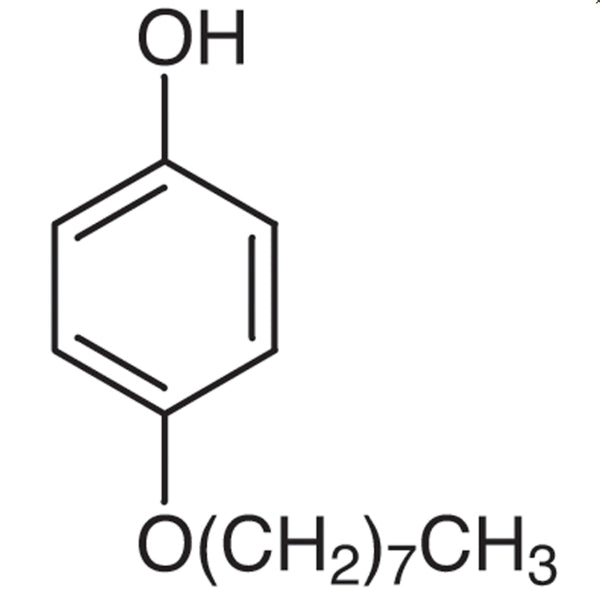
4-n-Octyloxyphenol from TCI, product code O0140, is a phenol derivative with an octyloxy group (an octyl ether) at the para position of the aromatic ring. The molecule is functional at both ends. One end is a reactive phenolic hydroxyl group that can be functionalized further. The other end is a long alkoxy chain that makes the molecule hydrophobic and flexible. As a non-heterocyclic building block, it is widely used as an intermediate in the synthesis of liquid crystals, functional organic materials, and amphiphilic compounds that need an aromatic core carrying an alkyl chain.
Chemists choose this compound because the phenolic hydroxyl group and the para-positioned octyloxy chain together give a linear molecule. That shape suits the construction of calamitic mesogens. The phenol group converts easily into esters by reaction with carboxylic acids or acyl chlorides, or into ethers by alkylation. This makes the compound a practical linking unit in multistep synthesis. The octyloxy chain also improves solubility in organic solvents and affects the phase transition temperatures of the final material. Both properties matter when designing liquid crystals and related materials.
In Indonesian laboratories, 4-n-Octyloxyphenol is mostly used in university organic chemistry and materials science research groups, and in research institutions that work on functional materials. Researchers use it to prepare liquid crystal candidates, study how alkyl chain length affects mesophase behaviour, and build amphiphilic molecules for surface and self-assembly studies. It also works well in advanced teaching laboratories that demonstrate esterification and etherification of phenols, where a well-defined, commercially sourced TCI building block helps give reproducible results.
- Liquid crystal synthesis: the linear para-substituted structure and the flexible octyloxy tail make this compound a good precursor for calamitic mesogens with a rod-like molecular shape.
- Esterification reactions: the phenolic hydroxyl group reacts readily with carboxylic acids or acyl chlorides, so it is a convenient starting point for aromatic ester linkages in larger molecules.
- Etherification and alkylation studies: the phenol can be alkylated to form new ethers, which lets researchers extend or change the molecular framework in stepwise synthetic routes.
- Functional organic materials research: combining an aromatic core with a hydrophobic alkyl chain helps researchers tune solubility and phase behaviour in new organic materials.
- Amphiphilic compound preparation: the polar phenolic head and nonpolar octyloxy tail provide a basic amphiphilic structure for studies of self-assembly and interfacial behaviour.
| Brand | TCI (product code O0140) |
|---|---|
| CAS number | 3780-50-5 |
| Molecular formula | — |
| Purity | — |
| Category | Chemistry > Building Blocks > Non-Heterocyclic Building Blocks |
| Pack sizes | see the TCI pack sizes shown on the product listing |
| Physical form | see the TCI product label and Certificate of Analysis |
| Storage | follow the storage conditions on the TCI label and Safety Data Sheet |
Store 4-n-Octyloxyphenol in its original, tightly closed TCI container in a cool, dry, well-ventilated place, away from direct sunlight, heat sources, and strong oxidizing agents. Always follow the specific storage temperature and conditions on the product label and Safety Data Sheet. When moving portions to a new container, use clean, dry, chemically compatible glass or suitable plastic, and label it clearly. Handle the compound in a fume hood or well-ventilated area. Wear suitable gloves, safety glasses, and a laboratory coat. Avoid skin and eye contact and do not inhale dust or vapour. Wash your hands thoroughly after handling, and dispose of waste according to institutional and local regulations.
—
Produk Terkait
-
4-Methoxyphenol TCI M0123
Regular price From Rp 477.750,00Regular price -
4-Ethoxyphenol TCI E0216
Regular price From Rp 980.700,00Regular price -
4-Heptyloxyphenol TCI H0441
Regular price Rp 5.539.800,00Regular price -
4-Amyloxyphenol TCI A0728
Regular price Rp 1.035.300,00Regular price -
4-Hexyloxyphenol TCI H0439
Regular price From Rp 1.115.100,00Regular price -
4-Butoxyphenol TCI B0923
Regular price Rp 1.193.850,00Regular price -
2-Bromo-4,5-dimethoxyphenol TCI B5297
Regular price Rp 2.466.450,00Regular price -
2-Bromo-6-methoxyphenol TCI B5026
Regular price From Rp 1.246.350,00Regular price