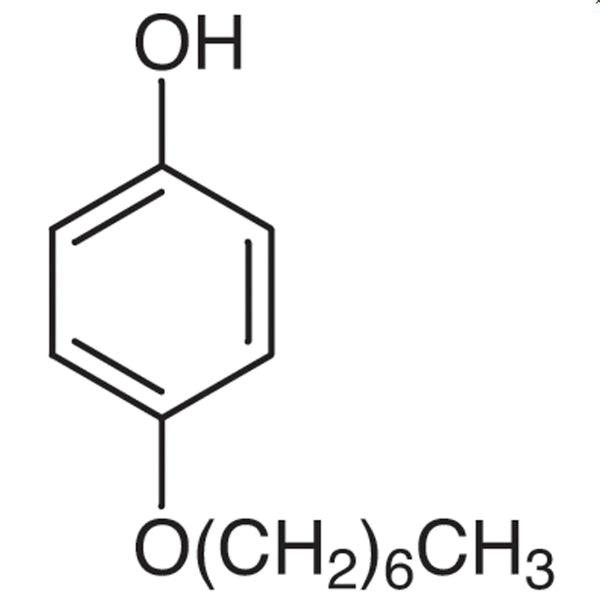
4-Heptyloxyphenol is a chemical compound widely used in laboratory settings for constructing complex molecules through various chemical reactions. It serves as a fundamental building block in organic chemistry, playing a key role in the synthesis of aromatic compounds and their derivatives. This versatile reagent is commonly employed in substitution and oxidation reactions, making it an essential tool for researchers and students alike. Its stability and compatibility with a range of organic solvents enhance its utility in diverse experimental setups.
The compound's stable molecular structure and good solubility in organic solvents make it a preferred choice for laboratory applications. These properties ensure consistent performance across different reaction conditions, reducing the risk of unexpected outcomes. Its relatively low reactivity also contributes to its safety profile, allowing for use in small-scale experiments without significant hazards. This combination of stability and reactivity makes 4-Heptyloxyphenol a reliable component in both academic and industrial research environments.
In Indonesian laboratories, 4-Heptyloxyphenol is frequently used by researchers and students in higher education institutions and research organizations. It supports a wide range of projects in organic chemistry, pharmaceutical development, and material science. Its availability and ease of use make it an ideal choice for both teaching and research purposes, particularly in regions where scientific and technological development is growing.
- Organic synthesis applications benefit from 4-Heptyloxyphenol due to its role in constructing complex aromatic compounds and derivatives.
- Pharmaceutical research utilizes this compound in the development of new drugs, as it can participate in key synthetic steps.
- Material science projects often incorporate 4-Heptyloxyphenol for creating advanced polymers and functional materials.
- Educational laboratories use this compound for teaching fundamental organic chemistry concepts and reaction mechanisms.
- Analytical chemistry applications may employ 4-Heptyloxyphenol as a standard reference in qualitative and quantitative analysis.
| Brand | TCI |
|---|---|
| CAS number | 13037-86-0 |
| Molecular formula | — |
| Purity | — |
| Category | Chemistry > Building Blocks > Non-Heterocyclic Building Blocks |
| Pack sizes | Available in various quantities as per supplier specifications |
| Physical form | Solid or liquid, depending on supplier packaging |
| Storage | Store in a cool, dry place away from direct sunlight |
4-Heptyloxyphenol should be stored in a cool, dry environment to maintain its chemical stability. It is recommended to keep the compound in a tightly sealed container to prevent exposure to moisture and air. While it is relatively inert, it should be handled with care to avoid contamination. In laboratory settings, it is advisable to store it away from incompatible substances to ensure safety. Proper labeling of containers is essential for identifying the compound and ensuring safe handling. Regular checks on storage conditions help maintain the integrity of the compound over time.
—
Produk Terkait
-
EthyleneGlycolMono(4-chlorophenyl)Ether TCI C0251
Regular price Rp 2.466.450,00Regular price -
CombretastatinA4 TCI C2520
Regular price Rp 18.893.700,00Regular price -
CesiumGreen TCI C2806
Regular price From Rp 4.877.250,00Regular price -
2,6-Dimethoxyphenol TCI D0639
Regular price From Rp 1.140.300,00Regular price -
2,6-Di-tert-butyl-4-methoxyphenol[Oxidationinhibitor] TCI D1811
Regular price Rp 4.691.400,00Regular price -
2,4-DimethoxybenzylAlcohol TCI D1835
Regular price From Rp 1.167.600,00Regular price -
4,4'-DihydroxydiphenylEther TCI D2121
Regular price From Rp 2.916.900,00Regular price -
2,6-Dimethoxy-4-methylphenol TCI D2591
Regular price From Rp 1.115.100,00Regular price



![2,6-Di-tert-butyl-4-methoxyphenol [Oxidation inhibitor] (CAS 489-01-0) - TCI D1811 - AMI Scientific](http://amiscientific.com/cdn/shop/files/TCI2510D1811.jpg?v=1768817498&width=533)