

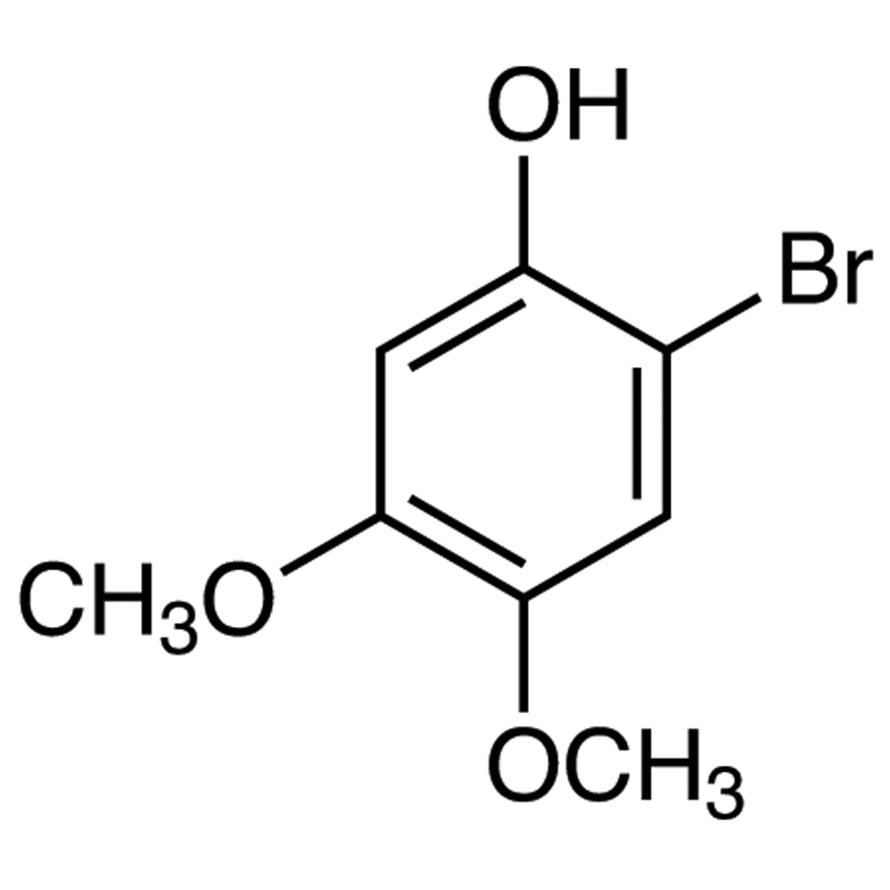
2-Bromo-4,5-dimethoxyphenol is a chemical compound widely used in laboratory settings for the synthesis of complex molecules. As a building block in organic chemistry, it serves as a versatile intermediate in various synthetic pathways. Its unique structure, featuring a phenolic ring with bromo and dimethoxy substituents, makes it a valuable reagent for chemical transformations. This compound is commonly employed in research to develop new organic compounds, pharmaceuticals, and functional materials. Its reactivity and structural versatility allow it to participate in multiple reaction types, including electrophilic and nucleophilic reactions.
The compound’s polar nature and reactivity make it a preferred choice in laboratory applications. Its ability to undergo substitution, reduction, or oxidation reactions enables the synthesis of a wide range of derivatives with specific functional groups. The presence of both hydroxyl and bromo groups enhances its reactivity, allowing it to be modified under controlled conditions. This makes it suitable for use in reactions requiring specific catalysts or elevated temperatures. Its chemical stability and reactivity ensure consistent results in synthetic processes.
In Indonesian laboratories, 2-Bromo-4,5-dimethoxyphenol is extensively used in organic chemistry research, drug synthesis, and the development of new chemical materials. It is a key component in the work of research institutions and universities focused on chemical innovation. Its role in creating complex molecular structures supports advancements in pharmaceutical and industrial chemistry. Its availability and reliability make it a standard reagent in many laboratory setups across Indonesia.
- Organic synthesis applications benefit from its reactivity and structural versatility, enabling the creation of complex molecules.
- Pharmaceutical research utilizes it as a building block for the development of new drug compounds and therapeutic agents.
- Material science projects use it to synthesize functional organic materials with specific chemical properties.
- Analytical chemistry applications take advantage of its reactivity for characterizing and modifying chemical compounds.
- Environmental chemistry studies employ it in the synthesis of compounds used for pollution control and remediation.
| Brand | TCI |
|---|---|
| CAS number | 129103-69-1 |
| Molecular formula | — |
| Purity | — |
| Category | Chemistry > Building Blocks > Non-Heterocyclic Building Blocks |
| Pack sizes | Available in various quantities as per standard laboratory supply |
| Physical form | Solid or liquid, depending on the specific product variant |
| Storage | Store in a cool, dry place away from light and incompatible substances |
This compound should be stored in a cool, dry place, away from direct sunlight and sources of heat. It is recommended to use airtight containers to prevent moisture absorption and contamination. Due to its reactivity, it should be kept separate from strong oxidizing or reducing agents. Proper personal protective equipment, including gloves and safety goggles, should be worn when handling. The compound should not be exposed to high temperatures or open flames. In laboratory settings, it should be handled in well-ventilated areas to minimize exposure risks. Always follow standard safety protocols for chemical handling and disposal.
—
Produk Terkait
-
3,5-Dimethoxyphenol TCI P0320
Regular price From Rp 4.345.950,00Regular priceRp 3.054.450,00Sale price From Rp 4.345.950,00 -
2,3-Dimethoxyphenol TCI D6490
Regular price From Rp 1.033.200,00Regular priceRp 738.150,00Sale price From Rp 1.033.200,00 -
2,5-Dimethoxyphenol TCI D5666
Regular price From Rp 1.618.050,00Regular priceRp 1.146.600,00Sale price From Rp 1.618.050,00 -
2,4-Dimethoxyphenol TCI D5629
Regular price Rp 4.161.150,00Regular priceRp 2.925.300,00Sale price Rp 4.161.150,00 -
3,4-Dimethoxyphenol TCI D3221
Regular price From Rp 1.988.700,00Regular priceRp 1.405.950,00Sale price From Rp 1.988.700,00 -
2,6-Dimethoxyphenol TCI D0639
Regular price From Rp 1.192.800,00Regular priceRp 849.450,00Sale price From Rp 1.192.800,00 -
2-Bromo-6-methoxyphenol TCI B5026
Regular price From Rp 1.298.850,00Regular priceRp 924.000,00Sale price From Rp 1.298.850,00 -
4-Bromo-2-methoxyphenol TCI B4056
Regular price From Rp 1.670.550,00Regular priceRp 1.183.350,00Sale price From Rp 1.670.550,00


