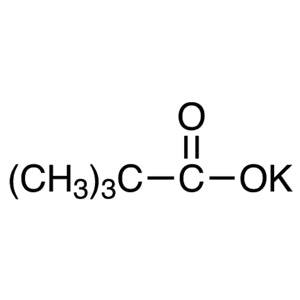
TCI P2354 Potassium Pivalate (CAS 19455-23-3) is the potassium salt of pivalic acid (2,2-dimethylpropanoic acid), a carboxylic acid that carries a bulky tert-butyl group. It is classified as a non-heterocyclic building block. In modern synthetic laboratories, its main role is as a mild base and carboxylate additive in transition-metal-catalysed reactions, especially palladium-catalysed C–H activation. It is also a convenient source of the pivalate anion for a wide range of organic and inorganic syntheses.
Chemists choose potassium pivalate because the pivalate anion is known to help the C–H bond cleavage step through the concerted metalation–deprotonation (CMD) mechanism. In this mechanism, the carboxylate acts as a "proton shuttle" close to the metal centre. The bulky tert-butyl group keeps the anion from coordinating too strongly to the metal. It also makes the salt more soluble in polar organic solvents than acetate. Because it is a solid salt, it is easier to weigh and dispense accurately than liquid pivalic acid, which helps with reproducible reaction setup.
In Indonesian laboratories working on synthetic organic chemistry and catalysis, potassium pivalate is an important supporting reagent when developing direct arylation and other C–H functionalisation reactions. University research groups, pharmaceutical and fine-chemical R&D teams, and graduate students screening reaction conditions often keep it alongside palladium catalysts, ligands and other bases. It lets them compare carboxylate additives in a systematic way when optimising yields and selectivity for new synthetic routes.
Related TCI products
- TCI P1012 18997-19-8 Chloromethyl Pivalate [Amino-Protecting Agent]
- TCI P0462 598-98-1 Methyl Pivalate
- TCI I0912 53064-79-2 Iodomethyl Pivalate (stabilized with Copper chip)
- TCI S0978 143174-36-1 Sodium Pivalate Hydrate
- TCI R0276 65545-21-3 Rhodium(II) Pivalate Dimer
- TCI P0668 3377-92-2 Vinyl Pivalate (stabilized with HQ)
- Palladium-catalysed C–H activation: the pivalate anion supports the concerted metalation–deprotonation step, so it is a standard additive for promoting C–H bond cleavage in catalytic cycles.
- Direct arylation reactions: as a mild base and carboxylate additive, it helps couple arenes or heteroarenes with aryl halides without preparing organometallic coupling partners first.
- Reaction condition screening: as an easy-to-weigh solid salt, it can be dispensed accurately when comparing carboxylate additives and bases during the optimisation of new catalytic transformations.
- Source of pivalate anion: it supplies the pivalate anion for organic and inorganic syntheses that need pivalate as a reactant, ligand or counter-ion.
- Catalysis research in polar organic solvents: it dissolves better in polar organic media than acetate salts, which makes it useful for homogeneous metal-catalysed reactions where solubility limits performance.
| Brand | TCI |
|---|---|
| CAS number | 19455-23-3 |
| Molecular formula | — |
| Purity | — |
| Category | Chemistry > Building Blocks > Non-Heterocyclic Building Blocks |
| Pack sizes | available in the pack sizes listed on the product page |
| Physical form | solid salt; store tightly closed in a cool, dry place |
| Storage | — |
- Product code: P2354
Store potassium pivalate in its original, tightly closed container in a cool, dry and well-ventilated area, away from moisture and incompatible materials such as strong acids and strong oxidising agents. Reseal the container promptly after each use to protect the contents from air and humidity. When weighing or transferring the solid, use clean, dry spatulas and glassware. Avoid generating dust, and work in a fume hood or well-ventilated area where possible. Wear standard laboratory protective equipment, including safety glasses, gloves and a lab coat. Avoid contact with skin and eyes, and do not inhale dust. Always read the supplier's Safety Data Sheet before use, and dispose of residues according to local regulations.
—
Produk Terkait
-
ChloromethylPivalate[Amino-ProtectingAgent] TCI P1012
Regular price From Rp 717.150,00Regular price -
MethylPivalate TCI P0462
Regular price From Rp 769.650,00Regular price -
IodomethylPivalate(stabilizedwithCopperchip) TCI I0912
Regular price Rp 2.279.550,00Regular price -
SodiumPivalateHydrate TCI S0978
Regular price From Rp 1.220.100,00Regular price -
Rhodium(II)PivalateDimer TCI R0276
Regular price From Rp 3.630.900,00Regular price -
VinylPivalate(stabilizedwithHQ) TCI P0668
Regular price From Rp 505.050,00Regular price -
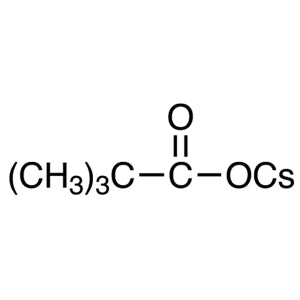
CesiumPivalate TCI C3230
Regular price From Rp 1.193.850,00Regular price
![18997-19-8 Chloromethyl Pivalate [Amino-Protecting Agent] - AMI Scientific](http://amiscientific.com/cdn/shop/files/TCI2510P1012.jpg?v=1767134108&width=533)