
![3-Bromo-9-([1,1':4',1''-terphenyl]-4-yl)-9H-carbazole (CAS 1141017-84-6) - TCI B5989 - AMI Scientific](http://amiscientific.com/cdn/shop/files/TCI2510B5989.jpg?v=1767093027&width=1946)
![3-Bromo-9-([1,1':4',1''-terphenyl]-4-yl)-9H-carbazole (CAS 1141017-84-6) - TCI B5989 - AMI Scientific](http://amiscientific.com/cdn/shop/files/TCI2510B5989.jpg?v=1767093027&width=1445)
TCI B5989 is 3-Bromo-9-([1,1':4',1''-terphenyl]-4-yl)-9H-carbazole, a heterocyclic building block that joins a carbazole core to a long, rigid linear terphenyl chain. Carbazole is an electron-rich aromatic framework long established in materials chemistry for its ability to transport positive charge and for its good thermal stability. Attaching a terphenyl group at the nitrogen atom extends the conjugated system while raising the glass transition temperature — two considerations that matter a great deal when a molecule is destined for the thin films of optoelectronic devices such as organic light-emitting diodes.
The property that gives this compound its value is the bromine atom at position 3 of the carbazole ring. That bromo group serves as a ready-made connection point for palladium-catalysed cross-coupling reactions, including Suzuki-Miyaura coupling with boronic acids, Buchwald-Hartwig coupling with amines, and Ullmann-type reactions. Researchers can therefore attach electron-donating or electron-accepting units in a directed manner at one specific position, then tune the molecular orbital energy levels to suit the design at hand. The combination of a defined reactive site and an already rigid, thermally robust scaffold is what makes the material a preferred starting point rather than a compound that must be built up from simpler pieces.
In Indonesian laboratories this building block is typically used in university and institutional research groups working on organic electronic materials and synthetic organic chemistry. It suits work where a carbazole-terphenyl scaffold is needed as an intermediate for host materials or charge-transport layers, and where a single well-defined halogen handle lets a group prepare a series of derivatives from one common precursor. Supplied under the TCI brand, it fits research-scale synthesis in laboratories that carry standard Schlenk or inert-atmosphere equipment.
TCI brochures (PDF)
- Building Blocks for Organic Semiconductor 2026-03-24 · p. 19
Related TCI products
- TCI B5461 339576-55-5 9-Benzyl-3-bromo-9H-carbazole
- TCI B5107 1226860-66-7 3-Bromo-9-(4-bromophenyl)-9H-carbazole
- TCI B4883 1698-16-4 10-Bromo-7H-benzo[c]carbazole
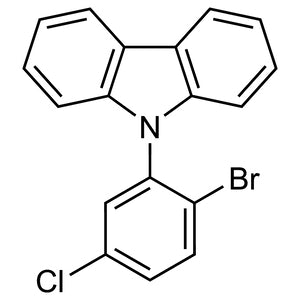
- TCI B6924 1361956-35-5 9-(2-Bromo-5-chlorophenyl)-9H-carbazole
- TCI B5870 131409-18-2 5-Bromo-7H-benzo[c]carbazole
- TCI B5868 1210469-11-6 10-Bromo-7-phenyl-7H-benzo[c]carbazole
- Suzuki-Miyaura cross-coupling: the aryl bromide at carbazole position 3 reacts cleanly with boronic acids under palladium catalysis, allowing new aryl units to be installed at one defined position.
- Buchwald-Hartwig amination: the same bromo handle couples with amines under palladium catalysis, giving researchers a direct route to attach electron-donating amino substituents to the carbazole core.
- Ullmann-type coupling reactions: the carbon-bromine bond participates in Ullmann chemistry, providing an alternative connection pathway when copper-mediated conditions suit the target structure better than palladium.
- Synthesis of organic light-emitting diode materials: the rigid carbazole-terphenyl framework and its raised glass transition temperature make it a suitable precursor for molecules destined for device thin films.
- Molecular orbital energy level tuning studies: attaching donor or acceptor units at the single bromine site lets researchers adjust orbital energies systematically and study how structure governs the resulting electronic properties.
| Brand | TCI |
|---|---|
| CAS number | 1141017-84-6 |
| Molecular formula | — |
| Purity | — |
| Category | Chemistry > Building Blocks > Heterocyclic Building Blocks |
| Pack sizes | please refer to the current TCI catalogue listing for this product code |
| Physical form | — |
| Storage | store according to the conditions stated on the manufacturer's label and safety data sheet |
- Chemical name: 3-Bromo-9-([1,1':4',1''-terphenyl]-4-yl)-9H-carbazole
- Product code: B5989
Store this building block in its original tightly closed container in a cool, dry, well-ventilated area away from direct sunlight and sources of ignition, following the conditions stated on the manufacturer's label and safety data sheet. Amber glass or the supplied container is appropriate, and the material should be kept away from strong oxidising agents. Handle the solid in a fume hood using gloves, safety glasses, and a laboratory coat, and avoid generating or inhaling dust. Because aryl bromides used in cross-coupling work are often weighed under inert atmosphere, transfer in a glovebox or under nitrogen where the subsequent reaction requires it. Consult the manufacturer's safety data sheet before first use and dispose of residues through the laboratory's chemical waste stream.
—
Produk Terkait
-
9-Benzyl-3-bromo-9H-carbazole TCI B5461
Regular price From Rp 1.510.950,00Regular price -
3-Bromo-9-(4-bromophenyl)-9H-carbazole TCI B5107
Regular price From Rp 2.571.450,00Regular price -
10-Bromo-7H-benzo[c]carbazole TCI B4883
Regular price From Rp 769.650,00Regular price -
9-(2-Bromo-5-chlorophenyl)-9H-carbazole TCI B6924
Regular price Rp 3.498.600,00Regular price -
5-Bromo-7H-benzo[c]carbazole TCI B5870
Regular price Rp 2.279.550,00Regular price -
10-Bromo-7-phenyl-7H-benzo[c]carbazole TCI B5868
Regular price Rp 5.485.200,00Regular price -
2-Bromo-7-methoxy-9H-carbazole TCI B5517
Regular price Rp 3.180.450,00Regular price -
2-(2-Bromophenyl)-9-phenyl-9H-carbazole TCI B5437
Regular price From Rp 1.193.850,00Regular price


![1698-16-4 10-Bromo-7H-benzo[c]carbazole - AMI Scientific](http://amiscientific.com/cdn/shop/files/TCI2510B4883_a6301f58-a063-4c77-86ec-5cb7f70da5fe.jpg?v=1767854168&width=533)
![5-Bromo-7H-benzo[c]carbazole (CAS 131409-18-2) - TCI B5870 - AMI Scientific](http://amiscientific.com/cdn/shop/files/TCI2510B5870.jpg?v=1767092869&width=533)
![10-Bromo-7-phenyl-7H-benzo[c]carbazole (CAS 1210469-11-6) - TCI B5868 - AMI Scientific](http://amiscientific.com/cdn/shop/files/TCI2510B5868.jpg?v=1767092861&width=533)

